

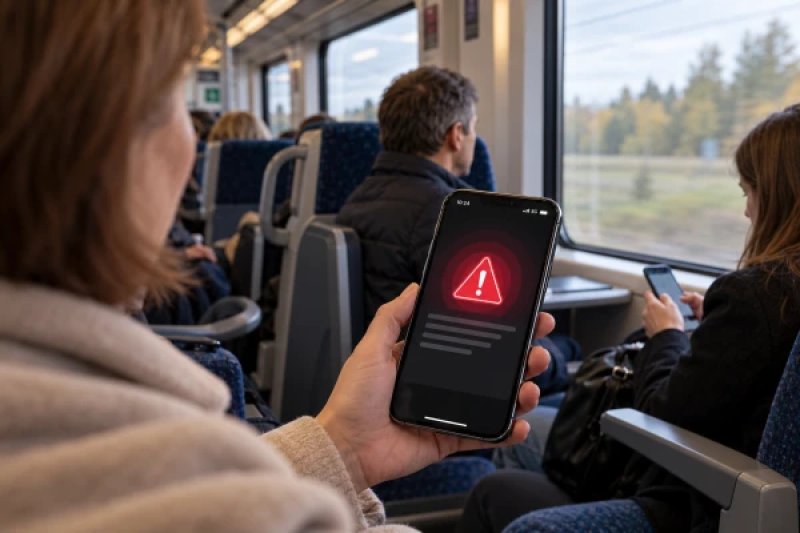
 Foto: BB.LV / Предупреждение на борту поезда
The appearance of a drone in Lithuania near the Latvian border on Sunday, October 18, led to delays in passenger trains. According to LSM.lv, special instructions have been developed for carriers in such situations, outlining the procedures to follow at various levels of aerial threat. On Sunday, residents of the Bauska, Aizkraukle, and Ogre regions received orange-level warnings through the emergency alert system. At the same time, restrictions affected train movements. According to the passenger carrier Vivi, the aerial threat impacted 11 routes. ## Passengers began to express discontent over the train stop One passenger, Liene, reported that she was traveling by train from Daugavpils to Riga on Sunday morning. Around 7:45, when the train was near the Aizkraukle region, passengers received alerts about the threat in the airspace on their phones. Soon after, the train came to a stop. According to Liene, some passengers began to express dissatisfaction, fearing they would miss their flight or be late for other commitments. > "When we approached the conductor, she explained that we would be standing still until the threat passed, and then we would continue our journey. People, unhappy about potentially missing their flight or being late for other matters, began to verbally attack her," the woman said. About half an hour after the threat passed, the train resumed its journey. ## What should trains do during yellow and orange warnings Vivi representative Sigita Paula explained that the company's staff acted according to algorithms developed in the summer of 2026. The instructions provide for different actions depending on the declared level of threat. - Yellow level: the carrier must inform passengers about the situation and be prepared to change travel plans. - Orange level: if possible, it is necessary to leave the danger zone within 20 minutes and ensure the safety of further movement. In the case of an orange warning, there is also the option to reduce speed and proceed to the nearest safe location, such as a train station. Passengers should be informed about what is happening. Specific actions depend on the directives of responsible government agencies. > "Right now, we rely on the instructions of competent authorities and follow them. There is no reason to believe that they are impractical. So far, there have been no such precedents," Paula explained. ## What about buses? Bus carriers also have recommendations in case of an aerial threat. Their actions should depend on the declared level of warning and the directives of the Crisis Management Center. The Ministry of Transport, together with the Road Transport Directorate and industry enterprises, has improved the relevant recommendations. Special attention is paid to information exchange between carriers and responsible services, as well as coordination of actions. Thus, in the event of an aerial threat, public transport passengers should consider the possibility of delays and changes in movement. Decisions about stopping or continuing the trip are made taking into account the level of threat and the instructions of competent authorities.
