

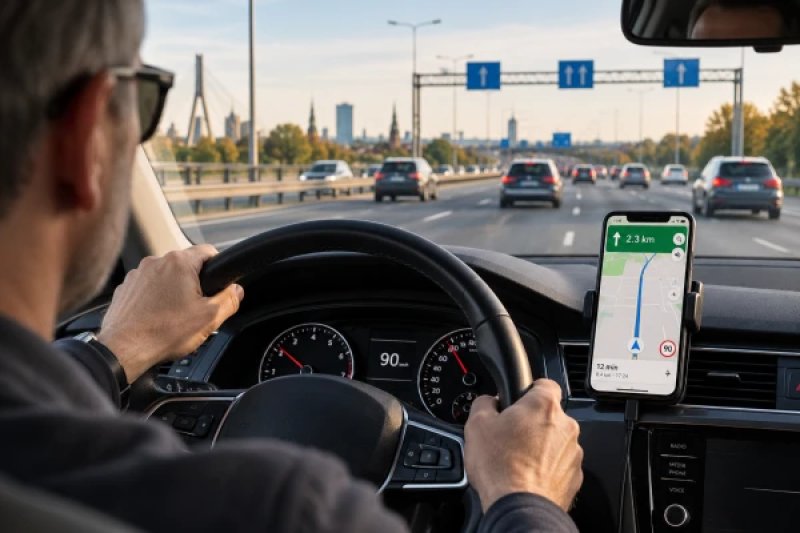
 Foto: BB.LV / Навигация по городской магистрали
The Latvian Bureau of Motor Insurers (LTAB) is working on a new solution that will allow motorists to find out how safely they drive. It is expected that the relevant feature will appear in the existing LTAB OCTA mobile application, reports the program "900 seconds" ([TV3](https://tv3.lv/zinas/latvija/satiksme/atruma-parsniegsana-un-citi-agresivi-manevri-drizuma-soferu-paradumus-vares-analizet-lietotne/)). The initiative is related to the problem of aggressive driving. According to data provided by LTAB, nearly 70% of drivers outside populated areas exceed the speed limit, and dangerous maneuvers remain one of the common causes of serious road accidents. ## What driver habits will the app evaluate The chairman of the board of LTAB, Jānis Abašins, explained that aggressive driving is not limited to speeding. > "Aggressive lane changes, attempts to cut in front of other cars, driving in bus lanes, the desire to catch up with, overtake, or teach someone a lesson — all of this is aggressive driving," he said. The new app is intended to analyze the everyday behavior of motorists behind the wheel. According to the head of the IT department at LTAB, Agris Daukste, the system will be able to automatically record various trip parameters. > "The app will independently register and assess your everyday driving habits: how often you brake sharply, make sudden lane changes, or significantly exceed the speed limit," he explained. Thus, the driver will be able to see not only individual violations or risky maneuvers but also the overall picture of their habits. ## Will insurance companies be able to see this data? At the initial stage, the results of the analysis are planned to be made available exclusively to the motorist. Insurance companies will only be able to obtain information with the driver's consent if they voluntarily decide to share it. At the same time, LTAB does not rule out that in the future, the assessment of driving style may be used to determine the cost of insurance. > "If you are a calmer and better driver, then your insurance should, accordingly, cost less," Abašins believes. This means that in the future, careful behavior on the road may become an additional argument for obtaining a more favorable price for the OCTA policy. However, the specific mechanism for calculating insurance costs based on such data has not yet been presented. ## When will the new feature be available? The development is still at an early stage. At the end of October, LTAB plans to hold a hackathon where participants — students — will propose technological solutions for analyzing driver behavior. The first results may appear as early as November when the organizers evaluate the submitted ideas and select the most promising ones. There is currently no talk of launching a ready-made feature for all users of the LTAB OCTA application. The timeline for its possible implementation has not been specified. ## Why has LTAB taken on this issue? The Bureau has also launched an information campaign titled "How much does your inattention on the road cost?" aimed at drawing attention to the consequences of risky behavior behind the wheel. According to a survey conducted by LTAB, some motorists admit that they consider themselves aggressive or potentially aggressive drivers. Abašins emphasizes that the greatest danger comes not from isolated mistakes but from the constant habit of driving aggressively. > "Accidents caused by aggressive drivers on highways and major streets are usually very severe, with serious consequences," he noted. LTAB hopes that the ability to see their own mistakes will help drivers change their behavior before it leads to a serious accident. Thus, the new feature could become not only a tool for self-control but also, in the future, link driving safety with the cost of car insurance.
