

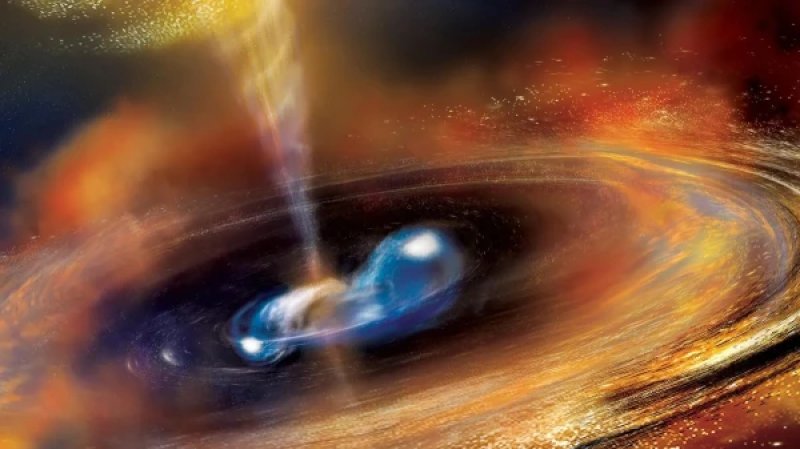
 Foto: BB.LV / космос
In the Milky Way, there exists an unusual source of gamma radiation, HESS J1507−622, which has puzzled scientists for over 15 years. It does not resemble other known gamma-ray-emitting objects and lacks the characteristic accompanying X-ray or radio emissions. Now researchers have proposed an explanation for this mystery: astronomers may be observing the aftermath of a collision between two neutron stars. The results of the new study, which has not yet undergone peer review, have been published on the arXiv platform and submitted to The Astrophysical Journal Letters. ## What Happens During a Neutron Star Collision Neutron stars are among the densest objects in the universe. They form after the explosions of certain massive stars when their cores collapse under the force of gravity. As a result, a mass greater than that of the Sun is compressed into a sphere the size of a small city. The matter is compressed so intensely that protons and electrons convert into neutrons. If two neutron stars form a binary system, over time they may spiral closer together and collide. Such a merger is accompanied by a powerful cosmic explosion known as a kilonova. In mere moments, a kilonova can release as much energy as the Sun emits over hundreds of thousands of years. It is during such events that a significant portion of heavy chemical elements, including gold and other precious metals, is formed. Thus, neutron star collisions are related not only to distant cosmic processes but also to the origin of some substances found on Earth. ## Why the Mysterious Radiation Has Interested Scientists The merger of neutron stars can be accompanied by a short gamma-ray burst, which typically lasts less than two seconds. One of the most well-known examples is the event GW170817, recorded in 2017 in the galaxy NGC 4993, approximately 140 million light-years from Earth. However, HESS J1507−622 behaves completely differently. Instead of a brief flash, astronomers observe a steady gamma radiation whose origin has yet to be convincingly explained. Previously, scientists had suggested that the source could be a kilonova. According to one hypothesis, during the collision of neutron stars, protons accelerated to immense energies are ejected into space. When colliding with the interstellar medium, they can create gamma radiation. The problem lay in the calculations: such a scenario would require a significantly more powerful explosion than expected from a typical kilonova. ## A New Explanation: It Might Be Electrons The authors of the new study proposed to change a key element of the hypothesis. According to their calculations, the source of gamma radiation could be electrons rather than protons. Electrons are more than 1800 times lighter than protons, so they can be accelerated to the necessary energies in a less powerful explosion. This allows for the observed gamma radiation to be explained without needing to assume an extraordinarily high energy from the initial collision. If the calculations are correct, HESS J1507−622 may be the remnant of an ancient kilonova, the radiation from which scientists continue to observe long after the explosion itself. ## When the Explosion Might Have Occurred According to researchers' estimates, the mysterious object is located between 12,000 and 47,000 light-years from Earth. The collision of neutron stars may have occurred between 200 and 3000 years ago — if counting from the moment the light from the event reached Earth. However, this is still just a scientific hypothesis. The work is awaiting review, and additional evidence will be needed to confirm the origin of HESS J1507−622. If the assumption is confirmed, astronomers will have the opportunity to study the remnant of a neutron star collision directly in the Milky Way.
