

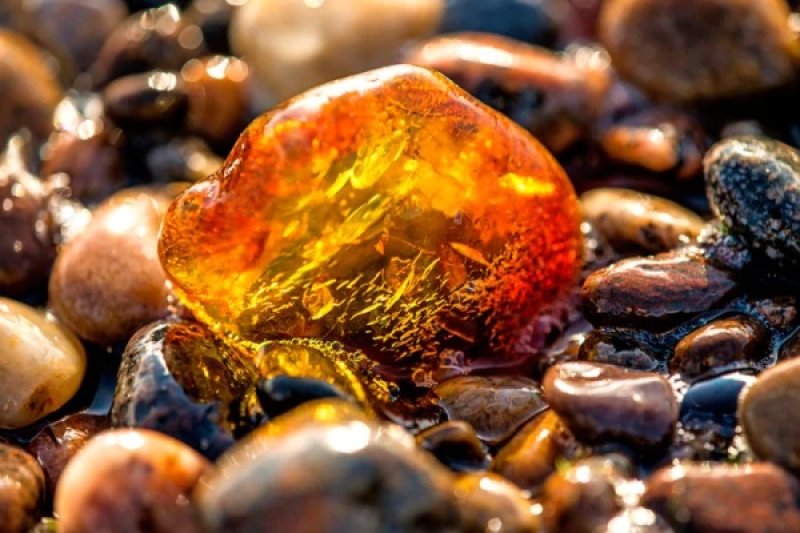
 Foto: BB.LV / янтарь
Unusual evening walks called "Amber Walk" (Dzintaru pastaiga) are organized by the tourism center of the South Kurzeme region. Participants will walk about five kilometers along the coast, listen to stories about amber, and learn how local residents extracted it long before modern flashlights appeared. Why is amber being sought in the dark? It’s all due to its amazing property: under ultraviolet light, amber begins to fluoresce. Depending on the composition and characteristics of the stone, the glow can be bluish, greenish, or milky. Therefore, with an ultraviolet flashlight, it can sometimes be easier to find it among the sand, seaweed, and ordinary pebbles than in daylight. However, the organizers do not promise guaranteed finds. Amber is not like mushrooms that grow in specific places. It is brought by the sea, especially after strong winds and rough seas. Experienced collectors know that it is worth searching for the sunstone not only on clean sand but also among the seaweed, twigs, and other marine debris washed ashore. By the way, amber is not a stone at all, but fossilized resin from trees that grew tens of millions of years ago. It can sometimes be confused with white phosphorus, which the Baltic Sea also washes ashore. This substance resembles amber externally, but when dried and heated, it can spontaneously ignite. Such finds have been discovered more than once on the Kurzeme coast, especially around Liepāja. Therefore, it is better not to pick up suspicious pieces, and even more so not to put them in your pocket: if there is the slightest doubt, the find should be left in place. But participants in the walk will be accompanied by professionals, so such situations are excluded. During the walk, participants will also learn about ancient methods of amber extraction. On the Kurzeme coast, amber was not only collected after storms but also caught from the water using special devices, as well as scooped up along with seaweed and marine debris. A visit to the Pāvilosta Local History Museum is also planned, where travelers will be introduced to local traditions and the history of life by the sea. Now, about the practical side of the adventure. Both walks will start at 17:00. Participants will gather at the Pāvilosta Tourist Information Center on Dzintaru Street, 2. The walk will also conclude there. The organizers recommend dressing warmly, wearing high rubber boots, bringing a regular flashlight, and reflective elements. And if you have an ultraviolet flashlight at home, be sure to take it with you. The organizers will also have such devices, but in limited quantities. Therefore, when registering, you need to indicate in advance whether you will need a flashlight. Participation costs 8 euros per person, and children under 12 years old can join for free. However, children must also be registered in the application form. All minors can participate in the walk only when accompanied by adults. Each walk has only 50 spots available. To participate on October 30, you need to register and pay no later than October 28. For the second walk on November 20, the registration and payment deadline is November 18. If spots run out earlier, registration will close early. If the application is submitted on time but payment is delayed, participation will cost not 8, but 10 euros. In this case, the money must be transferred no later than the day of the walk. The application can be filled out on the website of the South Kurzeme tourism center, where payment details are also published. Additional information can be obtained at the Pāvilosta Tourist Information Center by phone 29121894.
