

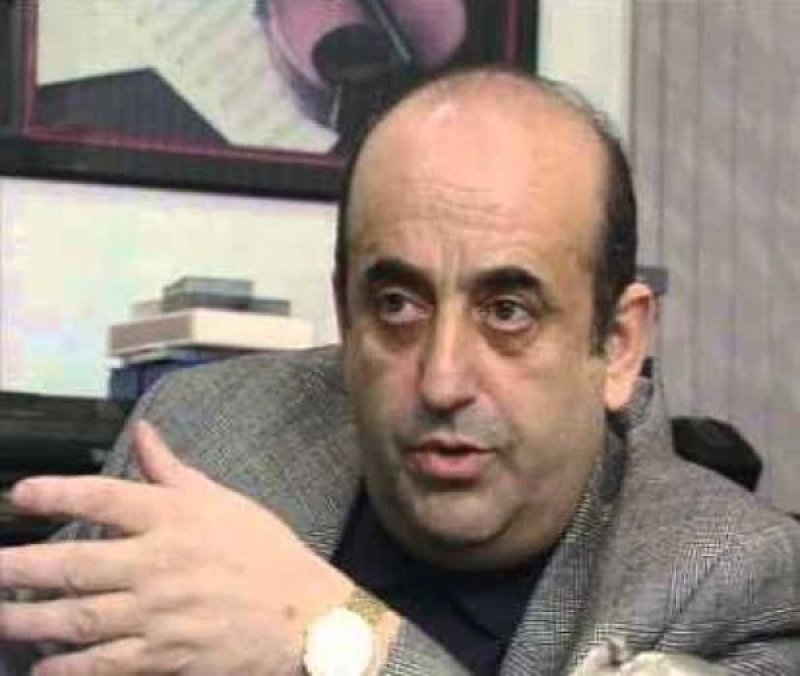
 Foto: BB.LV / Лучанский
His funeral will take place on Sunday, October 25, at the Jewish cemetery in Riga. According to the Israeli business publication Globes, at its peak, the deceased's fortune was about 2 billion dollars. The turnover of the company Nordex, founded by Luchansky, exceeded 3 billion dollars a year as early as the beginning of the 1990s. Georgy Luchansky was born in 1945 in Tashkent. After graduating from the Moscow Institute of Steel and Alloys, he was assigned to the Latvian SSR. He created one of the first student construction brigades and designed a uniform for it, which the students sewed themselves under his guidance. In 1969, he headed the headquarters of student construction brigades under the Central Committee of the Komsomol. In 1974, he was appointed vice-rector of the P. Stuchka Latvian State University (now the University of Latvia) for administrative and economic work, becoming the youngest vice-rector in Latvia. In 1982, he was arrested on charges of embezzling socialist property worth 2,564 rubles and was sentenced to seven years in 1983. He was sent to serve his sentence in the Jakabpils zone, created during the construction of a large factory. Initially, he worked there as a cutter, but during an inspection trip to the site by the Chairman of the Council of Ministers of the Latvian SSR Yuri Yanovich Rubens, he suggested that the zone's chief recruit the prisoner Luchansky as a foreman instead of hired workers, "because they were drunks and scoundrels." As a result, he became the head of the construction site, which was a unique case in the history of such facilities. In less than a year, the factory, which had been at the foundation level for 10 years, was built, and Luchansky was released in 1985. After his release from prison, he was "assigned to work" in distant Solikamsk, where Luchansky also worked in construction, creating from 60 "graduates" of the Latvian zone a prototype of a comprehensive construction brigade for subcontracting. After Luchansky returned to the Latvian SSR, Hero of Socialist Labor Albert Kauls invited him to the largest Latvian millionaire collective farm "Adazi" as a deputy. From February 17-19, 1987, the General Secretary of the CPSU Central Committee Mikhail Gorbachev visited the Latvian SSR, where he was shown the industrial giant VEF (which the General Secretary called "an enterprise of the 19th century") and the agrofirm "Adazi" (which he called "an enterprise of the 21st century"). At a meeting with the party activists of the republic, Gorbachev asked how he could help develop progress, to which A. Kauls replied with a request to help directly access the foreign market in order to "sell their products and purchase technologies not only for themselves but also for other farms." In September 1988, "Adazi", at Gorbachev's suggestion, created the foreign economic firm "Adazimpeks", fighting against the "state monopolists" of the USSR — such as Agrokhimexport — for the right to export goods in demand on the international market from the USSR, primarily fertilizers. The cost of a ton of fertilizer did not exceed 15 dollars, while it was sold on foreign markets for 90 dollars. The volume of transactions of the collective farm firm reached 50 million dollars as early as 1989. On February 26, 1990, the firm Nordex was registered in Austria (the founder was "Adazimpeks") with a charter capital of 3 million Austrian schillings (250 thousand dollars), earned by "Adazimpeks". A year later, Luchansky bought out his partners' shares and became the sole owner. He claimed that the initial capital was quickly spent, and the firm was saved by trading in mineral fertilizers, which began thanks to Luchansky's contacts with the Solikamsk Potash Plant. By 1993, the firm "Nordex" had become one of the five largest exporters of petroleum products from the CIS. Luchansky convinced the Russian Minister of Fuel and Energy Shafranik to cede Latvian companies part of the shares of Transnefteproduct when creating a joint Russian-Latvian enterprise "Latrosttrans". One of these companies was Software house Riga (SWH), with which Luchansky had partnership relations. In 1993, Luchansky gained influence in the Ventspils port and still linked his business interests with Latvia, where he owned shares in the foreign trade association "Interlatvia", which he used for lobbying within the republic, and the enterprise Christmas, created with Latvian cooperatives, focused exclusively on the foreign market. In early 1993, Grigory Luchansky financed the election campaign of Yegor Gaidar and Gavriil Popov, as he believed he should help the fate of "democracy in Russia". He claimed that he received no personal benefit from this. In the fall of that year, he met at a breakfast hosted by the sponsor of the Democratic Party of the USA, major construction businessman Sam Tomb, with US President Bill Clinton, which had dramatic consequences for the company "Nordex". The American press presented Luchansky's meeting with Clinton as evidence of the president's connection with the "Russian mafia", allegedly leaked from intelligence services. Luchansky was banned from entering England, the company's bank accounts began to be closed, and defamatory information was spread. American intelligence arrested dozens of "Nordex" contracts worth millions. Funding for the development of the world's largest gold deposit in Kazakhstan in partnership with a Canadian company was halted. To gain control of the largest metallurgical plant in Kazakhstan in Karaganda, together with American US Steel, it was necessary to raise 500 million dollars, of which Luchansky invested 75 million, while the rest was to be provided by his partner Shaul Eisenberg and Americans, but "Eximbank" refused US Steel financing. Taking advantage of "Nordex"'s difficulties, Ukrainian counterparties refused to return 150 million dollars. After that, Luchansky decided to stop the activities of his company, which was owed not only by private firms but also by entire countries — Ukraine, Kazakhstan, Belarus — for a total of about 400 million dollars: Ukraine was granted a loan to pay for Russian energy carriers under the guarantees of President Leonid Kravchuk, Kazakhstan under the guarantees of President Nazarbayev for the purchase of medicines (25 million), and Belarus under the guarantees of Prime Minister Kebich — for the purchase of plant protection products. From 1995 to 1997, Luchansky was engaged in investment financing with Israeli billionaire Shaul Eisenberg, with whom he was acquainted through joint projects in Kazakhstan and China. Seventeen joint ventures were created. In recent years, Georgy Luchansky lived in his house in Jurmala, in Majori, as well as in Vienna, Austria.
