

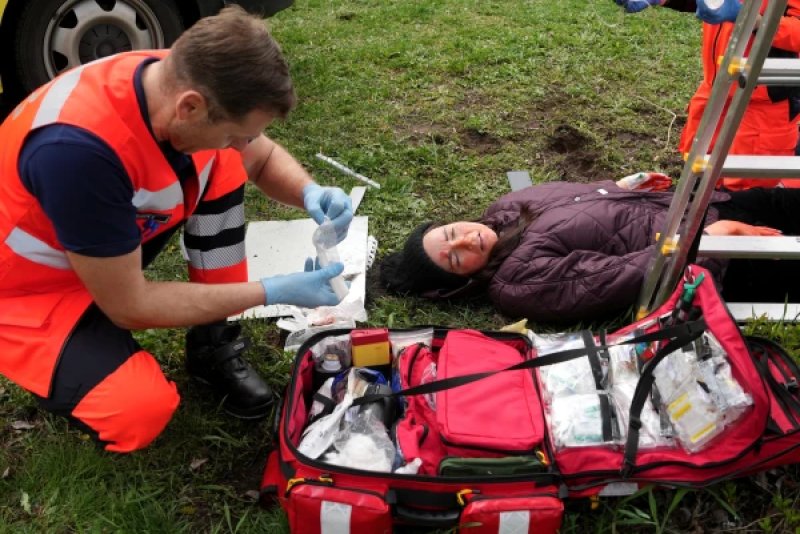
 Foto: BB.LV / Учения Службы неотложной медицинской помощи.
Latvia is preparing for mass disasters: medical personnel are being trained to save hundreds of victims This week, the Emergency Medical Service (NMPD) is conducting national exercises for the first time based on the MIMMS standard, which is used in several European countries and recognized by NATO. As reported by bb.lv, citing NMPD, the new system will allow medical personnel, rescuers, police, and military to act according to unified rules in situations where the number of victims significantly exceeds the capabilities of regular ambulance teams. This refers to the British MIMMS system (Major Incident Medical Management and Support), designed for organizing medical assistance during mass incidents. It provides unified principles for managing rescue operations, distributing responsibilities, determining the order of assistance to victims, and organizing their evacuation to hospitals. ### The war in Ukraine has prompted a reassessment of risks NMPD Director Liene Cipule notes that until now, Latvia has managed to avoid large-scale disasters and emergencies with a high number of casualties. However, events over the last decade have significantly changed the security situation in Europe. Terrorist attacks, devastating natural disasters, and the war in Ukraine have shown how important it is to be prepared for situations where a large number of people may need medical assistance in a short period of time. "Every state must be prepared for events where a large number of victims may require medical assistance in a short time," emphasized Cipule. According to her, in such circumstances, it is especially important that all involved services use unified and clear international standards. This will allow medical personnel, firefighters, police, and military to coordinate their actions more quickly, set priorities, and organize the evacuation of the injured. ### Medical personnel are trained to make decisions in seconds This week, Latvia is hosting the first organized NMPD national exercises based on the MIMMS system. The sessions are conducted by certified Latvian instructors and British mass incident medical management specialist Justin Burke-Jones. Participants are mastering the management of medical unit actions, information exchange during a crisis, assessing the safety of the incident scene, triaging victims by the severity of their condition, and planning evacuations. Particular attention is paid to practical training. Medical personnel have to make quick decisions under intense stress when the number of those needing assistance significantly exceeds available resources. One of the key elements of the system is medical triage. It allows determining who needs immediate assistance and who can wait, in order to use the limited resources of rescuers as effectively as possible. ### Police, army, and hospitals will be involved in the exercises The implementation of MIMMS involves close cooperation among various services. In the future, training should be conducted not only for ambulance staff but also for representatives of the State Fire and Rescue Service, police, National Armed Forces, Zemessardze, hospital emergency departments, and crisis management groups. This will allow all participants in rescue operations to use common algorithms of action. Such a system is already in use in several European countries, including Estonia, and its principles have been recognized by NATO as part of civil-military cooperation. The training is being conducted in collaboration with the British organization Advanced Life Support Group (ALSG), which developed the standard for the corresponding training course. ### The new system will require additional funding NMPD has been implementing MIMMS for several years. Currently, funding is being sought to expand the training program. The Ministry of Health is considering an informational report on the further development of military and crisis medicine and the necessary resources for this. The implementation of the international system is outlined in the NMPD development strategy for 2026–2030. After training a sufficient number of specialists, the principles of MIMMS are planned to be included in state disaster medicine plans and documents defining the ambulance service's readiness for emergencies. Thus, international standards should turn into specific instructions for actions during incidents with a large number of victims. ### Stockpiles of vital medicines are being created for crisis situations At the same time, Latvia is strengthening the healthcare system's preparedness for possible emergencies. Last week, the government approved rules for creating, storing, and using reserves of critically important medicines. Their task is to ensure uninterrupted supply of medications even in the event of serious supply disruptions during a crisis, emergency, or threat to national security. The formation of reserves will be organized by the National Health Service, entering into contracts with wholesale suppliers of medicines. Pharmaceutical companies will be required to ensure the storage, accounting, and timely updating of stocks. Upon receiving the appropriate order, they will be obliged to deliver the necessary medications to specified locations no later than 24 hours. The list of critically important medicines includes drugs for treating diseases from 20 groups, including pain relievers and antihistamines, medications for diabetes, cardiovascular, and oncological diseases. At the same time, the complete list of medications and volumes of reserves is classified information. NMPD emphasizes that the main goal of all these measures is to provide the fastest and most effective assistance to the population both during major incidents in peacetime and in the event of a serious threat to national security.
