

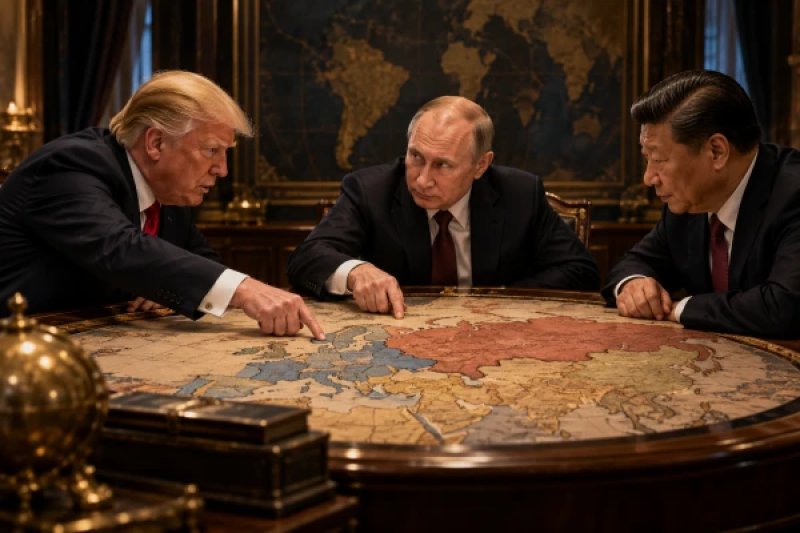
 Foto: BB.LV / Трамп, Си и Путин
According to Fesenko, the Kremlin is interested in such a meeting not for the sake of achieving a just peace. For Putin, this is primarily an opportunity to demonstrate that Russia remains one of the three great powers capable of determining the fates of other countries. "For Putin, this is a symbol of a new Yalta — the leaders of three influential countries are dividing the world," Slaidins conveyed the words of the political scientist. This refers to the analogy with the Yalta Conference of 1945, where Stalin, Roosevelt, and Churchill discussed the post-war order of the world. Fesenko believes that Putin would like to gain comparable international status by taking advantage of Trump's presidency. The most dangerous scenario for Ukraine is if Washington and Beijing attempt to negotiate with Moscow for a ceasefire on Russia's terms. Ideally, the Kremlin would like to ensure that the U.S. and China do not hinder its goals in Ukraine. Fesenko warns: this would not be a peace agreement, but a de facto granting of freedom of action to Russia. At the same time, the trilateral meeting remains only a possible option, and its holding does not guarantee any agreements. The political scientist also points out the Russian tactic of weakening Ukraine through strikes on its energy infrastructure and economy. In response, Kyiv and European allies need to strengthen relations with Washington and seek to increase pressure on Moscow so that concessions are demanded not only from Ukraine but also from Russia. At the same time, Ukraine should actively engage with China, explaining to Beijing that Russia's attempt to destroy or subjugate Ukraine increases the risk of a major war in Europe, which contradicts Chinese economic interests. However, Fesenko does not expect a quick start to real peace negotiations. In his opinion, the Kremlin may prolong the process in anticipation of political changes in Europe, particularly the presidential elections in France in the spring of 2027. As a result, real negotiations may be postponed until the second half of 2027. As Slaidins emphasized, even if Trump, Xi, and Putin do end up at the same table discussing Ukraine, it does not necessarily mean that they intend to achieve a peace acceptable to Kyiv.
