

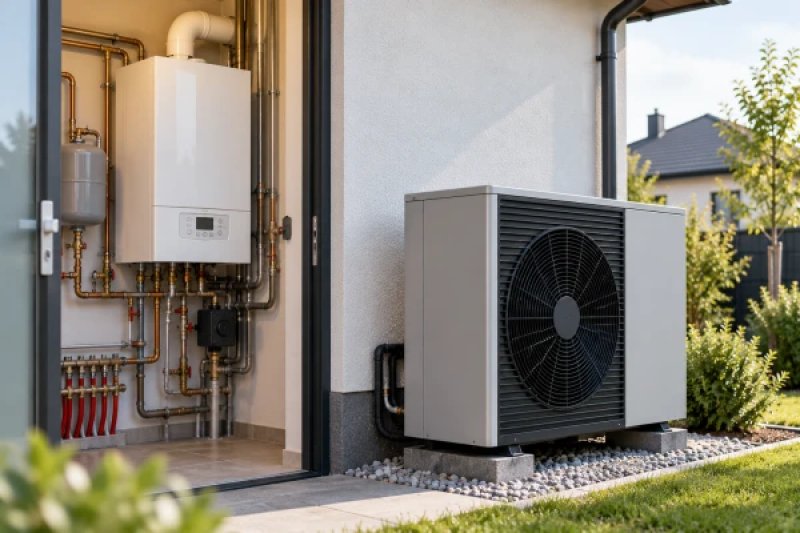
 Foto: BB.LV / Современная отопительная система дома
Gas heating, which has long been one of the popular solutions for private homes in Riga, is gradually giving way to alternative technologies. Against the backdrop of the European Union's climate goals, residents of Latvia are increasingly choosing heat pumps and other systems that use renewable energy resources, writes Latvijas Avīze. According to the Riga Energy Agency, in 2021, there were 748 applications submitted for the installation or retrofitting of gas heating systems. By 2025, this number had decreased to 352 — a reduction of about 53%. At the same time, interest in heat pumps has grown. If in 2021 there were 161 applications for their installation, by 2024, there were already 496. Over the past three years, heat pumps have become the most sought-after solution among applicants. As explained by Valdis Ratniks, head of the Energy Efficiency Information Center at the Riga Energy Agency, these changes show how significantly residents' preferences have shifted when choosing heating systems. However, the decrease in applications for new gas boilers does not yet mean a mass abandonment of already installed equipment. According to the gas distribution system operator Gaso, over the past year, the number of households using natural gas for heating has decreased by about 200 — from 60.9 thousand to 60.7 thousand. Meanwhile, Riga has been discussing restrictions on the installation of new gas heating systems for several years. Initially, the Riga City Council planned to ban the installation of new natural gas boilers starting in 2026. This decision was considered as part of measures to improve air quality and achieve climate neutrality. However, the deadline was later postponed to 2030. The changes are also related to the overarching European energy policy. The EU plans to phase out the use of fossil fuels, including natural gas, for heating buildings by 2040. But does this mean that gas boiler owners will have to dismantle their equipment? The Ministry of Climate and Energy emphasizes that the use of gas heating boilers is not prohibited in itself. Moreover, such equipment can technically operate not only on natural gas but also on renewable fuels, such as biomethane. Therefore, the possibility of further use of already installed systems will also depend on their technical condition, service life, and the availability of alternative fuels. The ministry notes that the transition to more environmentally friendly heating systems should occur gradually, taking into account the financial capabilities of residents. This means that having a gas boiler does not in itself obligate the owner to immediately purchase new equipment. However, when planning to replace a heating system, it is worth considering the long-term restrictions on the use of fossil fuels. Among the possible alternatives, the ministry mentions heat pumps, biomass heating systems, and combined solutions that allow the use of multiple energy sources. For those who have already decided to abandon gas heating, Latvia has a state support program in place. It has been available since 2022 and provides assistance to households in replacing fossil fuel-based equipment with more environmentally friendly systems. Under the program, a gas boiler can be replaced with a heat pump, pellet boiler, or solar collector system. Support for connecting to centralized heating is also provided. Applications for funding can be submitted until the end of 2029 or until the allocated funds are exhausted. Thus, while gas heating in Latvia remains permitted for now, future EU requirements and the possibility of using renewable energy resources are becoming increasingly important when choosing new equipment. For owners of existing boilers, the main question remains not immediate replacement, but planning for heating in the coming years.
