

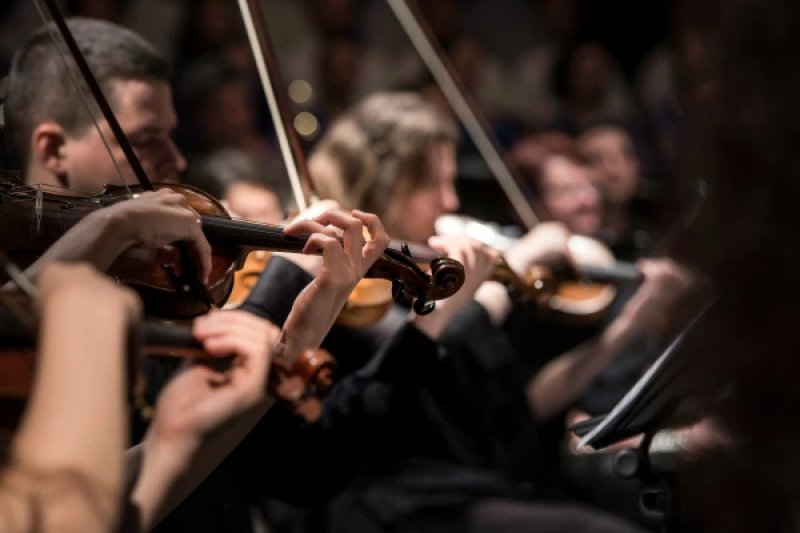
 Foto: BB.LV / скрипачи
Cultural workers in Latvia are reporting a growing wage gap with other sectors of the public sector and neighboring countries. A lack of funding complicates not only salary increases but also the attraction of specialists and the development of cultural institutions. At a press conference on Thursday, industry representatives provided specific examples of salary differences for musicians in the national symphony orchestras of the Baltic states. As noted by Sandis Voldiņš, a board member of the Latvian Association of Professional Music Ensembles and director of the Latvian National Opera and Ballet, the Latvian National Symphony Orchestra offers a second violin group musician a salary of 1512 euros before taxes, or about 1150 euros net. In comparison, the Lithuanian National Symphony Orchestra is looking for a percussion group musician with a gross salary of 2068 euros, which amounts to approximately 1300 euros after taxes. In the Estonian National Symphony Orchestra, a double bass group musician is offered 1900 euros before taxes, or about 1550 euros net. Thus, among the vacancies presented, the offer from the Latvian orchestra turned out to be the lowest paid. At the same time, these figures refer to different instrumental groups, so these amounts reflect differences between specific vacancies rather than average salaries of all orchestra members. The issue concerns far more than just musicians. Museums, libraries, archives, theaters, and other cultural institutions are facing insufficient funding. In the second quarter of 2026, the average gross salary of workers in cultural heritage institutions was 1395 euros, while in the performing arts sector it was 1365 euros. In comparison, the average salary in the public sector reached 1926 euros before taxes. This means that the difference was between 531 and 561 euros per month. In other words, workers in the aforementioned cultural sectors earned on average about 28–29% less than those employed in the public sector. According to industry representatives, significantly more funds would be required to eliminate this gap than could be found through the redistribution of the existing cultural budget. "The wage gap with the rest of the public sector in Latvia, by preliminary estimates, amounts to 30 million euros, and it is so large that it is utopian to think that it can be resolved through internal redistribution of resources in the cultural sector," emphasized Voldiņš. Dagnija Baltiņa, director of the Latvian National Library, drew attention to a separate problem. According to her, most employees of public cultural heritage institutions have salaries set at the minimum level or close to the lower limit established for the corresponding group of positions. Therefore, the overall restrictions on salary increases in public administration particularly affect cultural institutions, where the initial level of remuneration is already relatively low. Industry representatives believe that when establishing uniform restrictions, these differences must be taken into account. They demand a review of the existing salary restrictions, excluding them from the cultural sector, as well as a cancellation of the planned funding cuts for salaries in 2027. For institutions under the Ministry of Culture, the planned cut will exceed 1.2 million euros. To draw public and governmental attention to the situation, cultural institutions plan to hold a multi-day campaign "Culture (Sur)Lives" in November. Participants aim to highlight not only the level of salaries but also the consequences of insufficient funding for the operation of cultural institutions and the ability to attract new specialists. Thus, industry representatives are seeking a change in the approach to cultural funding, warning that the existing wage gap cannot be eliminated solely through internal resources.
