

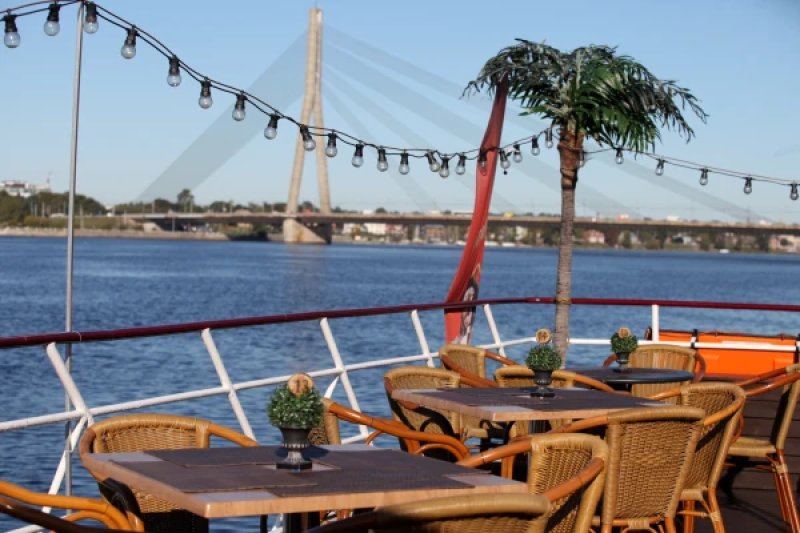
 Foto: BB.LV / кораблик на фоне Вантового моста
The repair of the Cable-Stayed Bridge in Riga, which is expected to last about two years, may significantly change not only road traffic but also river traffic in the capital, reports the program "900 seconds" of the channel [TV3](https://tv3.lv/zinas/latvija/satiksme/tas-bus-kapakmens-nozarei-pasazieru-kugisi-ar-lielam-bazam-gaida-kads-bus-pagaidu-tilts-daugava/). While city engineers are considering the possibility of building a temporary bridge over the Daugava, representatives of the shipping industry warn that a poorly thought-out decision could leave passenger carriers without work and restrict access to docks for private boat owners. According to the Riga Passenger Ship Association, boats and vessels of various sizes pass under the Cable-Stayed Bridge about 100 times a day. If the temporary crossing blocks this route, familiar routes will become inaccessible. > "If a bridge is built under which vessels cannot pass, we will find ourselves isolated, and this will be a tombstone for the entire industry," said Janis Uvarovs, a representative of the board of the Riga Passenger Ship Association. ### Not only passenger transport is at risk According to the association, the consequences of building a temporary bridge may affect not only companies organizing trips on the Daugava. Restrictions will also impact yacht and boat owners using docks in the Agenskalns Bay and other locations, as well as fishermen. If passage on the Daugava is closed, one of the few options left for small vessels will be the Riga City Canal. However, boat owners fear that it is not designed for such intense traffic. If a significant portion of river traffic is redirected there, the canal could turn into an overloaded two-way route. This, according to industry representatives, will increase the risk of collisions and create additional stress on the banks of the canal, which may be subject to erosion. ### Boat owners still do not know what the city is planning Another reason for dissatisfaction is the lack of specific information about the future temporary bridge. Representatives of the shipping industry claim that neither the design of the crossing nor its location relative to the existing Cable-Stayed Bridge has been discussed with them yet. > "As an industry, we know nothing about this," emphasized Uvarovs. Meanwhile, these decisions will determine whether vessels can continue to navigate the Daugava during the repairs and whether carriers will retain the ability to operate. ### The Riga City Council doubts the need for a temporary bridge Deputy Chairman of the Riga City Council Maris Sprindžuks acknowledges that the interests of boat owners must be taken into account when planning repairs. > "It is very important that we consider this part of society — the people who own boats, yachts," he noted. According to the vice-mayor, engineers are currently only assessing possible designs for the temporary bridge and comparing this option with other ways to organize traffic. There is no final decision on the construction of the crossing. One of the main questions is whether the temporary structure can withstand winter conditions on the Daugava. > "If the ice starts to move, this temporary bridge will simply be swept away, as has happened with all other similar bridges," warned Sprindžuks. A more reliable option could be a bridge on piles or supports. Such a structure would have greater load-bearing capacity and would be safer in winter. However, construction would be more expensive, and after the repair of the Cable-Stayed Bridge is completed, the supports would have to be dismantled and removed from the river. ### Instead of a temporary bridge, detour routes are proposed Sprindžuks himself leans towards another solution — the development of detour routes that would allow redirecting road traffic and public transport around the Cable-Stayed Bridge. In his opinion, such changes would require less investment and would benefit the city even after the repairs are completed. Unlike a temporary crossing, which would then have to be dismantled, improved detour routes could be used in the future as well. Nevertheless, the option of constructing a temporary bridge is not yet ruled out. City specialists continue to assess its advantages, costs, and possible consequences. Thus, the decision regarding the temporary crossing will affect not only motorists but also the operation of river transport in Riga throughout the two-year repair of the Cable-Stayed Bridge.
