

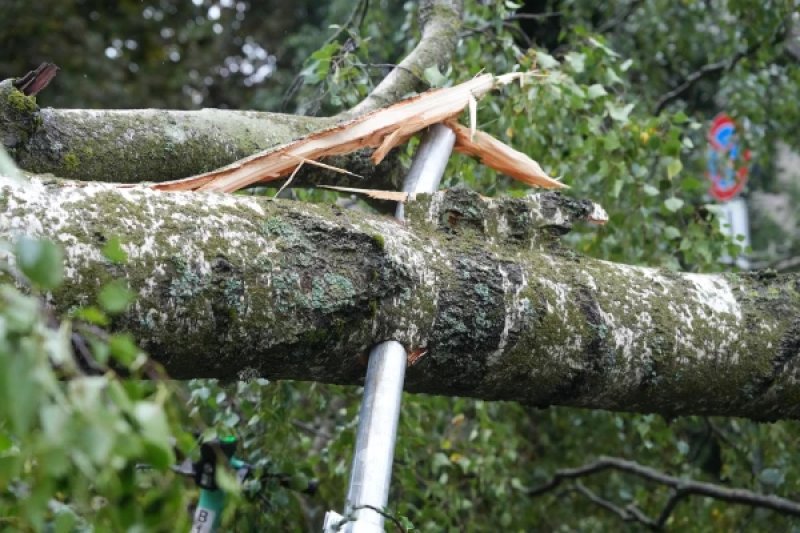
 Foto: BB.LV / поваленное бурей дерево
The Crisis Management Center of Latvia has come under criticism following the August storm that left nearly 300,000 households without electricity. Local government representatives state that they hardly felt the center's presence during the emergency, while Prime Minister Andris Kulbergs believes that the center needs reform. According to the TV3 program "Nothing Personal," the situation is complicated by the fact that a year after its establishment, the Crisis Management Center still lacks several key resources necessary for full coordination of state services' actions. The August storm was the strongest in Latvia in several decades. The bad weather hit a significant part of the country at night, and by morning many residents found themselves without electricity, mobile communication, and internet. Latgale and Selia were particularly hard hit. In some areas of Latgale, electricity supply could not be restored for almost a week. Due to power and communication outages, many shops and gas stations were closed in various places. Local government representatives claim that they were forced to cope with the aftermath of the disaster on their own. According to them, at the state level, they felt coordination mainly from the Ministry of Climate and Energy, but not from the Crisis Management Center. The criticism was so sharp that the mayor of Daugavpils even called for the center to be dissolved. Prime Minister Andris Kulbergs also stated that the institution is not functioning properly and needs transformation. However, the head of the Crisis Management Center, Arvis Zile, explains that the center should not automatically take charge of managing the aftermath of any major incident. According to him, legislation provides for the transfer of crisis management to the center in certain cases — for example, when there is a threat to national security or upon request from the responsible sector for assistance. In this case, the corresponding decision must be made by the government. During the August storm, such a decision was not made, so the center did not take charge of the crisis. Zile emphasizes that the institution was primarily created to manage significantly more serious crises that require coordination among various state structures, including interaction with the armed forces. However, the center is currently not fully prepared to carry out such tasks. One of the main problems is the lack of a unified system for operational information exchange between state services. "There is no unified information exchange system between services for quick interaction in the country. For example, police and firefighters can exchange information with each other, but we cannot quickly receive information from them here, as well as from the armed forces," Zile said. According to him, the situation with information exchange with the army is particularly complicated. "The armed forces have a special situation, as information there is mainly stored in secret networks, and in the current system, we do not have secret networks at all," explained the head of the center. This means that the institution, which is supposed to coordinate the actions of various structures in the event of a large-scale crisis, currently lacks the necessary infrastructure for the operational receipt of some information. Addressing the problem requires not only technical changes but also financial investments. Zile believes it is necessary to create a system that allows the center to receive current information from the State Police, the State Fire and Rescue Service, and possibly the Emergency Medical Service. "Investments and time are needed to implement such a system, and then we will see the same operational picture as they do. And, of course, this involves financial investments," he noted. Moreover, the center still lacks the necessary secure premises for housing communication systems and working with information of the appropriate security level. Thus, according to TV3, the institution has been assigned a wide range of tasks, but its technical and material support remains incomplete. The program "Nothing Personal" draws attention to the contradiction between the criticism from the Prime Minister and the fact that the Crisis Management Center is under his control. Journalists raise the question of how fair it is to hold the leadership of the institution responsible for its insufficient effectiveness if the state has not yet provided the center with the necessary resources. In turn, Zile calls for the completion of the infrastructure that has been planned and for providing the institution with the capabilities to fulfill its assigned tasks. The story of the August storm highlighted not only the difficulties of coordination between state structures and local governments but also the need to clearly define in which situations the Crisis Management Center should take charge of the actions of services and what resources are necessary for this.
