

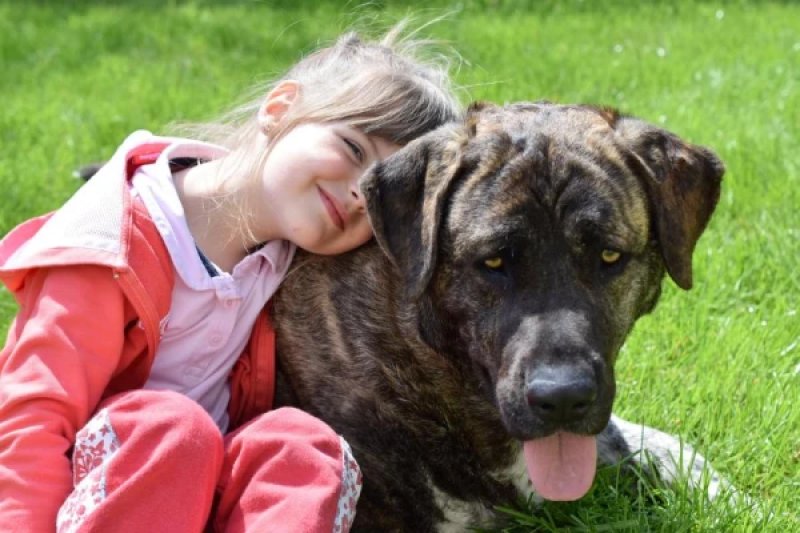
 Foto: BB.LV
Why You Shouldn’t Leave Children Unsupervised with Dogs Dogs bring us joy every day and do many cute things. Especially touching videos where four-legged friends hug babies bring smiles and warmth. However, not all dogs greet a new little neighbor with love. Some may trigger their protective instinct, and the situation can quickly become dangerous. What dog behavior towards a child should raise your concerns? TikTok Shows: The Protective Instinct in Dogs Towards Infants Can Be Dangerous A video that garnered over a million likes demonstrates that not all dog actions are cute, even if they seem so at first glance. You may not always be able to immediately interpret the warning signals that a dog may give. In this TikTok, a dog rested its head on a small child's head. While many might think that the four-legged friend wants to protect the child, in reality, the dog may perceive the child as its “prey.” Therefore, it could become very angry if someone tries to take the child away. TikTok user @dogsense emphasizes: “This behavior has NOTHING to do with protection!” This is because the dog’s body language and subtle gestures can be clear warning signals. If the child does not move away from a dog that exhibits a strong prey and protective instinct, the four-legged friend may show aggression. What is meant by the protective instinct in dogs? At certain moments, a dog may assess that a person (in this case, a child) is not strong enough to handle certain situations. Misinterpreting a person's behavior in a harmless context (for example, when a mother wants to take her child, and the dog thinks it is protecting the child from her) can lead to an escalation of the protective instinct and aggression. How to Understand That a Dog’s Protective Instinct May End Badly? It’s likely that the video was previously posted by another social media user who thought their dog’s behavior was cute. However, @dogsense explains how to recognize that the dog is not trying to protect the child but perceives it as prey. If you notice the following signs in a similar situation with a dog, you should quickly separate the four-legged friend from the person: 1. “Whale eyes”; large, dilated eyes, also known as the “puppy dog eyes.” 2. The dog licks its nose as you approach. 3. The four-legged friend displays strong body tension. 4. It makes a tense sound similar to a huff. 5. It repeatedly grabs the prey with its paws or blocks attempts by other people to approach. 6. The pet's ears are pinned back. 7. The dog lies on the prey and does not want to be moved away. Observing Your Dog is Key As can be seen, a dog’s protective instinct can quickly turn from “cute” to “dangerous.” And this can happen with almost no obvious signs. Therefore, keep a close eye on your four-legged friend when they are near your child. Then decide whether they should be near each other or not.
