

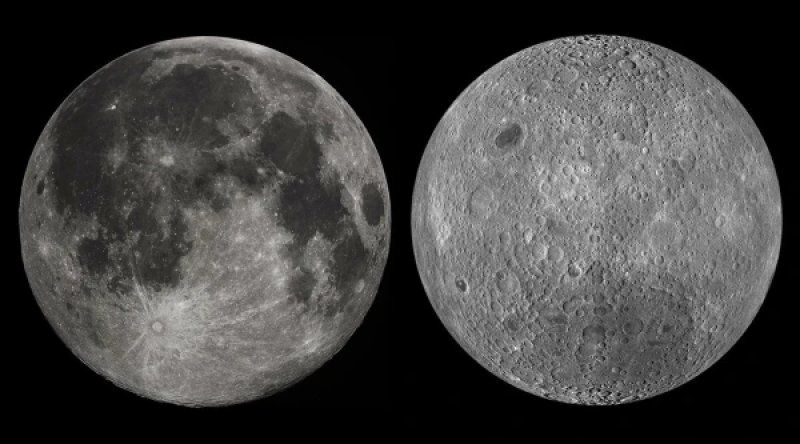
 Foto: BB.LV / Луна
The phrase "dark side of the Moon" is known to almost everyone. It became part of popular culture long before the band Pink Floyd released their famous album The Dark Side of the Moon. However, from a scientific point of view, this name is not entirely accurate, writes [IFLScience](https://www.iflscience.com/is-there-really-no-such-thing-as-the-dark-side-of-the-moon-define-dark-84989). The fact is that the side of the Moon that is invisible from Earth is not plunged into eternal darkness. Moreover, when considering all lighting features, it actually receives slightly more sunlight on average than the side facing us. But there is another unexpected detail: if darkness is understood as the color of the surface, then the darker side of the Moon is indeed the one that we constantly observe from Earth. ### Why Do We Always See Only One Side of the Moon? The Moon is in a state of what is called tidal locking with Earth. This means that the period of its rotation on its own axis coincides with the period of its orbit around our planet. One complete rotation takes about 27.3 days. Therefore, the Moon is constantly facing Earth with almost the same side. At the same time, it is not stationary and continues to rotate on its axis. Its rotation speed is simply synchronized with its movement around Earth. This phenomenon is also characteristic of other large moons of planets in the Solar System. For example, Pluto and its moon Charon are in mutual tidal locking: they always face each other with the same hemispheres. For a long time, the far side of the Moon remained a mystery to humanity. Even after the advent of telescopes, astronomers could only study the surface facing Earth. ### There Is Day on the Far Side of the Moon Too A common misconception is that the invisible side of the Moon is constantly in shadow. In reality, sunlight illuminates both hemispheres of the satellite. While one side experiences a lunar day, the other side enters night. A full cycle of day and night on the Moon takes about 29.5 Earth days. Thus, the Moon does have a dark, unlit area, but its location constantly changes. There are also places where sunlight almost never reaches. These are deep areas of craters near the lunar poles, where sunlight does not reach due to the terrain features. Such permanently shadowed regions are of particular interest to scientists, as they may harbor deposits of water ice. However, this concerns only specific areas of the surface, not an entire hemisphere. ### Why Does the Far Side Receive More Sunlight? At first glance, it seems that both sides of the Moon should receive the same amount of light. But there is a slight difference. The side facing Earth receives additional illumination from our planet, which reflects sunlight. During the daytime, this addition is almost imperceptible — less than one two-thousandth of direct sunlight. However, there is also an opposite effect. During lunar eclipses, Earth blocks the Sun from the visible side of the Moon. Such events occur regularly, while there are no such eclipses on the far side. The Earth's atmosphere allows and refracts some sunlight, so during a total eclipse, the Moon takes on a reddish hue. But most of the direct sunlight is blocked. As a result, as noted by Sky at Night Magazine, over a long period, the far side of the Moon receives slightly more sunlight than the visible side. The difference is small, but it disproves the notion that the invisible hemisphere is constantly in darkness. ### Why Can the Far Side Still Be Called Dark? The word "dark" does not always mean the absence of light. It is often used to denote something unknown or unexplored. In this sense, the expression "dark side of the Moon" is quite justified. For more than 350 years after the beginning of telescopic observations, astronomers did not know what the far hemisphere of the satellite looked like. It was only in 1959 that the Soviet automatic station Luna 3 first transmitted photographs of it to Earth. Since then, spacecraft have created detailed maps of the lunar surface, but the far side is still not as well studied as the visible side. For example, American astronauts from the Apollo program brought many rock samples from the hemisphere facing us. The first samples from the far side were obtained only in 2024, when the Chinese mission Chang'e 6 successfully delivered lunar soil to Earth. Additionally, some areas of the far hemisphere were first seen by humans directly during the Artemis 2 mission in 2026. ### The Far Side of the Moon Is Shielded from Earth's Radio Signals The invisible hemisphere has another feature that makes it particularly attractive for science. The Moon serves as a natural screen that blocks radio signals coming from Earth. Therefore, the far side is considered one of the most promising locations for future radio astronomical observatories. Here, scientists will be able to conduct observations with much less interference from terrestrial radio transmitters and satellites. One of the main goals of such research is to study the so-called dark ages of the universe, the period before the first stars appeared. Thus, the far side of the Moon can indeed be considered dark, but in a radio-technical sense. ### The Real Dark Side of the Moon Is the One We See The most unexpected answer emerges if we understand darkness not as the absence of illumination, but as the color of the surface. When we call an object dark, we usually mean that it reflects less light. This is exactly what happens with the two hemispheres of the Moon. On the visible side, there are vast dark plains known as lunar seas. They were formed as a result of ancient volcanic activity and consist mainly of basalt rocks rich in iron. Such a surface reflects less sunlight than the lighter lunar highlands. At the same time, the overwhelming majority of large lunar seas are concentrated on the hemisphere facing Earth. Scientists are still discussing the reasons for such a noticeable difference. One hypothesis suggests that the interior of the visible side of the Moon was warmer due to a higher concentration of radioactive elements. This could have sustained volcanic activity for a longer time. As a result, a larger area of extensive dark basalt plains formed on the visible side. It creates a paradox: if judged by the color of the surface and the amount of reflected light, the real dark side of the Moon is the one we see almost every night.
