

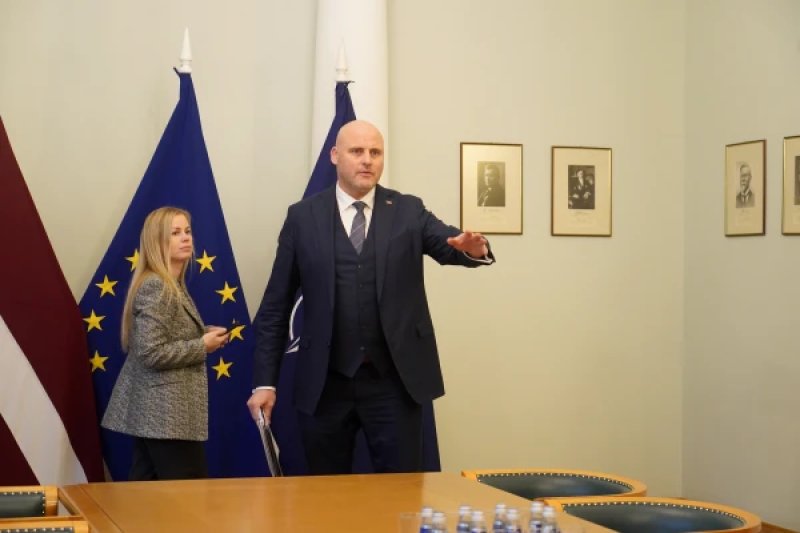
 Foto: BB.LV / Андрис Кулбергс
Prime Minister Andris Kulbergs today begins a meeting with potential partners of the new government to discuss the principles of government work and priority tasks. "We have prepared a broad proposal for discussion, but first we must agree on the principles of government work. They involve a higher level of accountability for ministers and a fundamentally different attitude towards the expenditure of public funds," quotes Andris Kulbergs his strategic communication advisor. Potential partners for cooperation must be ready to agree on specific tasks and deadlines for their implementation, as well as jointly take responsibility for difficult decisions. The proposed government agenda covers four areas: national security, economic growth, expenditure reduction, and more effective governance. "We are entering negotiations with a commendable awareness of the seriousness of the financial situation in the country. If we do not act now, by 2030 both the military and economic security of the country, as well as financial independence, may be at risk. We must be able to ensure necessary investments in defense and social security while simultaneously addressing long-standing issues. We have about a year to change direction and prevent the escalation of the country's financial problems," emphasizes Kulbergs. According to the scenario used in preparing the proposal by the Ministry of Finance, the state budget for 2027 needs to find 569 million euros, in 2028 - 893 million euros, in 2029 - 929 million euros, and in 2030 - 1.735 billion euros. Long-term coverage is necessary for defense financing at 5% of the gross domestic product; the need for additional funding is estimated at approximately 680 million euros per year. One of the proposed principles of budget discipline stipulates that new expenditures should only be approved if there is a clear source of funding and a justified achievable result. "Changes are necessary and inevitable, and we must show that we start being frugal with ourselves. I propose to halve state funding for political parties from 2027, eliminate representation expenses for ministers and deputies, reduce housing and fuel allowances for deputies, freeze the salaries of deputies and ministers, and review the expenses of the Saeima. With these measures, we will not achieve the savings goal of 500 million euros, but it will be the first test of our readiness to take responsibility. Trust from society must be earned through actions. If we call on people to support difficult decisions, we must set an example ourselves," emphasizes Kulbergs. Alongside expenditure cuts - economic growth and higher revenues Kulbergs emphasizes that simply cutting expenditures will not be enough to order public finances. The government must simultaneously work on economic growth and sustainable revenue growth for the budget. This means encouraging entrepreneurship, investment, and productivity, reducing barriers to business development, and achieving greater returns on public capital. These tasks must become an integral part of the government reform plan. "For a long time, I have pointed out the shortcomings in managing public capital. We must be able to clearly answer what return state-owned enterprises provide to society and how to increase it in the long term. One of the proposed solutions is to create a Development Fund by consolidating state capital companies under its management. The goal is more professional management, coordinated investments, and a greater contribution of public capital to the development of the Latvian economy," explained Kulbergs. The government's work in three stages Kulbergs' proposal envisions organizing the government's work in three interconnected areas. In the first stage, expenditures and functions of the state would be assessed simultaneously, initial reforms would be started, and measures to promote economic growth would be prepared. The task would be to identify where unjustified spending and duplication of functions can be reduced and what changes are necessary to stimulate entrepreneurship and investment. In the second stage, reforms would be implemented more broadly in public administration, making changes to the work of institutions, simplifying processes, and implementing measures aimed at economic growth. The results of the reforms should be assessed based on specific benefits for the population, businesses, and the state budget. In the third stage, the main task would be to consolidate what has been achieved so that responsible management, faster services, reduced administrative burdens, and transparent public spending become a permanent practice in public administration. For each minister, a mission letter with specific goals, tasks, objectives, and deadlines would be provided. Ministers would agree on the priorities of the sector with representatives of the industry, and the organization of government work would clearly define the responsibilities of ministers and the procedure for evaluating results. Society should regularly receive information about the fulfillment of tasks and achieved results. Instead of a traditional coalition agreement, it is proposed to develop a joint change plan for cooperation partners to work in the cabinet. The negotiations will also assess the possibilities of reducing the number of ministries. "We have four years of trials ahead of us. But this is also an opportunity to stabilize public finances, strengthen security, and create a foundation for faster economic growth in the country. For this, an agreement is needed on what needs to be done and the readiness of each to take responsibility for the result," emphasizes Kulbergs.
