

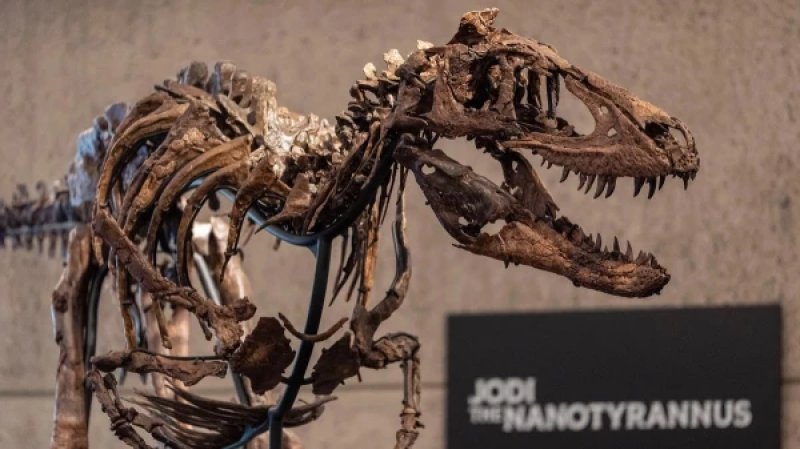
 Foto: BB.LV / В Нью-Йорке на аукционе Sotheby's за более чем 42 миллиона евро продали практически полный скелет хищного динозавра, жившего около 67 миллионов лет назад.
The final price turned out to be several times higher than the preliminary estimate, and the name of the new owner remains unknown. Scientists fear that this unique find may disappear from the sight of science. As reported by the Dutch publication NOS, the main lot of the auction was the skeleton of a Nanotyrannus — a small predatory dinosaur, a close relative of the famous Tyrannosaurus rex. The remains were given the name Jodie. They were discovered in 2019 in the American state of Montana, known for numerous finds of prehistoric animals. ## Price soared in 12 minutes Initially, the auction house Sotheby's expected to raise between five and eight million euros for the skeleton. However, the interest from collectors turned out to be significantly higher than expected. The bidding lasted only 12 minutes, but during that time, the value of the unique exhibit increased manifold. As a result, an unknown buyer paid more than 42 million euros for the dinosaur remains. Thus, the final amount exceeded the upper limit of the preliminary estimate by more than five times. The identity of the buyer is not disclosed. It is also unknown whether the new owner plans to display the skeleton for public viewing or keep it in a private collection. ## 191 bones aged 67 million years The find's value is particularly enhanced by its preservation. Jodie's skeleton consists of approximately 191 fossilized bones, making it an exceptionally complete specimen of an ancient predator. Nanotyrannuses lived in what is now North America at the end of the Cretaceous period, shortly before the mass extinction of dinosaurs about 66 million years ago. Externally, these animals resembled Tyrannosaurus rex but were significantly smaller. They moved on two powerful hind limbs, had long tails, sharp teeth, and relatively small front limbs. The name Nanotyrannus translates approximately as "dwarf tyrant." For a long time, scientists debated whether Nanotyrannus existed as a separate genus of dinosaurs or whether the discovered remains belonged to young specimens of Tyrannosaurus rex. Therefore, well-preserved skeletons of such animals are of particular interest to paleontologists: they allow for the study of bone structure, growth characteristics, and evolutionary relationships of ancient predators. ## Only three such skeletons Jodie's size is impressive, although compared to Tyrannosaurus rex, this predator was relatively small. The length of the skeleton from snout to tail tip is about 4.7 meters, and its height is approximately 2.7 meters. For comparison, an adult Tyrannosaurus rex could reach 13 meters in length and five meters in height. According to Sotheby's, there are only three such well-preserved Nanotyrannus skeletons known in the world. It is precisely the rarity and scientific value of the remains that likely contributed to the fierce competition among buyers. As NOS reports, citing the British newspaper The Guardian, six participants vied for the right to purchase the dinosaur, placing bids by phone and online. ## Scientists fear losing a unique find The sale of fossil remains for tens of millions of euros evokes mixed reactions from the scientific community. Paleontologists fear that rare specimens, falling into the hands of private collectors, may become inaccessible for research. If the new owner decides to keep the skeleton in a closed space, specialists will lose the opportunity to study it using modern scientific methods, and the public will miss out on seeing a unique testament to prehistoric life. One American scientist, commenting on the sale for The Guardian, also expressed doubt about the justification for such a high price. In his estimation, the total costs for excavating, preparing, and assembling such a skeleton probably do not exceed one million dollars. Meanwhile, the amounts that collectors are willing to pay for dinosaur remains continue to rise. Just a few months earlier, another Tyrannosaurus rex skeleton was sold for about 44 million euros. The sale of Jodie once again posed a difficult question for the scientific community: should unique testimonies of Earth's history become objects of private trade, or should such finds be preserved in museums where they will be accessible to researchers and visitors?
