

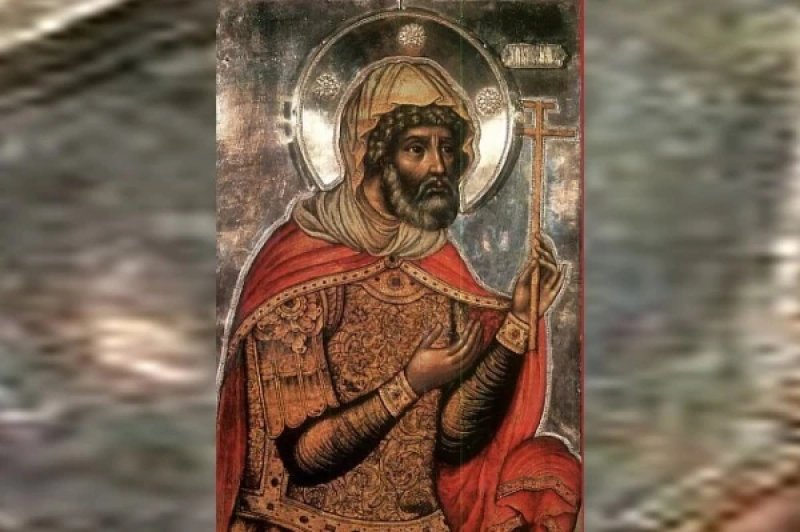
 Foto: BB.LV / онгин Сотник. Икона работы Фёдора Зубова, 1680 год.
In the folk tradition, the sun on this day was considered healing — everyone was required to go outside and warm themselves in its rays. **What is remembered in the Church on October 29, 2026** Longinus lived during the same period as the earthly life of Jesus; he was a simple Roman centurion, leading a unit, and thus entered history with the nickname Centurion. It was his unit that was tasked with guarding the place of Jesus' execution and the two robbers crucified alongside him at Golgotha. He is remembered as a killer, but at the same time, as one who, despite his duties and position, showed pity for Jesus. This saint is mentioned in the Gospel of John, where it is said that he pierced the crucified Christ with a spear, thereby ending both his earthly life and his suffering. This episode is also described in the Gospel of Mark, but he is not named there. It is believed that Longinus suffered from cataracts, which were cured when the blood of the Savior splashed on him from the wound. As is known, his death was marked by a solar eclipse and an earthquake. All these events led to a change in the consciousness of the simple soldier — he repented and turned to true faith. It is believed that he witnessed the resurrection of Jesus from the dead. Later, even in exchange for a bribe, he refused to give false testimony that Christ had not risen and that his body had been stolen by the disciples. After that, Longinus went to preach in his homeland of Cappadocia. His speeches were so convincing that they instilled fear in the city elders, who persuaded Pilate that he needed to be killed urgently. Forewarned, Longinus went to meet the squad sent for him, invited them into his home, and treated them. The guards, unaware of who the homeowner was, told him the purpose of their visit to the city. Then Longinus introduced himself and offered them to fulfill their duty right away. The guards tried to refuse, offering to help him escape, but seeing his steadfastness, they killed Longinus and his like-minded companions. They threw the bodies onto a dump. However, a miracle occurred — a blind pilgrim saw Longinus in a dream and asked her to bury his head, telling her where to find it. The woman fulfilled his request, after which she regained her sight. Today, the relics of the saint are kept in Rome, in the Church of Saint Augustine, while the tip of the spear with which he killed Jesus is in the Vatican. It is called the Spear of Destiny and is considered part of the instruments of the Passion of Christ and one of the main relics of Christianity. **The Meaning of the Holiday** Even a criminal can become a saint if he finds himself in the right place at the right time and performs the right action. **Folk Weather Signs** — Hoarfrost on the branches — indicates warming. — Rare clouds in the sky — indicates frost and clear weather. — Stars in the sky promise good weather for the next day. **What can be done on October 29, 2026** — Be sure to walk more. — It is customary to take winter clothes out into the fresh air and air them out. — Lift your spirits in every possible way. — A good day for hunting and fishing. **What cannot be done on October 29, 2026** — Do not sit at home all day. — Do not keep doors and windows open. — It is strictly forbidden to start quarrels and disputes. — It is very bad to be sad. — It is not worth engaging in handicrafts and sewing. **Interesting Fact** It is believed that the spear that ended up in Longinus's hands on the memorable day belonged to the third high priest of Judea, Phinehas, who was the grandson of Aaron and the great-nephew of Moses. With this spear, an Israelite and a Moabite woman were killed, which ended a plague in the land. With it, Joshua attacked Jericho. It was in the hands of King Herod. After the events at Golgotha, it was possessed by Constantine the Great, Justinian, and Charlemagne.
