

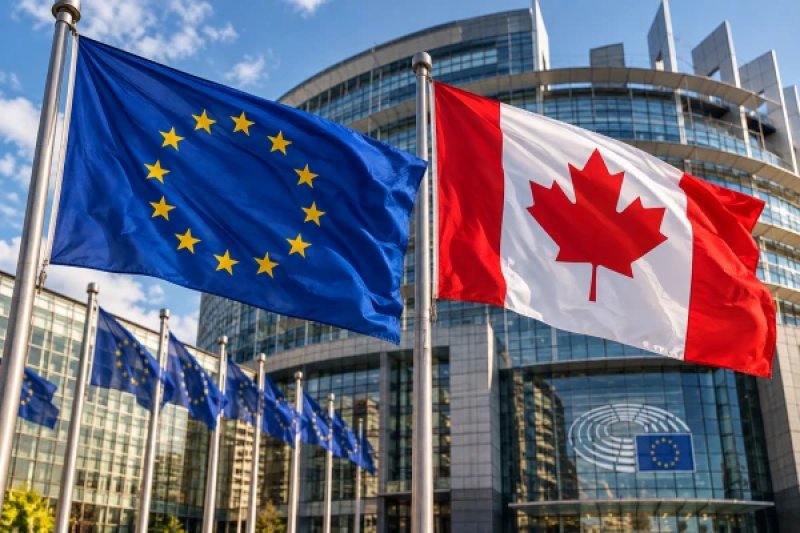
 Foto: BB.LV / Флаги ЕС и Канады у здания парламента ЕС
The European Union has abandoned plans to designate Canada as an associated member state of the EU. The relevant wording has been excluded from the draft joint statement that is expected to be adopted following the EU-Canada summit in Montreal. According to the LETA agency, citing DPA, German Chancellor Friedrich Merz and several other European leaders opposed the use of such a status. According to diplomatic sources from DPA, the objections were primarily related to the lack of a clear definition of the proposed status. Additionally, representatives from several EU countries were dissatisfied that the European Commission had not conducted the necessary consultations with them in advance. ## Von der Leyen proposed a special status back in September The idea of bringing Canada closer to the European Union at a new level was presented by European Commission President Ursula von der Leyen in September during her annual address on the state of the EU. At that time, she stated that Canada could become the first associated member state of the European Union. However, during the preparation of the joint statement, the terms "associated member state" and "associated membership" were excluded from the document. Instead, the parties intend to declare their desire for an "ever closer association" between Canada and the EU. Furthermore, the draft has softened the initially proposed commitments regarding the integration of financial markets and mutual provision of favorable conditions within the framework of economic security measures. The final statement is expected to be published on Friday, October 30, after the conclusion of the two-day summit in Montreal. ## The head of the European Commission continues to speak about associated membership Despite the objections from European leaders, Ursula von der Leyen has not abandoned her initial idea in her public speeches. After arriving in Montreal on Wednesday, she again used the term "associated member state" in a social media post. > "Europe and Canada are separated by an ocean, yet we have never felt closer to each other," wrote the head of the European Commission. According to her, the parties have a new goal — to bring Canada closer to the European Union more than ever before, as an associated member state. > "We want our unique partnership to go even further," emphasized von der Leyen. She also supported the concept of the "Alliance for the Future," proposed by Canadian Prime Minister Mark Carney. > "Thanks to the 'Alliance for the Future,' we will stand together against a world of growing competition. In Montreal, we will write a new chapter in our shared history," stated the President of the European Commission. It is this concept of the "Alliance for the Future" that now occupies a central place in the draft joint statement. ## What the new partnership entails Despite the abandonment of the wording regarding associated membership, the EU and Canada intend to expand economic and strategic cooperation. According to the draft document, the parties plan to work on reducing trade barriers and facilitating mutual investments. Particular attention is expected to be paid to ensuring reliable supplies of raw materials, medicines, and technologies. Additionally, the EU and Canada intend to develop cooperation in the field of artificial intelligence security. Another direction will be to explore opportunities for increasing the supply of Canadian liquefied natural gas to Europe. Canadian Prime Minister Mark Carney stated to reporters on Tuesday that for him, the content of future relations is more important than their official name. ## Trump previously threatened the EU with new tariffs The rapprochement between Canada and the European Union is taking place against the backdrop of tensions in trade relations between Ottawa and Washington during Donald Trump's presidency. Carney seeks to strengthen economic and political ties with European partners, expanding Canada's international cooperation opportunities. In September, Trump opposed the idea of granting Canada the status of an associated member state of the EU. The American president threatened to impose new customs duties against the European Union if it agreed to such a step. According to Trump, granting Canada such a status could be seen as a "hostile act." However, the DPA report does not indicate that the American position was the reason for the change in the statement draft. Diplomatic sources from the agency attribute the abandonment of the controversial wording primarily to objections from Germany and other EU countries.
