

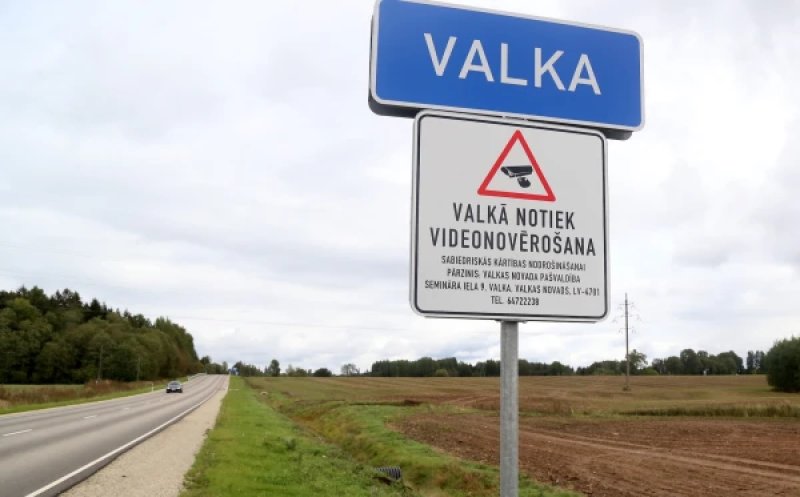
 Foto: BB.LV / Валка
### “The situation resembles Rezekne” The financial difficulties of the Valka region have been attracting the attention of the government and regulatory agencies for several years, reports [TV3 News](https://tv3.lv/zinas/latvija/valka-grimst-finansu-grutibas-tikmer-dala-iedzivotaju-jau-paspejusi-deklareties-valga/). The smallest municipality in Latvia is facing a shortage of funds to meet its current obligations. There have been delays in payments to suppliers, as well as tax arrears. Last autumn, at the request of the then Prime Minister, a minister responsible for municipal issues visited Valka. However, no solution was found during the negotiations. The state urged local authorities to bring the budget in order on their own, while the region's leadership insisted that the possibilities for further expenditure cuts were nearly exhausted. Meanwhile, the State Audit has begun a large-scale audit of the financial management of ten Latvian municipalities. Given the seriousness of Valka's situation, the results of the audit for this region were decided to be presented separately, even before the completion of the entire audit. The findings were critical. > “Weak financial management and insufficient internal control. There is a certain sense of déjà vu, similar to what we experienced about three years ago when we completed the audit of Rezekne around this same time,” said Ilze Bādere, a member of the State Audit Council. ### Income was inflated, and expenses were not controlled The auditors found that Valka's financial problems did not arise suddenly but had accumulated over a long period. Among the identified shortcomings were the planning of income that could not actually be obtained, the assumption of new financial obligations amidst existing risks, and insufficient control over debts. Additionally, the municipality set utility tariffs at a level that did not cover actual expenses. As a result, the gap between income and obligations gradually widened. According to the State Audit, the situation could have been less severe if the region's leadership had started addressing financial issues earlier. > “The Ministry of Finance has been closely monitoring Valka for several years now. This pressure has been felt,” noted Bādere. At the same time, she acknowledged that after the intervention of the Ministry of Finance, the situation began to gradually improve. However, in the auditors' opinion, the necessary measures should have been taken much earlier. ### Valka explains the crisis by the city's unusual situation The leadership of the Valka region does not deny the financial difficulties but believes that their causes cannot be explained solely by the mistakes of local authorities. The chairman of the regional council, Vents Armands Krauklis, draws attention to Valka's unique situation, which effectively forms a single urban organism with the Estonian town of Valga. Some people associated with Valka have declared their residence on the Estonian side of the border. According to the municipality, this negatively affects local budget revenues. The regional council believes that the peculiarities of the border town were not adequately considered either during the administrative-territorial reform or in the system of financial equalization for municipalities. According to local authorities, despite repeated appeals, the issue has not received a systemic solution. Krauklis claims that the municipality had to take out loans and continue development projects to keep Valka an attractive place to live. ### “When you think about which overdue bill to pay…” The chairman of the council admits that in the context of constant funding shortages, the municipality resorted to questionable financial decisions. However, according to him, this was not out of a desire to violate rules, but out of necessity to meet current obligations. > “When you sit and think about which bill to pay because payments are already overdue, and you take money from another account, pay it, and then return it — that is what those violations are,” Krauklis explained. He also disagrees with the positive assessment of halting the region's development projects. > “When this morning a representative of the State Audit says: ‘Finally, Valka has halted development projects. How good!’... This is a tragedy!” said the chairman of the council. In Krauklis's opinion, abandoning development could further complicate Valka's long-term situation, as the city risks losing its attractiveness for residents and entrepreneurs. ### Valka decided to initiate financial stabilization This week, the regional council decided to initiate a financial stabilization procedure. This rarely used mechanism is designed for municipalities that cannot cope with serious financial problems on their own. It is expected to allow Valka to obtain an emergency loan from the state and stabilize its obligations. However, such assistance will be accompanied by increased oversight from the Ministry of Finance and the need for further expenditure cuts. It is the potential restrictions that raise the greatest concerns among the region's leadership. ### Support for sports, culture, and families is at risk According to Krauklis, under strict financial stabilization, the municipality may be advised to focus solely on functions explicitly mandated by law. This would call into question expenditures on additional local programs. > “From their perspective, if there is no money, you need to do only what the law prescribes,” said the chairman of the council. Among the areas that the leadership of Valka intends to fight to preserve, he mentioned support for sports, public organizations, cultural events, and local traditions. Additionally, there is talk of additional assistance for families with children and co-financing of school lunches. > “We will fight to the last,” emphasized Krauklis. At the same time, final decisions on cutting specific programs have not yet been made. ### The decision now rests with the government In the near future, the issue of initiating financial stabilization for the Valka region is planned to be included in the government’s agenda. The subsequent decisions will determine the conditions under which the municipality can receive state assistance and what restrictions will need to be imposed. The State Audit believes that the current difficulties are largely related to shortcomings in financial management, while the region's leadership insists on the need to consider the special conditions of the border town. For the residents of Valka, the main consequence of the crisis may be a reduction in municipal services and support programs that go beyond the mandatory functions of the municipality.
