

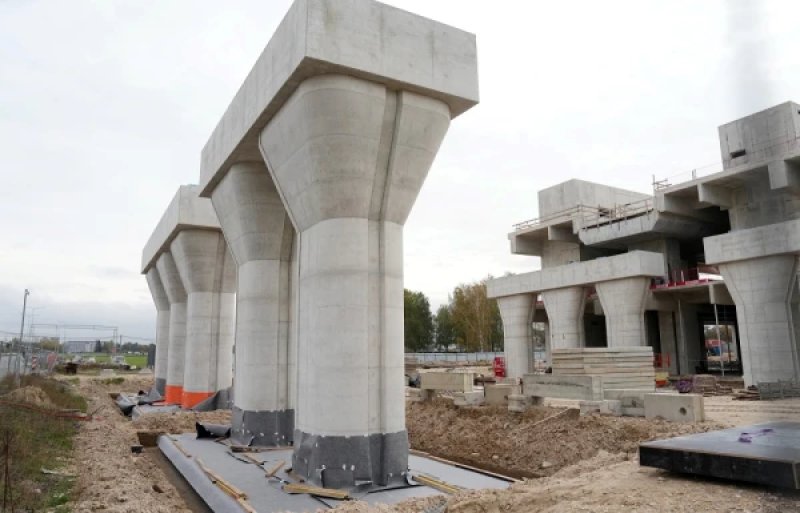
 Foto: BB.LV / опоры моста rail baltica
Earlier, Latvijas dzelzceļš warned that without large-scale reconstruction, the operation of electric trains could be at risk within the next five to ten years, reports the program Nekā personīga of the channel [TV3](https://tv3.lv/zinas/latvija/neka-personiga/bistamo-dzelzcela-kontakttiklu-labosanai-paredzeto-naudu-novirza-jaunajam-sliedem-uz-lidostu/). ### 140 passengers found themselves on the tracks after an accident On the evening of October 24, the Riga – Jelgava train encountered an emergency situation near Olaine. Immediately after leaving the station, a loud sound was heard, a flash appeared, and the train made an emergency stop. As a result, 140 passengers had to walk back along the railway tracks to the station in the dark. The incident reminded of another dangerous case that occurred two years earlier in Kemeri. At that time, an old electric train experienced a short circuit, and the contact network did not shut down and continued to spark. As a result, the train caught fire. Fortunately, there were no passengers on the train, and no one was injured. After that incident, Latvijas dzelzceļš prepared an internal report for the Ministry of Transport on the state of the railway infrastructure. The document stated that the contact network was built between 1950 and 1972 and has not undergone a full-scale reconstruction since then. Experts warned: if large-scale updates are not conducted, the operation of electric trains may have to be halted within five to ten years. ### Why did the new accident occur Unlike the incident in Kemeri, during the October incident, the protective systems worked correctly. The chairman of the board of Latvijas dzelzceļš, Artis Grinbergs, stated that engineers thoroughly studied the circumstances of the incident. > "We are already in a better situation now. All the mechanisms of the electrical equipment worked, and that is good news," he noted. Preliminary findings indicate that the cause of the short circuit was a metal element in the structure that should not have been present at the connection of the equipment. It is at the Olaine station that the old and new railway infrastructure currently intersects. According to Grinbergs, the problem arose at the junction of these infrastructures, leading to a chain reaction. The chairman of the board of Pasažieru vilciens, Raitis Nešpors, explained that bright sparks occur during a short circuit, especially noticeable in the dark. At the same time, modern Škoda electric trains are equipped with their own protection systems that reduce the risk of fire. ### Eight incidents in three years However, such accidents cannot be considered isolated. According to Pasažieru vilciens, there have been eight cases of short circuits related to the contact network in the last three years. > "On average, there are two to three cases per year. The causes were of two types. Some cases were related to the aging of the contact network itself, while others were related to maintenance work," Nešpors explained. Such incidents not only create dangerous situations for passengers but also lead to damage to trains. After a short circuit, it is often necessary to repair or completely replace the pantograph — the device on the roof of the electric train through which it receives electricity from the contact wire. Over three years, such repairs have cost the carrier approximately 250,000 euros. However, these expenses are covered by the insurance company. ### Money will only be enough for part of the contact network The total length of the electrified contact network in Latvia is about 500 kilometers. Modernization is already underway in certain sections, including the directions to Tukums and Jelgava. Funding for the upgrade of approximately 300 kilometers of the network is planned for the next three years. However, the remaining sections, including the directions Ogre – Aizkraukle and Zemitāni – Skulte, currently remain without the necessary funding. Money for their modernization is planned to be sought from European funds after 2028. The reason is the redistribution of previously allocated funds to other railway projects. ### Why the money was redirected to the airport Initially, European funding was intended for the modernization of the existing railway infrastructure, including the Aizkraukle direction and the extension of electrification to Krustpils. However, plans changed after the revision of the Rail Baltica project. The station at Riga Airport is already under construction, but the initially planned international route through it will not be implemented at this stage due to the high cost of the project. A problem arose: the built infrastructure could remain without practical application. To avoid this, it was decided to create a railway connection between the center of Riga and the airport using tracks of the standard gauge familiar to Latvia. This is where part of the funds, previously intended for the upgrade of the existing network, is being redirected. Transport Minister Rihards Kozlovskis explained the decision as a necessity to ensure the use of already constructed facilities. > "A lot of work has been done to achieve at least some functionality. To ensure both communication and the possibility of creating an operational station at Riga Airport, where there is currently just a concrete structure," the minister stated. Latvijas dzelzceļš also does not consider the redistribution of funds a loss for the railway sector. > "Has someone robbed us? No. We rather see this as a functional task now," Grinbergs said. ### 264 million euros allocated for new railway projects Total funding 264 million € Latvijas dzelzceļš 131 million € Eiropas dzelzceļa līnijas 133 million € Planned travel time to the airport 12 minutes Of the total amount, 131 million euros will be received by Latvijas dzelzceļš. The funds are intended for the construction and reconstruction of railway tracks, replacement of the contact network, and creation of a connection to the airport. Another 133 million euros will be allocated to the company Eiropas dzelzceļa līnijas, responsible for the implementation of Rail Baltica. This money is intended for the completion of the construction of the airport station and part of the railway embankments. ### To the airport in 12 minutes, but the ticket will cost about 8 euros New Škoda electric trains from Pasažieru vilciens are expected to run on the new tracks to the airport. According to preliminary estimates, the journey from Riga Central Station to the airport will take only 12 minutes. It is planned that trains will run twice an hour. However, the state does not intend to subsidize this route, so the cost of travel for passengers will be significantly higher than the usual city rates. The ticket is preliminarily estimated at about 8 euros. At the same time, trains may only start running by 2030, so the final price may still change. > "With such frequency, up to two million passengers could be transported per year," Nešpors said. ### Infrastructure built at Riga Station without tracks Part of the redistributed funds will also be directed to the construction of railway tracks and access to the southern part of Riga Central Station. This infrastructure was built as part of Rail Baltica, but currently, trains cannot use the constructed station due to the lack of a necessary connection to the existing railway network. Previously, 74 million euros, intended for the development of infrastructure for battery trains on non-electrified routes, were already redirected to complete this project. It is expected that trains will be able to enter the new part of the station in 2028. The company Eiropas dzelzceļa līnijas does not consider the current situation a planning mistake. Board member Davis Blaus explained that the infrastructure was originally designed for a European gauge of 1435 millimeters. According to him, Rail Baltica is being implemented in separate stages depending on available funding. > "This is not money wasted, as it is now necessary to understand how this project is being implemented. Funding is allocated fragmentarily," Blaus stated. ### New trains will have to wait a few more years The problems of railway infrastructure are not limited to the contact network. Outdated diesel trains continue to be used on non-electrified routes in Latvia, which also experience technical incidents. In the future, they are planned to be replaced with modern battery trains. However, the delivery of such trains is expected only in about four years. Thus, alongside seeking funds to complete Rail Baltica projects, Latvia will have to address the issue of the aging existing railway network. And although part of the contact network is already being modernized, the upgrade of the remaining sections now depends on whether new European funding can be found after 2028.
