

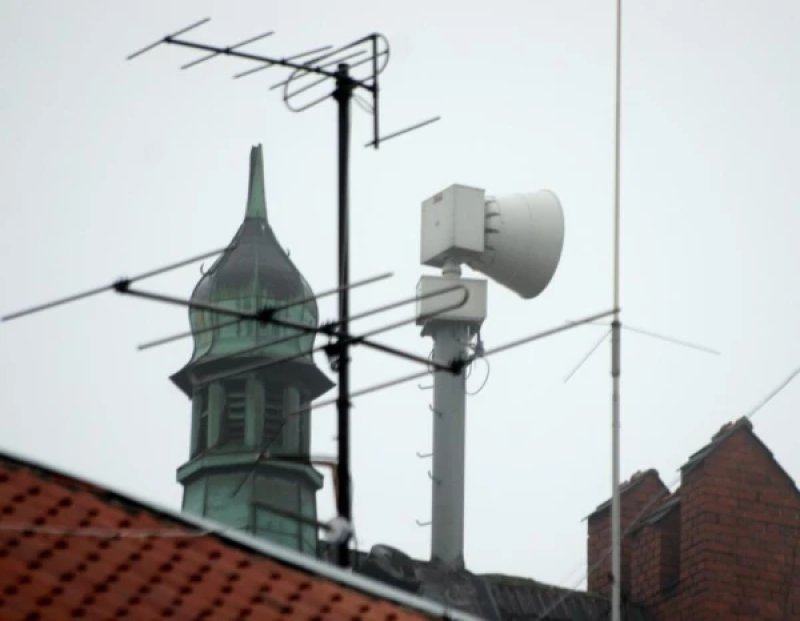
 Foto: BB.LV / сирена
## Who actually makes the decision to evacuate? If an evacuation is declared in Latvia in the event of war or military threat, who exactly will make the decision — the state, local government, army, police, or VUGD? "This area is quite strictly regulated, and I will try to explain briefly. The level of decision-making depends on the scale of the threat and the declared legal regime. In the case of a state-scale evacuation, the Cabinet of Ministers will make the decision. In the event of a military threat, the Ministry of Defense and the National Armed Forces will be involved. In turn, the decision to evacuate a specific territory or region within its competence will be made by the relevant local government, the chairperson of the local government council, or the local civil defense commission. The Crisis Management Center is the coordinating body that ensures cooperation among all services — government, army, and emergency services. The State Fire and Rescue Service will practically plan, organize, and lead civil defense and rescue operations, as well as coordinate the evacuation process on site. The State Police and Zemessardze/NBS will ensure public order, regulate traffic, guard evacuated areas, and assist in carrying out the evacuation." ## ## Where to look for information if the situation becomes dangerous? "In crisis situations, you should only follow official information. There are several reasons for this. The first is the risks of misinformation. With the onset of a crisis, there will be a lot of misinformation, not even out of malice, but because of human nature — spreading rumors. In the age of social media, this is becoming dangerous. Secondly, official channels will have the most up-to-date and operational information about road damages, traffic jams, evacuation site capacities, etc. I am convinced that after the last storm, the malfunction with Latvijas Radio has also been resolved, and we will not have to face anything like that in the future. The media where you should look for information are Latvijas Radio, LSM.lv, Latvijas Televīzija, Sargs.lv, VUGD.gov.lv. Private radio stations and TV channels will likely also duplicate this information. But the primary source is always better. In addition, there are several applications — the VUGD 112 Latvija app, the State Police app “Mana drošība,” and applications from regional municipal police, as well as other municipalities already have their own applications. Let’s not forget about sirens and cellular broadcasting messages. When the sirens start sounding, you need to turn on the radio or check the VUGD app. In turn, cellular broadcasting messages will contain a lot of information. A big mistake is that people turn off cellular broadcasting messages. They do not come very often and are important enough to pay attention to. On site, you should follow the instructions of emergency services (police, VUGD, NBS) and local government representatives. To sum it all up, there are enough information channels to cover a large part of society, and it will be up to the individual to listen or ignore it." ## ## Does each region already have its evacuation route? Have specific evacuation routes for different regions been developed in Latvia at this time? "Yes, routes and logistics are being planned. Can a person see something now? I will say — a little, and there are reasons for that. The state and each local government are developing their civil defense plans (CAP) according to their specifics. These plans also include points with evacuation routes and directions, gathering places, reception points in their and other municipalities, coordination with the state plan, and so on. Some civil defense plans of local governments are publicly available, but specific action plans are not published, and there are several important reasons for this. In the event of war or military threat, the prior publication of specific evacuation routes would reveal to the enemy where a large number of people would be moving. This, in turn, could be used to carry out terrorist attacks against the civilian population. The military and operational situation can change rapidly. In the event of an invasion, a specific road or bridge may be damaged or become dangerous. Similar situations can occur in the case of major floods — a road may be washed out, and the entire route has to be changed. Therefore, routes are adjusted in real-time based on the operational situation. If I have not done preparatory work and have not planned my evacuation routes in advance with all backup options, then it will be safer to rely on the routes that will be official." ## ## Why is it important to know where to get information now? Martins' explanation reminds us that evacuation is not just about packing things into a car and leaving home. In a crisis situation, a very large number of people may be moving simultaneously, and the accessibility and safety of roads can change extremely quickly. Therefore, one of the most important preparatory measures that everyone can take right now is to ensure that emergency alerts are working on their phones, that the 112 Latvija app is available, and that they know where to look for official information. The State Fire and Rescue Service also reminds that in the event of an evacuation, residents should move in the indicated direction and follow the instructions of the responsible services.
