

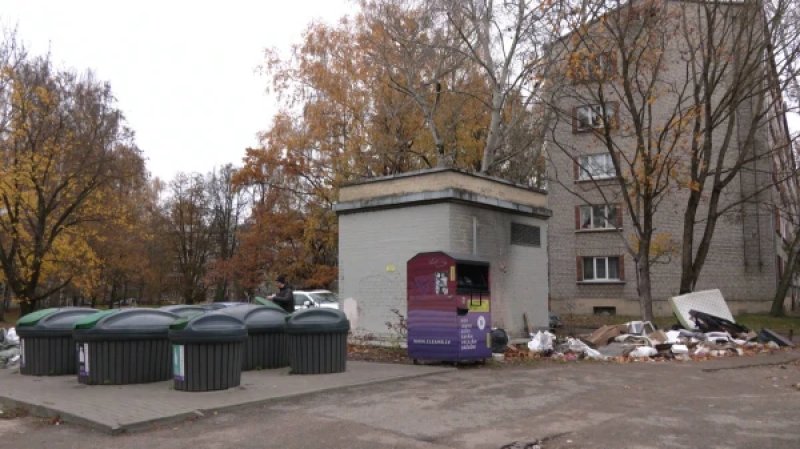
 Foto: BB.LV / мусорники
The situation was investigated by the Bez Tabu program ([TV3](https://tv3.lv/beztabu/nejedzibas/pardaugava-veidojas-jauna-izgaztuve-iedzivotaji-ludz-palidzibu/)). ### Refrigerators, Tires, and Construction Waste in the Middle of a Residential Area The dump near the house at 12 Kristapa Street has long turned into a place where almost everything unnecessary is brought. During a visit, the Bez Tabu crew found car tires, construction waste, clothing, a computer monitor, a refrigerator, old windows, and furniture. Residents say that the problem has existed for many years, but the situation has noticeably worsened recently. Near the containers, journalists met local resident Eleonora. The woman was trying to tidy up the area around the flowerbed, moving trash and fallen leaves with a hanger she found on the ground. However, the efforts of individual residents are not enough to cope with the constantly growing dump. ### "Even Garbage is Brought from Private Houses by Cars" Local resident Zhanna claims that the dump has effectively become a public drop-off point for bulky waste. According to her, items are brought here not only by residents of nearby apartment buildings. > "Even garbage is brought from private houses by cars," the woman said. She believes that neither the municipality nor the management company Rīgas namu pārvaldnieks (RNP) is taking sufficiently effective measures. The sanitary condition of the area is particularly concerning. > "The surrounding area is getting polluted, there are places where rats can hide, and people bring all sorts of things to these garbage containers," Zhanna says. Residents proposed installing surveillance cameras to record violators and prevent the further transformation of the area into a dump. However, achieving the implementation of this idea has proven difficult. ### Police Suggested Residents Film Violators Themselves According to Bez Tabu, residents appealed to the Riga Municipal Police with a request to install a camera near the garbage containers. However, they were denied. Instead of installing surveillance, they were advised to take photos and videos of people illegally leaving waste themselves. In the management company Rīgas namu pārvaldnieks, they acknowledge that the problem does indeed exist. The regional manager of the Housing Fund Management and Support Center of RNP, Linda Šilska, explains the worsening situation by the unrestricted access to the container site. > "As long as the site is freely accessible, garbage is thrown here not only by residents but also by unscrupulous passersby," she said. ### Installing Cameras Requires Consent from 20 Houses The dump is intended for residents of 20 nearby apartment buildings. This circumstance complicates the resolution of the problem. As explained by Rīgas namu pārvaldnieks, the installation of a surveillance system and the improvement of the site require a corresponding decision from the owners of the apartments in the buildings that use it. > "If we want to carry out improvement works on this site, including the installation of a surveillance system, the decision to carry out these works must be made by all residential buildings assigned to the site," Linda Šilska explained. The management company promises to consider the possibility of organizing a vote through a survey of the owners. At the same time, the RNP representative notes that legislation provides for a mechanism for re-voting if the necessary quorum is not achieved during the first survey. In her opinion, this gives hope for a decision to be made. However, specific timelines for the installation of cameras are not yet provided. ### Garbage Collection Promised Weekly — at Residents' Expense While the issue of surveillance remains open, the management company offers a temporary solution. Bulky waste from the site on Kristapa Street is planned to be removed once a week. The costs for this service will be distributed among the residents of all 20 houses using the containers. Thus, those who do not leave bulky waste near the containers will also have to pay for the cleanup. At the same time, unrestricted access to the site remains, meaning the problem of new waste appearing is still unresolved.
