

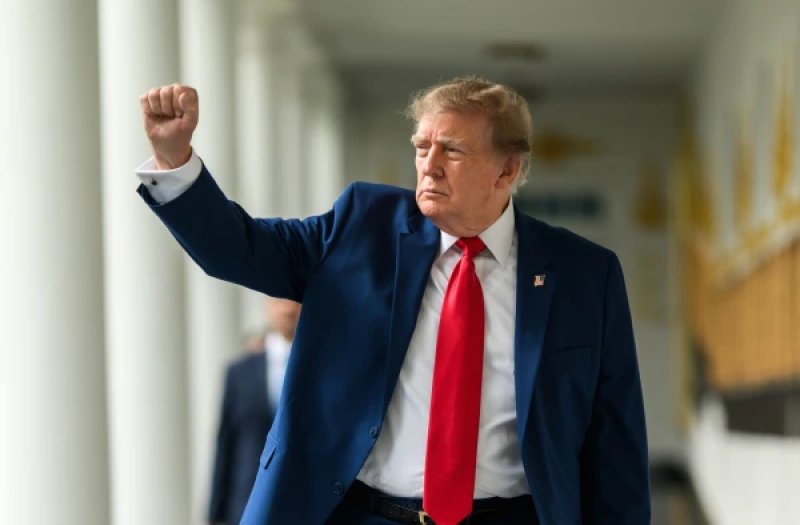
 Foto: BB.LV / Трамп
The results of the midterm elections in the U.S. will limit Donald Trump's capabilities in domestic politics. However, this does not mean that the American president will become weaker. On the contrary, if Congress narrows the space for maneuver domestically, Trump is likely to assert his power even more actively in areas where the head of state traditionally has greater freedom of action — in foreign, trade, and defense policy. Therefore, for Europe, it is possible that the most difficult two years of his second presidential term are just beginning. This opinion was expressed by U.S. expert Josef Braml. For Europe, it is possible that the most difficult two years of Trump's second term are just beginning. The midterm elections are primarily a summation of the domestic political course. Even before the counting of votes was completed, it became clear that there was a significant advantage for the Democrats in both chambers of Congress. For Trump, this is more than a defeat for his party. These elections became a referendum on his second term, the rising cost of living, the consequences of his trade policy, and, not least, the consequences of the war with Iran. ## ## From Congress to the Global Stage A Democrat-controlled Congress is capable of blocking legislative initiatives, influencing budget allocations, creating investigative committees, and inundating the government with subpoenas for testimony. Moreover, the Senate, where the majority belongs to the Democrats, can deal a serious blow to Trump's personnel policy. The period of virtually unimpeded power execution by Republicans has come to an end. And this is where the problem lies for Europe. The American system of checks and balances restricts the president in domestic politics much more than in foreign policy. Therefore, when faced with insurmountable obstacles at home, Trump gains an additional political incentive to shift his activity to the area where he can still demonstrate dominance. This approach aligns well with his narcissistic leadership style. Trump is not inclined to perceive limitations as a natural part of institutional separation of powers. He translates defeats into the realm of personal relationships, shifts responsibility onto others, and seeks to demonstrate strength. Foreign policy is an ideal platform for this: the president has significant freedom of action here, international crises invariably attract maximum attention, and real or perceived successes can easily be presented as the result of his own will. This does not mean that Trump will necessarily unleash a new war. However, Europe should be prepared for the fact that a president whose position at home has weakened will compensate for this with even more demonstrative displays of strength on the international stage. ## ## Tariff Weapons Primarily Hit Europe This primarily concerns economic policy. Trump perceives tariffs mainly not as an economic tool but as a means of political pressure. Europe has already felt this firsthand. After the trade agreement with the EU, a ceiling of 15% tariffs applies to most European exports to the U.S. At the same time, significant additional charges remain — for example, on steel and aluminum. The example of Audi is telling. At one time, Trump raised tariffs on European passenger and commercial vehicles to 25% and openly linked his policy to a demand for companies: to avoid paying tariffs, they should organize production in the U.S. As a result, Audi announced investments of about four billion dollars in building a plant in the U.S. Shortly before the midterm elections, Audi AG CEO Gernot Döllner even appeared with Trump at a campaign event in Georgia. Thus, Trump's geo-economic strategy becomes evident: the choice of production location is determined not by free trade but by politically created price pressure. German and European companies must relocate capital and jobs to the U.S. After losing the elections, Trump may attempt to strengthen this course, as he presents rigidity in trade policy as proof of his effectiveness. ## ## Ukraine and NATO Become Leverage A similar situation is observed regarding NATO. Trump has repeatedly publicly questioned American support for this alliance. His position on Greenland, moreover, vividly demonstrates how far his purely pragmatic, "commercial" approach to foreign policy extends. Last summer, at the NATO summit, he again spoke about the necessity of American control over Greenland — a territory belonging to Denmark, a NATO ally. This is by no means a secondary issue. It reveals a fundamental difference in understanding the essence of the alliance. Europe ideally sees NATO as a community united by common values and interests and security. Trump, on the other hand, perceives alliances as a kind of commercial transactions: who pays what, who gets what, and what benefits the United States derives from it. ## ## Iran: A Dangerous Bet on Escalation In the case of Iran, the risk is even higher. Trump sought to limit the conflict. However, more than six months after it began, sustainable resolution has not been achieved. Moreover, Iran has clearly demonstrated how vulnerable the global economy is due to problems in the Strait of Hormuz. As a result, a dangerous situation is developing. A president weakened by domestic political problems may attempt to compensate for this by demonstrating strength on the international stage. To assert that Trump will necessarily escalate the conflict for this reason would be irresponsible. However, his political incentive for demonstrative toughness may not necessarily diminish just because his party is losing in the midterm elections. And Europe would have to pay for this: through rising energy prices, new waves of refugees, additional military commitments, and further weakening of international non-proliferation regimes.
