

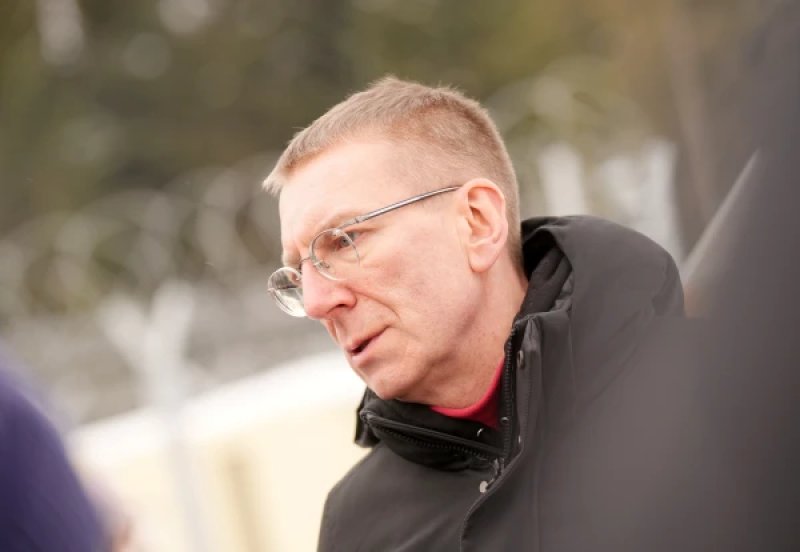
 Foto: BB.LV / Ринкевич
According to the president, negotiations with the factions of the Saeima regarding the government program and upcoming work will begin after the official nomination of Andris Kulbergs as prime minister. It will then become clear which parties can cooperate and what they will agree upon. These agreements will also be reflected in the budget. Rinkēvičs reported that Kulbergs has familiarized him with the budget forecasts. In the president's assessment, the situation with next year's budget is not so "tragic"; however, difficulties are expected in the next four years. He acknowledged the validity of the demands from various sectors and groups in society, including the need to support cancer patients and raise salaries for healthcare and cultural workers. However, it will not be possible to meet all the demands, and the parties will have to recognize that the state cannot afford to launch many new programs. "I think that at some point, almost every political force will come to the realization that it is impossible to implement everything, and even if we were to dismiss all state management three times, those millions are not there," Rinkēvičs said. According to him, the resolution of some issues also depends on negotiations regarding the multiannual budget of the European Union (EU). Among them, the president mentioned the railway project "Rail Baltica," which requires significant funding. Rinkēvičs assesses the prospects of negotiations on the EU budget realistically: many donor countries are not ready to increase contributions, so discussions are currently focused on the EU's own revenues, including the possibility of introducing pan-European taxes. At the same time, the president noted that "everyone wants everything," including Latvia. Speaking about the formation of the government, Rinkēvičs noted Kulbergs' determination to work. In the last elections, the "United List" received 41 parliamentary mandates, so it will require relatively little additional support to create a parliamentary majority. In the president's opinion, the choice between a broad and narrow coalition depends on the upcoming tasks. A broad coalition may complicate decision-making, while a narrow one may face difficulties with the work of the Saeima committees. "A minority government has full responsibility, but there must also be opportunities for maneuvering. Any model is good, but this should be decided by the prime minister and the political force he leads," Rinkēvičs said. Commenting on the possible influence on the new government of the leader of the "Latvia First" party, Ainars Šlesers, the president stated that he does not draw "red lines" between parties. He reminded that during negotiations with political forces in early October, he outlined important principles for himself: support for Ukraine, security, foreign policy and defense, adherence to human rights standards and democratic principles. As long as the parties are willing to discuss these issues from a state perspective, the president does not intend to exclude anyone from the negotiations. Rinkēvičs still hopes that the government will be formed before the state holidays, although this depends not only on the prime ministerial candidate. Speaking about economic development and the state's opportunities to increase revenues, as mentioned by Kulbergs, the president noted that discussions are currently focused mainly on residence permits. In his opinion, it is also necessary to consider the possibility of changing tax policy so that municipalities have an incentive to attract entrepreneurs. Earlier, it was reported that on Wednesday, the president tasked Andris Kulbergs, the candidate for prime minister, with forming the government.
