

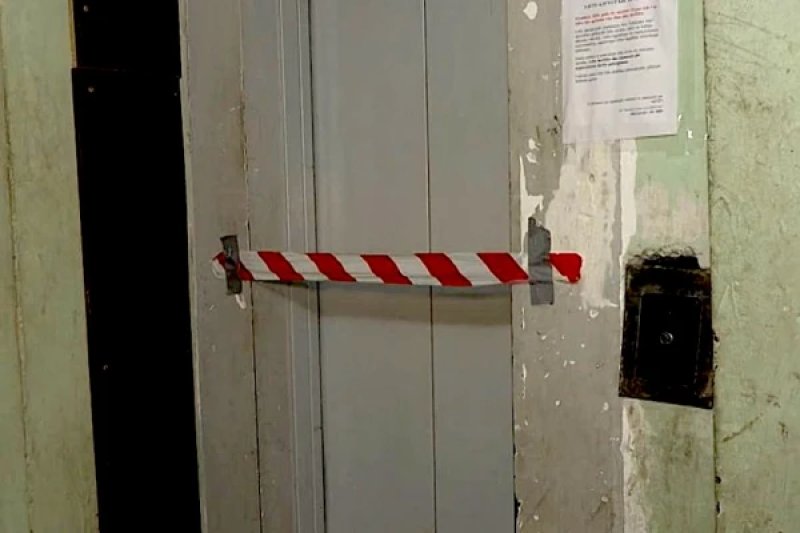
 Foto: BB.LV / двери лифта
The situation is reported by the program "News 360TV," which cites [nra.lv](https://nra.lv/latvija/533704-daudzas-latvijas-majas-esosie-baltkrievijas-razojuma-lifti-ir-bistami.htm). ### Elevators turned off in two nine-story buildings The first to feel the consequences of the elevator safety inspection were the residents of Iecava. After a warning from the supervisory authorities, the managing company Bauskas novada komunālserviss decided to stop the equipment in both nine-story buildings in the city. Now, residents of the upper floors have to climb up to 162 steps on foot every day. This is especially difficult for elderly people, residents with limited mobility, and parents with small children. At the same time, the elevators in these buildings cannot be called very old. They were replaced in 2013, and the work was paid for by the apartment owners themselves. However, the equipment was produced at the Belarusian plant "Mogilevliftmash," which has now raised concerns among supervisory authorities. ### The manager fears for people's lives Bauskas novada komunālserviss explains the elevator shutdown for safety reasons. According to company representative Anita Cehanovich, the manager is not ready to risk the health and lives of residents until a conclusion is received from specialists. > "As managers, we have decided that these elevators should be turned off to avoid endangering people's lives. Whether there are indeed discrepancies and how many there are, we cannot comment on right now — a specialist will come and provide a conclusion," she said. Thus, the equipment was stopped even before the technical expertise determined the nature and scale of possible violations in the specific elevators. ### CPPC: elevators were not required to be turned off However, the position of the Consumer Rights Protection Center (CPPC) differs from the decision of the managing company. The agency emphasizes that the identified discrepancies do not automatically mean a ban on the operation of all affected elevators. CPPC representative Sanita Gertmane explained that the supervisory authority provided for the possibility of further use of the equipment, provided that additional control and risk mitigation measures are implemented. > "We chose the least harsh solution for residents and effectively allow the continued operation of the elevators. The manager can additionally ensure the elimination of risks," she stated. This means that the state supervisory authority allows continued operation, while the manager prefers to completely stop the equipment until the circumstances are clarified. For residents, this difference in approaches means the need to climb stairs daily. ### About 70 elevators across Latvia are in question The problem is not limited to two buildings in Iecava. According to the CPPC, there are about 70 elevators produced by "Mogilevliftmash" in Latvia that have been found to be non-compliant with safety requirements. A significant portion of such equipment is installed in nine-story residential buildings in Riga and Daugavpils. This means that the decisions of managing companies may affect residents of other apartment buildings. However, there is currently no talk of a mass shutdown of elevators in Latvia. The supervisory authority does not require their immediate mandatory shutdown, and further actions will depend on the assessment of the technical condition of the equipment and the decisions of the managers. ### Will elevators in Riga and Daugavpils be turned off? The main question now is whether other housing managements will follow the example of Iecava. On one hand, managers are obliged to ensure the safety of the equipment and may prefer to stop it to eliminate possible risks. On the other hand, turning off the elevators creates serious difficulties for residents of multi-story buildings, especially those who cannot physically use the stairs on their own. Final clarity should come from technical expertise, which will determine what specific discrepancies exist in the particular elevators and what measures are necessary for their safe operation. For now, the situation in Iecava shows that even in the absence of a direct ban from the state, managers may decide to stop the equipment.
