

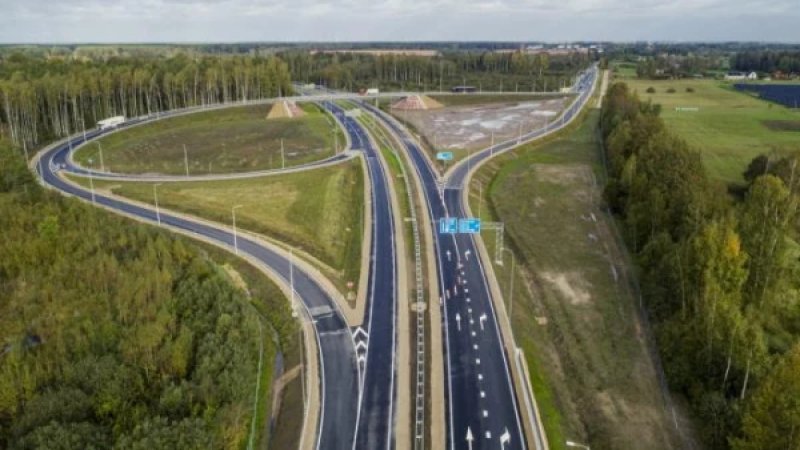
 Foto: BB.LV / окружная дорога
Plans for the construction of a highway in southern Latvia, which will connect the Bauska bypass road with the Lithuanian border, have elicited mixed reactions from local residents. More than a hundred people gathered at a public discussion in Ceraukste. While many acknowledge the need to improve transportation infrastructure, the proposed route options raise concerns among property owners and farmers, reports LSM. Particularly contentious were issues of land expropriation, access to agricultural land, and the location of new road interchanges. ### Two options for the new road: through Ceraukste or bypassing it Currently, two possible options for the construction of a section over 14 kilometers long are being considered. The first option is along the existing A7. The new road will largely follow the current route of the A7 highway from the Bauska bypass road to the Lithuanian border. The second option is to bypass Ceraukste. The route will go around the settlement and then reconnect with the existing A7 route, continuing towards Lithuania. These options were presented by Maris Labsvirs, head of the project department at Madaberi. The project includes the construction of parallel access roads and two-level interchanges. However, the organization of access to private properties and agricultural plots has become one of the main topics of discussion. ### "Two-thirds of the land will disappear, and the houses will remain between the interchanges" Some residents fear that the construction of new infrastructure will require significant land expropriation. One participant in the discussion emotionally described the potential consequences for his farm: > "Two-thirds of the agricultural land will disappear, and the houses will remain between these 'roundabouts' in the middle. What walls will you build? Chinese ones?" Farmers from the Ceraukste and Brunava parishes are particularly concerned about maintaining convenient access to their fields. They argue that the design must consider not only the movement of cars and trucks but also the needs of agricultural machinery. ### Will combines and tractors be able to drive on the new roads? Farmer Gintautas Tarvidas from the Brunava parish pointed out the quality of the future parallel roads. > "These parallel roads must be of sufficient quality for the movement of large machinery — with heavy loads, combines, tractors," he explained. For agricultural enterprises, the width of the roadway, maneuverability, and the preservation of convenient routes between fields are crucial. If the new highway limits existing exits, farmers will have to use specially designated access roads and interchanges. Therefore, their location and technical specifications are of fundamental importance for local farms. ### Residents fear losing green space near their homes The potential proximity of the road to residential buildings raises just as many questions. Local resident Liga Spale emphasized that people are not against infrastructure development per se. > "We are not against infrastructure development, the construction of the road, but we are really concerned about the location of this road because it will stretch into our green zone, towards the apartment building," she said. Residents fear that the new highway will alter their familiar living environment and reduce green spaces near their homes. ### Will residential houses have to be demolished? Questions about the possible expropriation of residential properties were also raised at the public discussion. However, Evija Skrastin, a consultant from the Estonian, Latvian & Lithuanian Environment agency, assured that no residential houses are planned to be expropriated. At the same time, the issue of expropriating individual plots of land and organizing access to them remains one of the main subjects of discussion. The final route option has not yet been selected.
