

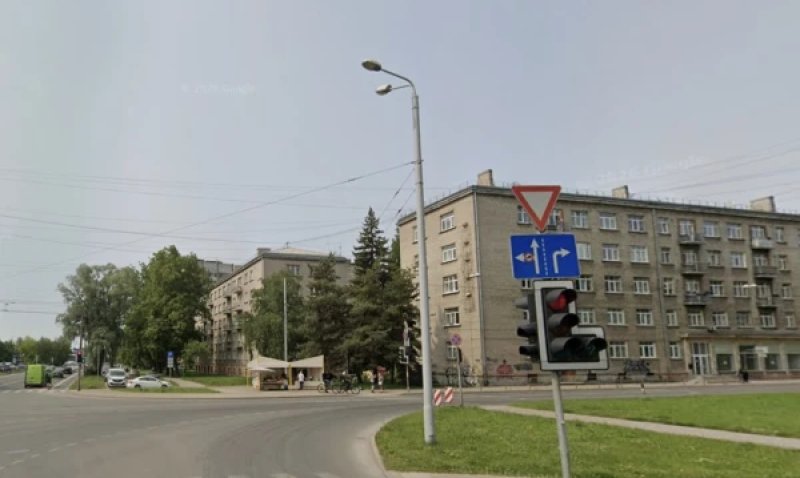
 Foto: BB.LV / перекресток
However, the host of the program [TV3](https://tv3.lv/zinas/latvija/satiksme/masinas-dzen-ara-no-centra-bet-kur-tam-braukt-zebra-apluko-rigas-attistibas-planu/) Zebra, Pauls Timrots, points out a contradiction: cars are being pushed out of the city center even before full detour options are created. He believes that the changes on Zirņu Street particularly illustrate this problem. ### The Street Intended for Bypassing the Center is Already Being Altered One example of controversial changes is Zirņu Street, which was considered part of the transport route around the center in Riga's development plans. However, the traffic organization on this street is changing in such a way that it becomes more difficult for cars to pass through. At the intersection of Zirņu Street and Krišjāņa Valdemāra Street, one lane is designated for turning right, while the other is for going straight and turning left. According to observations from the Zebra program, this scheme creates conditions for traffic jams: if one driver stops waiting for an opportunity to turn left, it delays the entire flow of cars behind them. A similar situation has developed on another section of Zirņu Street, closer to Skantes Street. There, part of the space previously available for cars has been allocated for a bike lane and parking spaces. As a result, the throughput of the street, which was supposed to help drivers bypass the center, raises questions. ### "First, a Bypass Needs to Be Created, and Then Cars Should Be Displaced" Pauls Timrots believes that the main problem lies not so much in the changes themselves but in the sequence of their implementation. According to him, the city development documents provide a certain logic for transforming the transport system. > "If we want to develop the city, it is important in what sequence we do everything, and this is described in the plan," notes the host of Zebra. He points out that restrictions for drivers are being introduced already, even though the necessary transport infrastructure has not yet been created. > "Right now, we see that cars are being pushed out of the center in various ways — by installing flowerbeds, eliminating parking spaces, narrowing the roadway. But the development plan states that only after creating this crossing over the Daugava can cars be pushed out of the center," emphasizes Timrots. Thus, in his assessment, the city is effectively acting in reverse order: first restricting traffic, and only then should it provide alternative routes. ### Priority for Pedestrians and Cyclists, Additional Difficulties for Drivers The development of pedestrian and cycling infrastructure occupies an important place in Riga's transport policy. New bike lanes, green zones, and landscaping elements are appearing on the streets. At the same time, the space designated for cars is being reduced. However, as noted in the Zebra program, the need to move around the city by car does not disappear. Cars are still used for longer trips, and changes on individual streets can affect traffic in the broader urban transport network. According to Timrots, it is especially important to consider this when transforming streets that are supposed to serve as bypass routes. ### Where Will Cars Go if the Center Becomes Less Accessible? The host of Zebra does not dispute the idea of creating a more convenient urban environment for pedestrians and cyclists, but raises the question of how car flows will be organized. According to his observations, some Riga streets increasingly resemble well-maintained courtyard areas with greenery, flowerbeds, and limited traffic. But if such changes affect important transport routes, the question arises as to where to redirect cars. Timrots believes that the city's development requires a coordinated approach: restrictions on traffic in the center should be accompanied by the creation of real alternatives for drivers. For now, according to the Zebra program's assessment, Riga is reducing the opportunities for passage on existing streets without providing the planned infrastructure for bypassing the center.
