

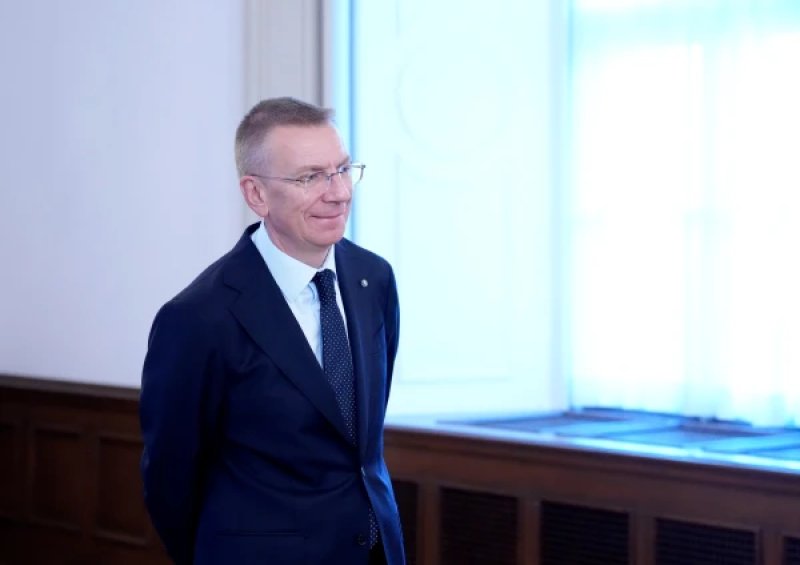
 Foto: BB.LV / Ринкевич
### Europe Risks Falling Behind the Rest of the World According to Rinkevics, after the end of the Cold War, there was a sense in Europe that the previous threats were behind, and further development would be relatively stable and predictable. However, historical events of recent decades have shown that these expectations have not been met. The president believes that Europe must recognize not only the changing security situation but also its own lag in key areas. In his assessment, the "old world," especially European countries, is rapidly losing ground to Asia and the United States in economic and technological development. In a positive sense, Europe is becoming a kind of "cultural and historical reserve," preserving its rich heritage. However, the downside of this process is the insufficient pace of technological, defense, and economic development. Rinkevics emphasized that real actions, not just statements at international meetings, are necessary to change the situation. ### The Collapse of the USSR Did Not Conclude Historical Processes The president also referred to the events of the early 1990s. According to him, the collapse of the Soviet Union effectively meant the disintegration of the empire, but this process stopped at a certain point. Even then, signs appeared that the consequences of the USSR's collapse would be much more complex than had been imagined against the backdrop of the end of the Cold War. As examples, Rinkevics mentioned events in Transnistria and Moldova, as well as conflicts in South Ossetia, Abkhazia, and Georgia. At the same time, the president warned against directly comparing the current international situation with the end of the 1930s and the 1940s. In his opinion, history does indeed repeat certain elements of the past, but at the same time creates new circumstances that cannot be explained solely by historical analogies. ### Latvia Made the Right Choice by Joining the EU and NATO Speaking about Latvia's situation after regaining independence, Rinkevics noted that the country was effectively living "like Christ in the bosom," focusing on integration into the European Union and NATO. The president called joining both organizations an absolutely correct decision. He suggested contemplating what position Latvia would be in today if it had remained outside the EU and the North Atlantic Alliance for any reason. At the same time, Rinkevics believes it is necessary to openly discuss collective security issues, including the practical application of Article 5 of the NATO treaty. According to him, it is important to understand under what circumstances the collective defense mechanism will be activated and what the allies' response will be. ### Mere Declarations Are No Longer Enough The main conclusion of the president is that Europe can no longer rely on the notions of security and stability that were formed after the end of the Cold War. In Rinkevics's opinion, to maintain their positions, European countries need to strengthen defense, develop the economy, and invest in technology. Political declarations and "nice summits," the president believes, can no longer replace concrete decisions. Thus, according to his assessment, Europe faces the task not only of adapting to the changed international situation but also of overcoming the growing lag behind other global centers of economic and technological development.
