

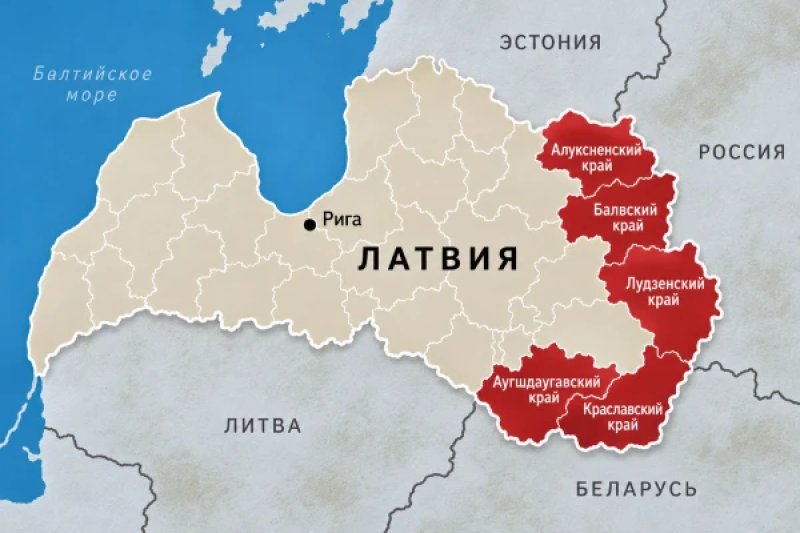
 Foto: BB.LV / карта Латвии
Five municipalities in the eastern border area of Latvia intend to unite their efforts to draw greater attention from the government to the problems of territories directly located at the borders with Russia and Belarus. According to LSM, this concerns the Alūksne, Augšdaugava, Balvi, Krāslava, and Ludza regions. It is along these five municipalities that the eastern border of the country runs, with a length of 284 kilometers with Russia and 173 kilometers with Belarus. Local authorities believe that their territories face specific challenges related not only to economic development but also to ensuring national security. ### Expected special support, but received a law for 15 municipalities One of the main reasons for creating the association was disappointment with the law on the development of eastern territories of Latvia. The border municipalities hoped that the document would provide special support measures specifically for the five regions directly adjacent to the state border. However, in the end, the law's scope was extended to a broader region, including 15 municipalities. At the same time, the special role of the five border regions in strengthening the country's security, in the opinion of their leaders, was not sufficiently reflected. > "We hoped that this law would be a continuation of the law on counter-mobility and would provide certain benefits for the five eastern border municipalities. Unfortunately, we did not see this in the law," said Vitalijs Aizbalts, chairman of the Augšdaugava Regional Council. ### "We want our problems to be heard too" According to Aizbalts, the interests of border territories often remain overshadowed by the problems of the capital and its surroundings. In particular, when discussing the financial equalization of municipalities, the main focus, according to his observations, is on Riga and its suburbs. > "Recently, when discussing the municipal financial equalization fund, we hear more about the problems of Riga and its suburbs. We want the opinions, problems, and needs of our five municipalities to be heard and addressed as well," he emphasized. The creation of the association should help the five regions to present a unified position in negotiations with government institutions. ### Drones, defense facilities, and economic lag The chairman of the Alūksne Regional Council, Dzintars Adlers, points out that border territories have to simultaneously address issues of security and economic development. Among the specific problems, he mentions drone incursions and land expropriation deals in the interests of the Ministry of Defense. However, economic inequality between the eastern territories and the capital remains a serious problem. > "The most important thing is that there is a huge regional imbalance between the major cities of the eastern border area and the capital. The indicators of wages and GDP produced in our territories differ significantly," said Adlers. In the opinion of the leaders of border municipalities, these differences need to be taken into account when developing state policies to support regions. ### How will the new association work? In the newly created association, all five municipalities will have equal rights in decision-making. It is expected that joint work will allow for aligning positions on issues of security, funding, and regional development, as well as more effectively representing the interests of residents in the eastern border area. However, the association has not yet begun official activities. For its creation, the corresponding decision must be approved by the councils of all five regions — Alūksne, Augšdaugava, Balvi, Krāslava, and Ludza. Only after that can the association begin its official work.
