

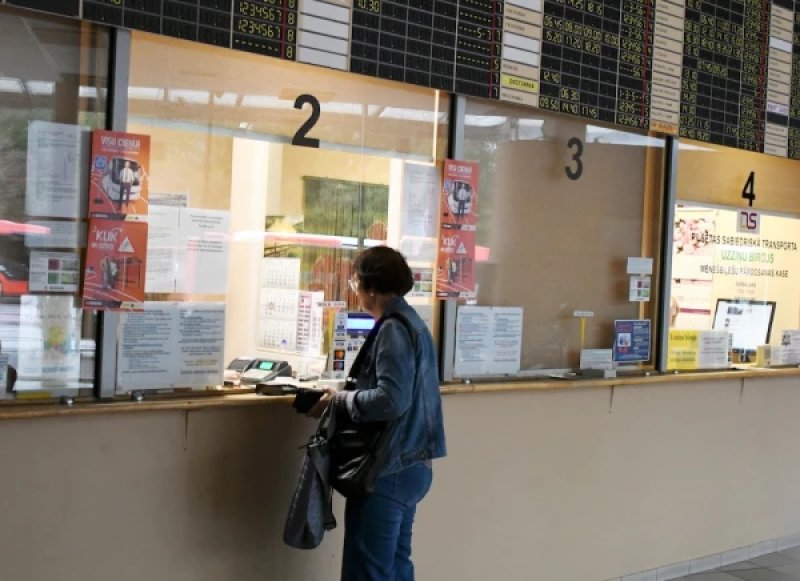
 Foto: BB.LV / человек у билетной кассы автовокзала
In Latvia, several options for financing public transport for 2027–2030 are being considered, as previously reported by [BB.lv](https://bb.lv/statja/politika/2026/11/02/cto-budet-s-avtobusami-i-poezdami-posle-2027-goda-vlasti-latvii-rassmatrivaiut-tri-varianta). The Ministry of Transport considers the allocation of an additional 15 million euros annually from the state budget to be the most preferable option. This would allow for the preservation of the current benefits system and the existing transport network. However, even with such a decision, the average ticket price for public transport is proposed to increase by 10%, reports the LETA agency. The ministry emphasizes that in 2027, there are no plans to abolish travel benefits. At the same time, in the context of funding shortages, the possibility of changing their size is being considered. ### Three options: from reducing routes to additional funding The Ministry of Transport has prepared an informational report on financing public transport for 2027–2030. The document is currently being coordinated with other institutions, after which it will be reviewed by the government. Three scenarios are proposed. | Option | What will change | | ----------------------------- | ------------------------------------------------------------------------------------------------------------------------------- | | 1. Without additional funds | Significant reduction of regional bus and railway services, substantial fare increases, and changes to benefits | | 2. Revision of benefits | Preservation of the route network, average fare increase of 10%, limitation of state compensation to 70% of the fare cost | | 3. Additional 15 million euros | Preservation of routes and existing benefits, average fare increase of 10% | The ministry considers the third option to be the most preferable, as it will affect passengers the least. However, its implementation depends on whether additional funds can be found in the state budget. ### What will happen to benefits if 15 million euros are not found? In that case, the Ministry of Transport considers the second scenario to be practically feasible: to preserve routes, increase fare prices by an average of 10%, and revise the benefits system. It is proposed to set the maximum level of state compensation at 70% of the fare cost. This means that a passenger who receives a 70% benefit will pay the remaining 30% themselves. Deputy State Secretary of the Ministry of Transport Kaspars Berzins emphasizes that this does not mean an automatic reduction in benefits. Possible changes will be discussed jointly with the Ministry of Welfare, the Ministry of Education and Science, and the Ministry of Smart Governance and Regional Development. Particular attention will be paid to socially vulnerable groups to minimize the impact of possible changes. ### How much will passengers pay with a 70% benefit? The ministry provided examples of travel costs if the state compensates 70% of the ticket price. | Route or mode of transport | Full cost | With 70% benefit | | -------------------------------------------------------- | ---------------- | ------------- | | Public transport in state cities | 0.70–1.80 € | 0.21–0.54 € | | Buses in the Riga region | 1.50–2.80 € | 0.45–0.84 € | | Bus Riga — Rezekne | 11.90 € | 3.57 € | | Train, zones A–D | 3.30 € | 0.99 € | | Train Riga — Daugavpils | 8.90 € | 2.67 € | | Train Riga — Liepaja | 9.10 € | 2.73 € | Calculations by the Ministry of Transport for the scenario with a 70% compensation. These are not approved new rates and not necessarily the prices after the proposed 10% fare increase. Thus, even with a revision of benefits, the state will continue to cover a significant portion of the travel costs for passengers entitled to such support. ### Without additional funding, nearly 800 bus routes may be canceled The ministry warns that the most stringent scenario — maintaining funding at existing levels — will lead to a significant reduction in transport services. According to the agency's calculations, a funding shortfall may necessitate the cancellation of about 794 bus routes. As a result, passenger traffic may decrease by more than three million trips per year. Such changes will particularly affect residents of regions, the elderly, schoolchildren, and those without their own vehicles. Minister of Transport Rihards Kozlovskis considers changing benefits for certain groups of the population to be a last resort. In his opinion, it is necessary to find a solution that will maintain the accessibility of public transport and prevent significant reductions in routes. ### Why is public transport underfunded? The main problem is rising transport costs with virtually unchanged base funding. According to the Ministry of Transport, from 2024, the base funding for public transport from the state budget remains at 93.8 million euros. Meanwhile, in 2026, transport provision costs are projected to be around 109.9 million euros. Base funding covers about 85% of projected costs. Costs are rising due to increased wages, fuel price hikes, energy resources, and other expenses. In recent years, the state has had to provide additional funding for the sector from contingency funds. Kozlovskis believes that continuing such a practice is unacceptable. ### Almost every third euro of state subsidies goes to benefits In 2025, the state allocated 26.2 million euros for compensating discounted travel. This accounted for almost 28% of the total public transport funding. In other words, nearly every third euro of state support for transport was used to compensate benefits for certain categories of passengers. The Ministry of Transport emphasizes that the goal of possible changes is not to abandon assistance to socially vulnerable residents but to find a sustainable funding model for the entire transport system. ### What else is planned for change? At the same time, the ministry intends to increase the efficiency of public transport. Among the planned measures are the digitalization of transport, development of cashless payments, implementation of a unified ticketing system, and more accurate accounting of passenger traffic. There will also be closer integration of bus and rail services, coordination of school transport, and a review of bus station operations. The agency hopes that these measures will increase revenue, improve service quality, and utilize state funds more effectively. The final decision on public transport financing and possible revision of benefits will be made by the next government, taking into account the possibilities of the state budget.
