

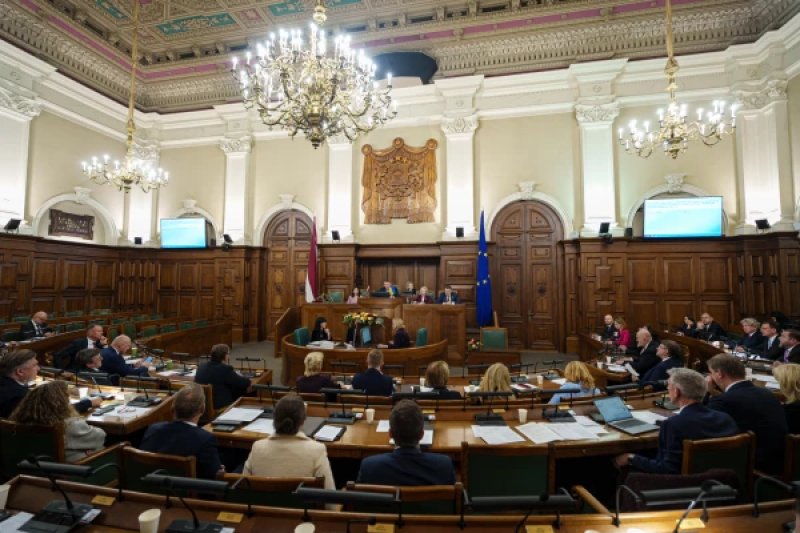
 Foto: BB.LV / Пленарное заседание Сейма
This week, the 15th Saeima began its work. Each of the 100 deputies took an oath (a solemn promise), after which the deputies assumed their rights and the powers of the entire parliament were confirmed. Then, the full composition of the presidium of the Saeima was elected, and the new speaker of parliament, Edvards Smiltens, along with colleagues, initiated an extraordinary meeting with one agenda item - "On the refusal to create parliamentary cooperation groups with the parliaments of the Russian Federation and the Republic of Belarus." Vice-Speaker of the Saeima Inara Murniece (National Alliance) explained: "First of all, in this draft resolution, we refer to the statements adopted by the 14th Saeima, which were adopted here, in this meeting hall, by a convincing majority of votes... And I will say again — a similar draft resolution on the refusal to create cooperation groups with the mentioned pseudo-parliaments was also adopted by the 14th Saeima. This means we would continue this, I would say, geopolitical course of Latvia. About the main things, as I promised. We are a parliament elected during a war, and probably the issues we will be working on will be closely related to security, economic development, defense, and foreign affairs, our geopolitical course, with questions of how we can feel secure, how to protect Latvia, and how to safeguard our residents. Today, the president, welcoming us at the first meeting of the Saeima, stated very clearly: Russia is a threat to Euro-Atlantic security. NATO documents also state clearly: Russia is a threat. We have understood that Russia in this war with Ukraine is an aggressor country, and Belarus is a country that allows this Russian aggression to be carried out (condones it). This formulation, which I believe is very accurate, was found by the Ministry of Foreign Affairs of Latvia. Thank you to our diplomats for their precise and clear language," the vice-speaker stated in particular. The deputy from "Sovereign Power - Young Latvians" Rudolf Bremanis expressed doubts about the necessity of such a decision and its legal validity. "It seemed to me that this was already a criminally punishable activity — trying to form such groups ... well, to make contact with these two countries. It turns out, no. So you are upset that someone might try? We really did not plan to create such a group ... or even two. And now it turns out that ... this is agreed with strategic partners, for example, the Americans, who are now meeting with Russia, Ukraine ... America ... in trilateral negotiations, for example. The Scandinavians were making phone calls ... the Prime Minister, the President ... of Finland, Norway ... respectively, with Russian officials. Okay, that’s one point, but there’s also a legal aspect. This is a draft resolution, and the Regulations are still above — like a law, aren’t they? It turns out that this has only an advisory nature. If someone wants, they can create these groups, just not communicate. As soon as someone starts communicating ... I don’t know, with representatives of Russia ... then automatically it’s a criminal case. On the one hand, this is probably to protect us ... from such attempts and not to undertake them ... if someone wanted. We really did not plan ... if you were upset about this. Why do anything like that at all? It turns out to mislead new deputies ... those who do not know. The Regulations are above. You can calmly form, just not meet ... I don’t know ... fly to Istanbul or Abu Dhabi ... to meet with them... But I was legally advised ... this has no legal force. If one wanted, one could only get a criminal case for contacting representatives of these two countries. And that would already be a different matter," said R. Bremanis. In response, the speaker of the Saeima, Edvards Smiltens, explained that the resolutions adopted by the parliament - including this one - are mandatory for all deputies, and therefore parliamentary groups with these two countries cannot be created. In the end, the resolution was voted for by deputies of the United List, the National Alliance, "New Unity", "Latvia First" and "Progressives", while deputies of "Sovereign Power - Young Latvians" voted against. When the parliament will gather for the next meeting is still unknown, but it is planned to approve the compositions of the committees.
