

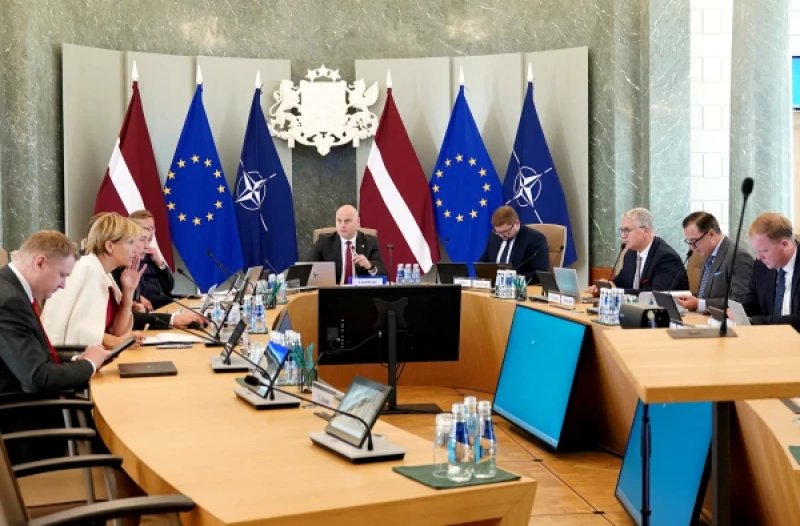
 Foto: BB.LV / Заседание правительства ЛР
According to the LETA agency, the relevant information report on the implementation of the government plan was reviewed by the Cabinet of Ministers. According to the document, out of 185 activities, 132 are considered completed, 50 are still being implemented, and three have not even been started yet. ## The Plan Had to Be Reduced Due to Lack of Funds Initially, the government program included 215 activities. However, in July, their number was reduced to 150. Finance Minister Maris Kucinskis then acknowledged that it was impossible to complete all 215 items within the existing budget. Prime Minister Andris Kulbergs explained that the updated plan retained 61 priority areas, of which 17 require significant financial investments. Another 30 activities were excluded as insignificant, and 35 were classified as additional tasks, the implementation of which depends on the availability of funding. At the same time, ministers were allowed to continue working on these 35 initiatives if the necessary funds could be found. ## Three Promises Have Not Yet Been Started By mid-October, the government had not begun implementing three activities. The first concerns support for energy-intensive enterprises. The Ministry of Economics was supposed to propose a mechanism for concluding long-term contracts for electricity supply at a rate 30% lower than the short-term market price. However, the initiative did not receive support, as a conducted study did not confirm its effectiveness. The second unfinished activity is related to free meals for fifth-graders. The government intended to ensure the necessary funding in the current school year if additional funds were allocated. The third concerns the implementation of the salary payment schedule for educators. Both education-related issues are expected to be addressed during the preparation of the state budget for 2027 and the budget plans for the following three years. ## Another 50 Activities Are in Progress Among the unfinished tasks are the implementation of European regulations on electronic evidence, the documentation for the establishment of the Bank of Defense, Security, and Resilience, as well as providing state guarantees to border guards for obtaining bank loans for a down payment when purchasing or building housing. At the same time, the State Chancellery reports that out of 61 priority activities, 52 were completed by mid-October. ## What the Government Recorded as Achievements The State Chancellery emphasizes that special attention was paid to defense, internal security, and the protection of critical infrastructure. The construction of infrastructure at Latvia's external border continued, and the capabilities for the use of drones and countering them were developed. Cooperation with NATO allies and Ukraine was strengthened, including within the framework of the Drone Deal agreement. A unified mechanism for compensating direct damage caused by military incidents was also created. Among the achievements, the government cites the preparation of a digital voting platform for the elections to the 15th Saeima, improvements in the oversight of state investments, and a reduction in administrative burdens. In the construction sector, amendments were adopted allowing projects to be implemented in phases, starting with the so-called zero cycle. In healthcare, decisions were made to reorganize the hospital network and improve access to medical care in the regions. In the social sphere, support for housing benefit recipients was expanded during the heating season, and a new funding model for educators' salaries, "Program in School," was introduced in education. ## Kulbergs: People Expect Results, Not Promises Prime Minister Andris Kulbergs believes that the results of the government's work should be assessed based on specific decisions. According to him, behind the statistics are measures to strengthen national security, reduce bureaucracy, improve the business environment, and enhance the well-being of the population. At the same time, the Prime Minister acknowledges that some reforms require more time, political decisions, and additional funds. He emphasizes that a change of government should not mean the cessation of work already begun. "Residents expect not new promises from the government, but real actions and changes that can be felt in everyday life," Kulbergs stated. It should be noted that Andris Kulbergs took over the government after the resignation of Evika Silina. The Saeima approved him as Prime Minister on May 28, 2026. The ruling coalition includes the "United List," "New Unity," the National Alliance, and the Union of Greens and Farmers.
