

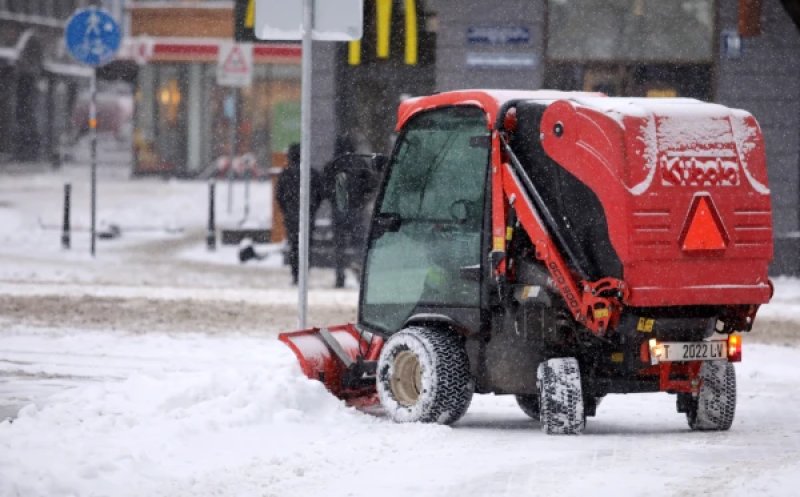
 Foto: BB.LV / Уборка снега
Local authorities note that the volume of work and expenses for winter street maintenance directly depend on weather conditions and the intensity of snowfall. Therefore, actual costs during the season may either increase or decrease. ## 174 Units of Equipment and 115 Workers The centralized maintenance of sidewalks, roadways, bridges, and overpasses adjacent to the streets will be provided by 174 units of equipment. 115 employees will be involved in the work. Both the resources of the Department of Urban Space and Mobility of the Riga Municipality and contractor equipment will be used for cleaning. Street cleaning will be organized in order of priority. First, the main streets served by public transport, as well as bridges and overpasses, will be cleared. Cleaning of bicycle infrastructure is also planned. After that, work will be carried out on less significant streets in urban neighborhoods. A total of 1,645 Riga streets, with a total length of 1,136 kilometers, are planned to be serviced during the winter season. The streets are divided into three maintenance categories, and the execution of work will depend on meteorological conditions and the actual situation on the roadway. ## Who Will Clean the Streets of Riga Winter maintenance of the roadway in different districts of the capital will be provided by the following enterprises: - In the Kurzeme district and Zemgale suburb — the contractor association Roadeks un LAU. - In the Latgale suburb and Central district — the association of companies Eco Baltia vide and CBF Ļ-Ko. - In the Vidzeme suburb and Northern district — the enterprise Vizii Urban. - The cleaning of bridges and overpasses will be provided by the company Rīgas tilti. ## Sidewalks Must Be Cleared at Least One and a Half Meters The Riga Municipality will also centrally ensure mechanized cleaning of sidewalks adjacent to municipal streets this winter. In spring, centralized collection of sand used for spreading on sidewalks during winter will also be organized. According to mandatory municipal regulations, **sidewalks and pedestrian paths must be cleared of snow by at least 50% of their width, but in any case, not less than 1.5 meters.** Snowbanks may be formed at the edges of sidewalks if they do not obstruct pedestrian movement. At the same time, it is prohibited to create snowbanks closer than five meters from pedestrian crossings and intersections. In total, winter cleaning of sidewalks will be provided over a length of 1,056 kilometers. For these works, 42 units of equipment of various sizes adapted to the width of the sidewalks, their features, and the conditions of the historic center of Riga will be used. ## Which Sidewalks Are Maintained by Janitors As before, the maintenance of sidewalks along intra-yard roads will remain the responsibility of the managers of the adjacent territories and their janitors. If necessary, managers can additionally spread material on sidewalks if cleaning is delayed or particularly hazardous weather conditions arise, such as ice. For spreading on sidewalks, a sand-salt mixture is allowed, with a salt concentration not exceeding 20%. ## Parks Will Be Spread Mainly with Gravel The enterprise Rīgas meži is responsible for the capital's parks and squares, which manage about 453 hectares of Riga's parks and gardens, as well as all paths in Mežaparks. During the winter season, the enterprise ensures their maintenance and the spreading of paths, primarily using gravel. In more complex areas, such as on stairs, a mixture of sand and salt will also be used to prevent icing. ## Penalties for Unremoved Snow and Icicles For improper maintenance of adjacent territories, including uncleaned roofs from icicles, the municipality may initiate administrative proceedings and demand the violation be rectified. If necessary, forced execution is also possible: cleaning will be organized by the municipality, and the costs will be recovered from the person responsible for maintaining the respective territory. ## Stops and Parking Lots Are Also Included in the Plan Almost 1,500 public transport stops in Riga will be cleared sequentially, primarily by hand. In addition, cleaning of 6,000 parking spaces managed by Rīgas satiksme is planned. Both manual labor and equipment will be used for this.
