

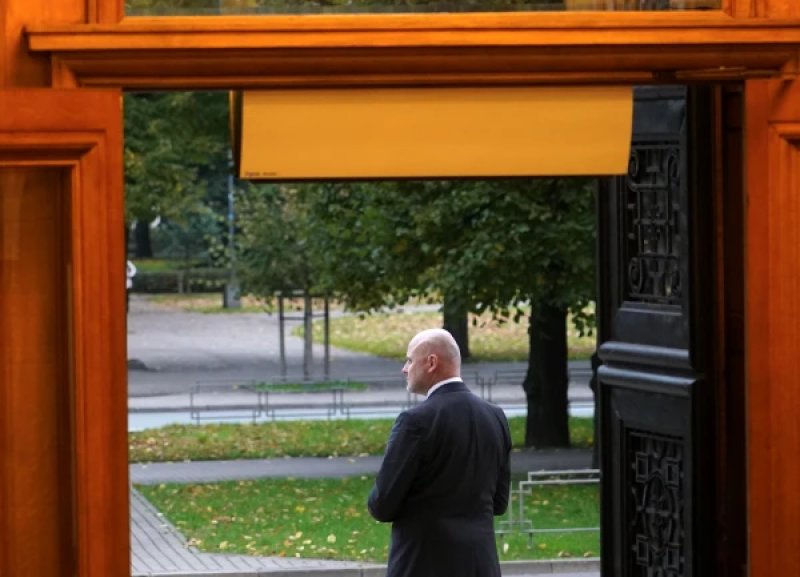
 Foto: BB.LV / Андрис Кулбергс
In response to the question of whether the star hour of the politician from the 'United List' is coming to an end, the expert noted: "That’s what an hour is for, to eventually end." However, Ikstens' further assessment sounded less optimistic: "But I regret that the star, which shone so brightly, is gradually starting to fade." One of the reasons for the current difficulties, the political scientist sees in the fact that Kulbergs is still much better known to voters and colleagues as an opposition figure than as a politician capable of leading the government. Now he must not only criticize the decisions of others but also negotiate with partners and create a functioning coalition. "We got to know Kulbergs best as an opposition member in the Saeima, not as a representative of the ruling coalition. But he has been out of the comfortable opposition seats for some time now. It’s no longer enough to just criticize; he also needs to create something himself," Ikstens explained. In the professor's opinion, Kulbergs currently lacks the political experience for such a complex task. The situation he finds himself in requires entirely different skills, and negotiations are not going as successfully as one might have assumed at the beginning of the process. Another problem may lie within the 'United List' faction itself. Leading a large parliamentary team seems to be a serious advantage, but in practice, reaching an agreement with all its representatives may prove to be challenging. "I am beginning to get the impression that this faction is not as united as it may seem. And perhaps that is why the process is moving so slowly," the political scientist suggested. Recall that after the start of the 15th Saeima, Latvian President Edgars Rinkēvičs tasked Andris Kulbergs with forming a new government. The candidate himself had previously hoped to present a model of the future cabinet by mid-November. Several coalition options are currently being discussed. One involves cooperation between the 'United List' and the National Alliance and 'New Unity', while another suggests a government of two parties, the 'United List' and the National Alliance. A minority cabinet led by Kulbergs, which could rely on support from the 'Latvia First' party, is also being considered.
