

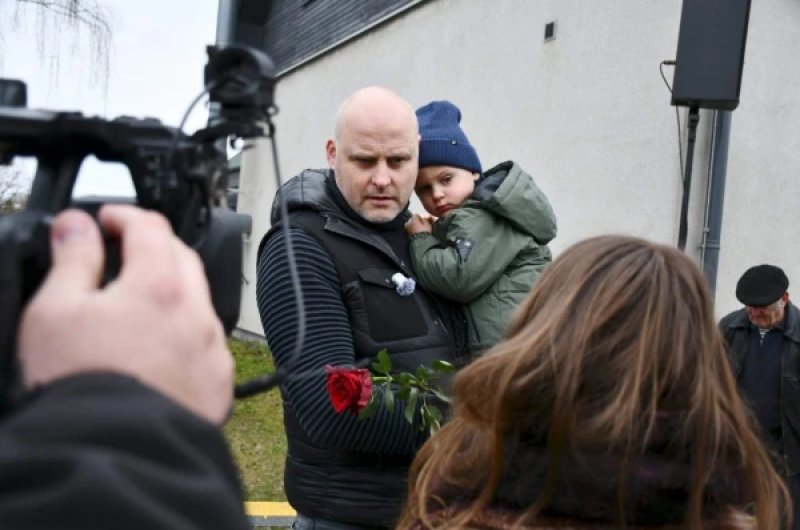
 Foto: BB.LV / Кулбергс с сыном
This time, it was his son that the Prime Minister addressed the protesters with in his arms: some saw it as horrifying, while others viewed it as a normal reaction from a father and were surprised by the abnormal hatred that flooded the internet. "Today is Saturday. Where was he supposed to put that child? Leave him home alone?" asked one commentator. In her opinion, a person in the position of Prime Minister does not stop being a father, and the mere presence of a child next to a parent is not something out of the ordinary. Another commentator sarcastically remarked: "Where else could he put him? On a shelf?" Several people recalled their childhood when parents took their children to work, public events, and even demonstrations. One woman wrote that she herself participated in rallies with her parents in the late eighties and still remembers the events of the Atmoda period. "A child feels good where their parents are," she concluded. Another commentator noted: "He will only be Prime Minister for a few years, but he is a father for life." Others emphasized that children are part of society, and there is no reason to believe that their place is only at home, in kindergarten, or at events specifically designed for children. "The child surely feels much better in the arms of their parent in any situation," wrote one participant in the discussion. Others questioned whether the protest was an appropriate place for a child. The opposing opinion was equally categorical. One commentator called Kulbergs' action "maximally foolish," pointing out that taking a child to work is not bad, but one should assess the nature of the specific event and the child's well-being. Others pointed out that a protest can inherently be an emotional environment — people may shout, boo politicians, express anger and dissatisfaction. Therefore, the question arose whether a small child should be on stage at the moment when the crowd reacts sharply to their father. "Here, the child rather looks like a PR tool," one commentator expressed. Others suggested that the child's appearance before the public could be a conscious "humanization" of the politician's image — an attempt to present the official not only as a head of government but also as a family person. There is no public evidence that the child's presence was a pre-planned public relations tactic. Also, one photograph cannot lead to conclusions about the child's well-being, their desire to be at the event, or the circumstances under which they were next to their father. ## ## Ieva Brante: a politician has the right to be a father too Ieava Brante also joined the discussion. She admits that what happened may be perceived as a humanization of the politician's image, but she does not see the child's presence as something reprehensible. "Perhaps this is a communication tactic that can be characterized as humanization, i.e., giving the politician's image more humanity and closeness to the voter. There is nothing wrong with this in itself. A politician also has the right to be a father, a husband, and just a person," Brante writes. At the same time, she separates the politician's family life from political responsibility. In her opinion, politicians should not use their family or personal sacrifices as an argument when society demands accountability for decisions made. "It is not society that has taken time away from him for family, and society should not feel guilty about it," Brante writes. Her assessment of the political situation is sharp: "In opposition, you can demand. In power, you must act." ## ## "Can’t a father hold his child anymore?" This question runs through a significant part of the discussion on social media. Many commentators do not understand why a completely ordinary situation of a parent and child turned into a political scandal. "I found it sweet," writes one woman. "Didn’t he go to Latgale for the weekend with his family, not just possibly for a protest? He is a father; maybe the child wanted to be with dad at that moment." Someone else emphasized that regardless of position, "a father remains a father." There were also people who do not politically support Kulbergs but do not see it as a problem that the child was next to him. "I don’t like Kulbergs, and I don’t vote for him. But being a father and being at an event on Saturday with a child in his arms seems to me the most natural thing in the world," wrote one commentator. This also shows that the discussion does not strictly follow the lines of political sympathies. At the same time, the selection of comments visible on social media is certainly not a public opinion poll and does not allow for conclusions about which viewpoint dominates in Latvian society.
