

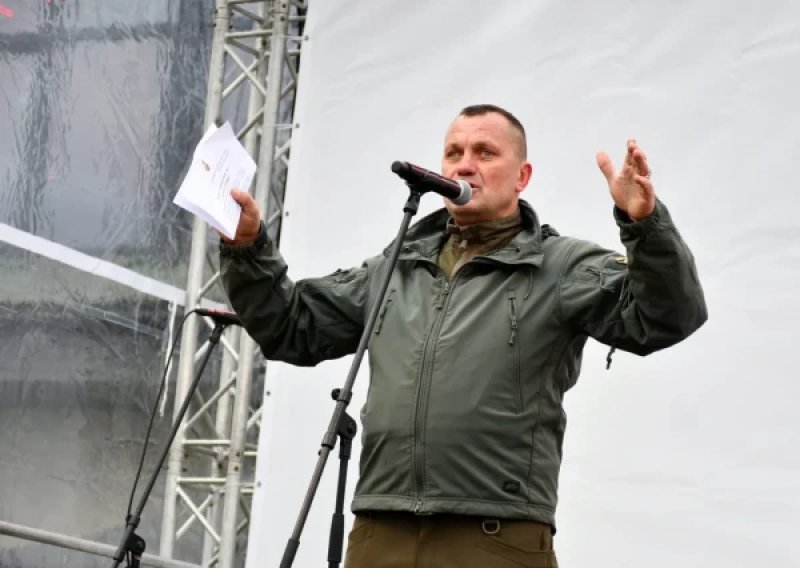
 Foto: BB.LV / Калве
According to him, the event in Jekabpils went well, although more participants were expected. At the same time, after the protest, the organizers received numerous calls from residents expressing support and gratitude. Therefore, they do not intend to limit themselves to just one action. On Tuesday, November 10, the organizers will meet to discuss further actions in case the transit of Russian grain is not halted. Kalve did not rule out that it might not be about a repeat protest, but about blocking railway tracks to prevent the transportation of grain through Latvia. Kalve also criticized Prime Minister Andris Kulbergs' speech to the participants of the event, calling his tone aggressive and his promises insufficiently specific. Additionally, he negatively assessed the presence of the Prime Minister's young son on stage during the speech, suggesting that it looked like an attempt to shield himself from the protesters. "There was no good feeling left after Kulbergs' speech," Kalve admitted. As reported, Kulbergs promised on Saturday to submit a bill to the Saeima that would allow halting the transit of Russian grain by prohibiting new contracts. Coordination of the initiative between ministries is planned for next week. "The transit must be stopped; we should not feed the Russian military machine and provide money for the destruction of Ukrainians," the Prime Minister stated, acknowledging that it has not been possible to resolve this issue quickly. In Kulbergs' opinion, a unilateral ban at the level of Latvia will not solve the problem - restrictions need to be pursued jointly with the European Union (EU), as transit regulation falls under its competence. The Prime Minister also warned of possible legal disputes and financial costs in the event of a national ban. He added that the Baltic countries have already advocated at the EU level for the cessation of such transit. The goal of the action "No to Bloody Grain!" is to achieve a ban on the transit of grain produced in Russia and in the occupied territories of Ukraine through Latvia. As reported, the transit of grain from Russia through Latvia increased 3.1 times in the first ten months of this year compared to the first ten months of 2025, according to information from the State Revenue Service (SRS). In the first ten months of this year, 1.115 million tons of grain were exported from Russia through Latvia, while in the first ten months of last year, 357,645 tons were exported. In turn, the volume of grain transported in transit from Belarus has increased several times, according to SRS data. In the first ten months of this year, 185,756 tons of grain were transported in transit from Belarus through Latvia, while last year it was 60.8 tons.
