

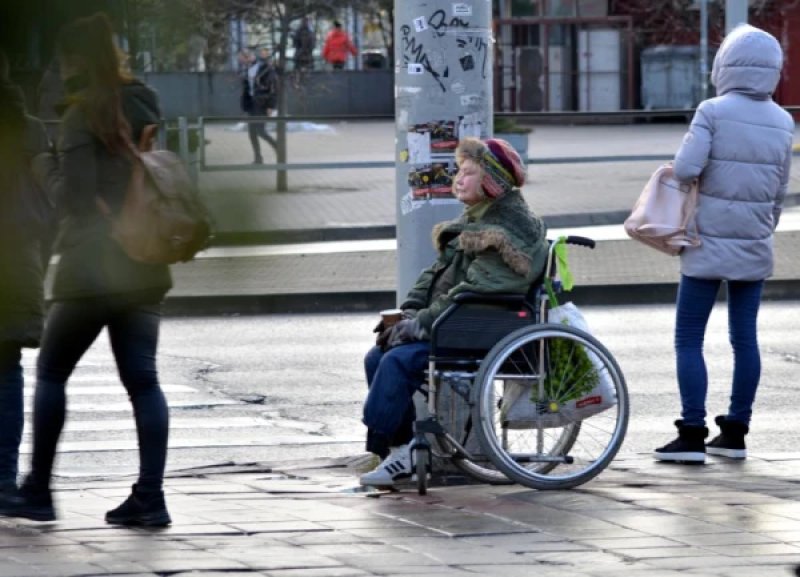
 Foto: BB.LV / женщина-инвалид
Attempts to reduce government budget expenditures should not lead to worsening conditions for the most socially vulnerable residents of Latvia. This is especially true for children and people with disabilities, for whom public transport is often the only way to reach schools, hospitals, or social institutions. This position was expressed by Ombudsman Karina Palkova while commenting on the proposals from the Ministry of Transport regarding changes to the funding of regional public transport starting in 2027, as reported by the LETA agency. The Ombudsman’s Bureau has already submitted official objections on the Portal of Regulatory Act Projects. ### "Behind These Numbers Are People" According to Palkova, the introduction of an additional fare for children and people with disabilities can only be considered as a last resort when other ways to solve financial problems have been exhausted. > "Behind these numbers are people for whom public transport is often the only way to access essential services. We must not allow people to have to give up important everyday needs due to the government's financial problems," emphasized the Ombudsman. Her office notes that even a relatively small additional fee can become a significant financial burden for families who rely on public transport daily. The consequences could be particularly serious for those who need to regularly visit medical facilities, educational institutions, or social services. ### Why Does the Ombudsman Consider Cutting Benefits a Problem? The Ombudsman’s Bureau emphasizes that the accessibility of public transport is directly linked to the realization of fundamental human rights. This involves not only the ability to move but also access to education, healthcare, employment, and participation in public life. The Constitution of Latvia provides special protection for children, including children with disabilities and those without parental care. International human rights norms also require prioritizing the protection of vulnerable groups, especially in times of economic hardship. Therefore, the Ombudsman believes that social guarantees can only be reduced after a thorough assessment of the consequences, necessity, and proportionality of such a decision. Moreover, the report prepared by the Ministry of Transport does not clarify whether the voices of those directly affected by the changes have been adequately heard, according to the bureau. Palkova urges the government not to promote the reduction of benefits until all possible alternatives have been considered. ### What Changes Does the Ministry of Transport Propose? The Ministry has prepared three options for funding regional public transport for the coming years. They differ in the amount of required government funding, possible changes to the route network, and the size of compensation for discounted fares. | Option | Ticket Prices | Benefits | Route Network | | ------------------------------------------- | ------------------ | -------------------------------- | ----------------------- | | First — without additional funding | +30% | Compensation up to 70% | Buses −14%, trains −3% | | Second — with preservation of routes | +10% | Compensation up to 70% | No reductions | | Third — with additional funding | +10% | Existing benefits preserved | No reductions | The first option implies the most significant changes. If the government limits itself to the existing basic funding, the regional bus network will need to be reduced by approximately 14%, and the volume of state-ordered rail transport will decrease by 3%. At the same time, the cost of travel will increase by an average of 30%, and state compensation for benefits will be limited to 70%. The second option allows for the current route network to be maintained but involves an average ticket price increase of 10% and a reduction in compensation for discounted fares to 70%. According to the ministry's estimates, this measure would save about 6.9 million euros annually. In the future, ticket prices are planned to be regularly reviewed. The third option, which the Ministry of Transport itself considers the most preferable if funding is available, provides for the preservation of both the existing route network and current benefits. However, ticket prices will still rise by an average of 10%. To implement the third option, the state will need an additional approximately 15 million euros per year. ### Why Did the Issue of Reducing Benefits Arise? The Ministry of Transport explains the need for changes by the rising costs of public transport. Starting in 2024, the basic funding from the state budget will remain at 93.8 million euros per year. However, by 2026, expenses for providing transport services are projected to be around 109.9 million euros. Thus, the difference between basic funding and expected expenses is about 16.1 million euros. The ministry notes that the costs for carriers have increased due to rising wages, fuel prices, energy resources, and other expenses. At the same time, the budgeted funds have long been insufficient to fully cover the state's obligations in the area of regional public transport. ### Public Organizations Also Oppose Cutting Benefits Objections to the possible limitation of benefits have previously been expressed by patient organizations, the association of people with disabilities and their friends Apeirons, as well as the society "Latvian Network for Child Welfare." The Ombudsman has joined these objections, emphasizing the need to assess the social consequences. The Ministry of Transport also acknowledges that significant reductions in regional routes could worsen access to jobs, education, healthcare, and other essential services. Therefore, the ministry advocates for maintaining the existing transport network and gradually increasing the efficiency of the system. The final funding option is to be chosen by the Cabinet of Ministers, taking into account the possibilities of the state budget. Thus, a decision on cutting benefits has not yet been made. One of the three options under consideration allows for the complete preservation of current benefits for passengers entitled to free travel.
