

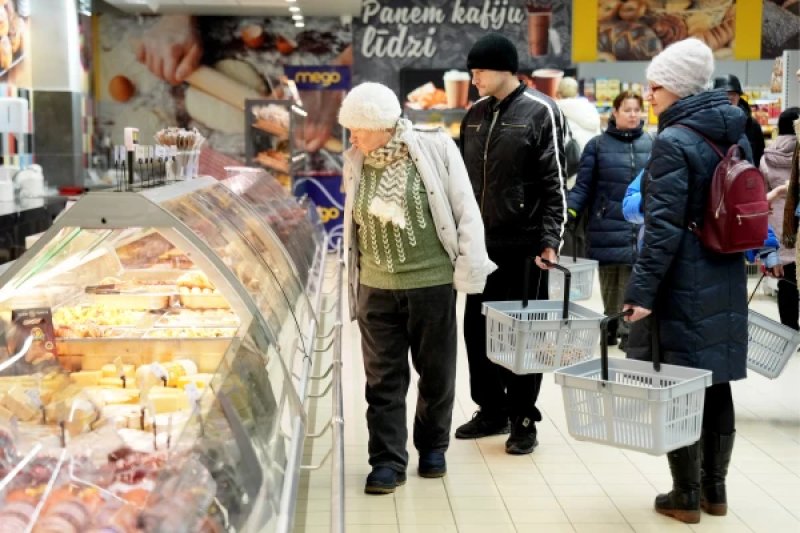
 Foto: BB.LV / Люди в магазине
Fuel, natural gas, and electricity prices are rising, while global markets continue to see increases in the prices of various food products and raw materials. Does this mean that in the coming months, residents of Latvia will have to pay more for bread, milk, butter, meat, and other everyday products? According to the Central Statistical Bureau, in September, prices for food and non-alcoholic beverages in Latvia were 4.8% lower than a year ago. Meanwhile, data from the Food and Agriculture Organization of the United Nations (FAO) indicate a reverse trend in the global market: over the year, the price index for food commodities increased by 5.8%. In September alone, the price index for grains rose by 5.1%. Changes in the energy market are even more pronounced. In September, diesel fuel in Latvia averaged €2.08 per liter — 39.1% more than a year earlier. At the end of October, the price of natural gas on the European exchange exceeded €100 per megawatt-hour. The average exchange price of electricity in Latvia in October reached €112.56 per megawatt-hour — 7% more than a year ago. According to the latest estimates from Eurostat, annual inflation in the Eurozone in October was 4%, while in Latvia it was 3%. However, the rise in raw material and energy costs does not always immediately reflect on store price tags. Manufacturers and traders operate under previously concluded supply contracts, so consumers may feel the effects of rising costs only after a few months. What should Latvian shoppers expect? "Neatkarīgā" surveyed industry experts to find out which products might rise in price and how serious the changes will be. ## ## Prices are not rising yet. But for how long? Leading researcher at the Institute of Agrarian Resources and Economics, Doctor of Economics Inguna Gulbe predicts that food prices in Latvia are likely to rise in the next six months. However, compared to last year, some products may remain cheaper for a while longer. According to Gulbe, the price increase could begin quite soon, but it may be delayed by Christmas discounts and the subsequent period of traditional quiet in trade. The researcher expects price increases for almost all categories of food products, but she does not venture to predict specific percentages. A more cautious assessment is provided by the president of the Latvian Traders Association, Henriks Danusevics. He notes that currently, there is a decrease in prices in almost all categories of food products. The exception is bread and related products. Most vegetables have also become cheaper, except for tomatoes and cucumbers, whose prices depend on the season. At the same time, Danusevics acknowledges that businesses still need to compensate for costs caused by previous fuel price increases. These costs do not always immediately factor into product prices, but they may appear in the next price offerings from suppliers. That is when prices will start to rise. ## ## What will happen to bread, milk, and vegetables? Deputy Chairperson of the board of the "Farmers' Union" Maira Dzelzkaleja-Burmistre emphasizes that food prices in Latvia are largely determined not by local conditions but by the situation in European and global markets. Latvia is too small a market for fluctuations in local harvests to significantly change the overall price level. Speaking about bread, Dzelzkaleja-Burmistre notes that grain is currently relatively cheap, and no significant increase in its cost is observed. Therefore, any potential rise in bread prices is primarily linked to the costs incurred by processing enterprises for electricity and natural gas. Inguna Gulbe, in turn, points out that grain prices are indeed rising on global markets, albeit slightly. This could affect not only the prices of flour and bread but also the prices of poultry, eggs, and pork. ## ## Changes are also possible in the dairy market According to Dzelzkaleja-Burmistre, purchase prices for milk have remained low for about eight months, but an increase is expected soon. This could lead to higher prices for butter, cottage cheese, and other dairy products. At the same time, the expert notes one peculiarity in price formation: when purchase prices for milk were decreasing, there was no comparable reduction in dairy product prices on store shelves. Prices for fruits and vegetables, according to her observations, have already risen slightly. In the future, they may be affected by expensive fuel and costs associated with storing products during the winter period. ## ## The main threat — next year's harvest In the longer term, risks appear even more serious — not only in Latvia but throughout Europe. Adverse weather conditions this year have created additional problems for agriculture. As Dzelzkaleja-Burmistre explains, hay and feed for livestock were generally successfully harvested. However, the situation with sowing winter crops has proven to be significantly more complicated. In some regions, only 50–60% of the planned areas have been sown. In spring, these fields will have to be planted with spring crops, which usually have lower yields. As a result, the overall grain harvest next year may decrease. This primarily concerns Latvia, as well as grains and rapeseed — the most common agricultural crops in the country. Even more serious concerns are related to the prices and availability of mineral fertilizers across Europe. Dzelzkaleja-Burmistre does not rule out that there may even be a shortage of fertilizers in European countries in the spring. If farmers start to reduce their usage due to high prices, it will negatively affect future harvests. Both Dzelzkaleja-Burmistre and Gulbe critically assess the European mechanism for cross-border carbon regulation (CBAM), which will also apply to the import of certain types of mineral fertilizers starting in 2026. Its goal is to account for carbon emissions arising from the production of imported goods in their cost. In Dzelzkaleja-Burmistre's opinion, the new regulation significantly increases the cost of mineral fertilizers, so European lawmakers will have to reconsider it. Inguna Gulbe points to another problem. The main products of Latvian farmers — grain and rapeseed — are sold on the global market, where prices are determined by exchange quotations. Therefore, local producers cannot simply raise their selling prices to compensate for the increase in fertilizer costs. ## ## What could curb price growth? One of the factors that could limit the rise in food prices is competition. Both Inguna Gulbe and Henriks Danusevics mention the trade agreement between the European Union and the South American bloc Mercosur, the temporary application of which began on May 1 of this year. According to both experts, competition from South American products may help curb price increases in the European market. However, Gulbe emphasizes that the situation looks different from the perspective of consumers and local producers. For consumers, lower prices are undoubtedly an advantage. However, for Latvian enterprises, which operate under different costs and production requirements, it becomes more challenging to compete. Another limiting factor for price growth is the purchasing power of the population. Gulbe believes that a reduction in purchasing volumes will not allow producers and traders to raise prices indefinitely. Henriks Danusevics, in turn, positively assesses the reduced VAT rate of 12% introduced in Latvia for bread, milk, eggs, and poultry. In his opinion, this practice should be extended to other health-beneficial products traditional to Latvia. "I don’t want to scare people, but it won’t get easier" Overall, experts' assessments indicate that the rise in prices for almost all food products is quite likely. The increase in production costs creates the necessary prerequisites for this. "I don’t want to alarm people, but it won’t get easier," concludes Inguna Gulbe. At the same time, she emphasizes that technological advancements and new solutions can partially compensate for unfavorable economic conditions. Therefore, the researcher does not predict a catastrophe. But she also does not see any particular grounds for optimism at the moment.
