

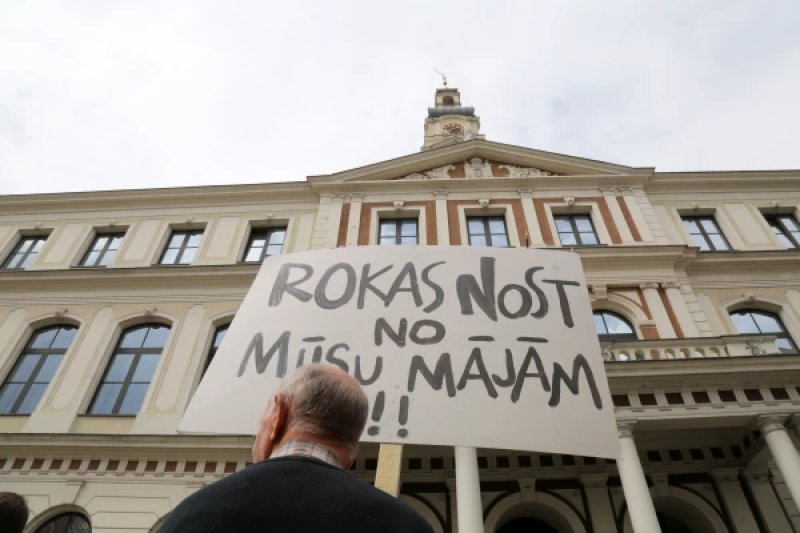
 Foto: BB.LV / Пикет у Рижской думы
Recently, many residents of Latvia received a notification from their local government that they need to pay additional property tax for the year 2026. Among those 'lucky ones' who received a letter requesting to contribute for the benefit of the state was economist-analyst Evgenia Zaitseva. She conducted a sort of investigation and shared the results with bb.lv: “After receiving such a letter, my neighbor perceived it as a message from scammers. Another neighbor, a pensioner, clutched her heart – she had all her expenses calculated until the end of the year, and no new expenses were planned. Someone wealthier simply paid. But I, due to my profession, decided to investigate further… First, as experts do, I assessed the appearance of the document, its design, and control elements. Everything was in order – the document was original, composed and prepared by the Financial Department of the Riga City Council. So, will I have to pay? But why? I started to dig deeper – how does the local government justify such a demand? Here is the text – explanations: The State Land Service (hereinafter – SLS) adjusted the fiscal cadastral values (hereinafter – FCV) for 2026 for plots of land in Riga, which, according to information provided by the National Heritage Administration, have a registered encumbrance in the State Information System of the Real Estate Cadastre – the status of a cultural monument. During a re-examination, the SLS established that a reducing coefficient of 0.7 had been unjustifiably applied to the FCV of these plots. The adjusted FCV values come into effect on January 1, 2026. Bureaucratic language is a special language that almost always requires translation into plain human language. I possess the skill of such translation, but here I was at a loss – • The National Heritage Administration determined that the land on which my house stands is a cultural monument (?), • The status of a cultural monument imposes restrictions on me as a property owner, creating inconveniences, • For these inconveniences, the State Land Service had previously reduced the cadastral value of my land by 30 percent (coefficient 0.7), which reduced the amount of my property tax, • Now something has changed, and I am being asked to pay additional property tax, and the amount of the additional payment is a staggering 42 percent more than the amount of land tax that was assessed for me for 2026, which I have already paid. ## Questions, questions... I was unable to call the Financial Department of the Riga City Council – the sent notification regarding the tax had no phone numbers, and searching for it on the Council's website was not worth the trouble. Therefore, I decided to call the State Land Service, which determines the cadastral value of real estate, and the necessary phone number was indicated in the message. I quickly got through, and they kindly explained to me that the reducing coefficient of 0.7 for calculating the fiscal cadastral value was canceled as of January 1, 2025. This was done in accordance with amendments to Cabinet Regulation No. 103-2020, adopted in 2024, which define the rules for the cadastral valuation of real estate. So, the amount of my land tax should have increased for the year 2025 since the reducing coefficient was canceled? But the amount of tax for 2025 matched exactly the amount of tax I paid for 2024, 2023, and 2022 (I didn’t check further). Yet for 2026, the amount of land tax was reduced!? Miracles, indeed… I decided to investigate further and used the link that the Riga City Council provided in its request for additional tax payment. As a result, I ended up on the Open Data Portal of Latvia - https://data.gov.lv/dati/lv/dataset/https-data-gov-lv-dati-lv-dataset-zemes-vienibu-un-zemes-vienibu-dalu-fiskalo-kad-vertibu-parrekins. The explanatory text here is even more bureaucratic than in the Council's letter. I read it about five times and understood that the land service recalculated the cadastral value of the plots under residential buildings twice in 2026 (on January 14-15 and March 19) concerning those for which, according to the National Heritage Administration, "an encumbrance in the form of the status of 'cultural monument' was registered or removed." It seems clear now – the heritage managers electronically provided new data about the removal or assignment of the status of 'cultural monument' to the land service, and during the merging (exporting) of data, a technical error occurred in the land service database. The error is simple – new data was uploaded into the cadastral database with the old, reducing coefficient of 0.7. BUT! – - Firstly, this reducing coefficient should have been excluded from the cadastral database by the end of 2024 so that the land service could correctly calculate the cadastral value of the land for 2025 (without reduction), as defined by the amendments to Cabinet Regulation No. 103-2020! - Secondly, from this explanation, it follows that my land, for which I am now being asked to pay additional tax, was excluded from the list of 'cultural monuments' in 2025 or, conversely, included in this list. Only this way can one understand the reason for the manipulation with the cadastral value of my land and, consequently, with the tax… The question hung in the air again, and I had to call the National Heritage Administration to find out what was happening with my land – has it become a cultural monument or ceased to be one? It turned out that my land (Riga's Quiet Center) is all right, and it has been a protected area of the historical center of Riga since 1998, which is listed as a protected area registered with UNESCO. That is, regarding my land, the heritage managers did not enter any new data into the cadastral database in 2025! So, we return again to the error in the computer system (database) of the State Land Service, and it seems that the error is systemic, double, and has lasted for several years! What is the error and why has it persisted for years? If in 2026 my land's cadastral value, as well as the tax, was reduced by applying a no longer valid reducing coefficient, then why did I pay more in those years when this coefficient was in effect? And if I paid more tax than in 2026 when the coefficient was applied, then it turns out that for the previous ten to fifteen years, I paid an increased tax, and it was taken from me unjustifiably. Modestly, around 50 euros were overcharged from me each year. So I wonder, maybe now that I have figured it out – I should ask for that money back… Some might say, what’s the big deal – she doesn’t want to pay tax. But the fact is that on the Open Data Portal of Latvia, I found out that there are over 32 thousand property owners like me across Latvia… Yes, and in general, I think that the requested tax should not be paid until an audit of the land cadastral database is conducted and the cause of the failure in calculating the fiscal cadastral value of real estate for 2025, 2026, and beyond is identified, as there are constant discussions about increasing this cadastral value, and with it, the tax.
