

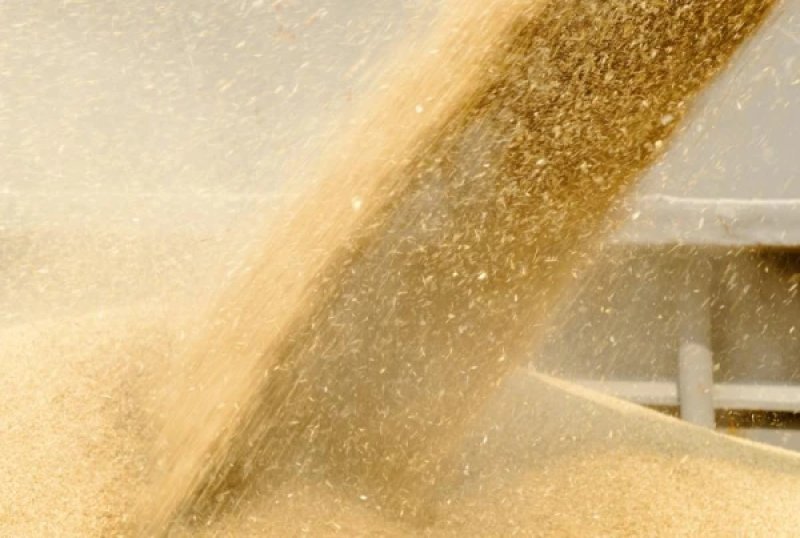
 Foto: BB.LV / пересыпка зерна
As reported by BNS, the representative of the minister, Justas Jaskevičius, stated that the legal acts necessary to tighten control over food grain from Russia and Belarus, effective from November 16, have already been agreed upon and signed. "Every batch of food grain from Russia and Belarus will be checked both documentarily and physically. The control will cover wheat, barley, corn, and sunflower seeds during their transshipment or storage in Lithuania. Samples will be taken from each batch for laboratory research to establish the true origin of the grain," Jaskevičius said in a comment to BNS. As BNS reported, to prevent the transit of grain that may have been stolen from occupied territories in Ukraine through Lithuania, Kęstutis Mažeika instructed the State Food and Veterinary Service (SFVS) at the beginning of September to verify the origin of all grain - not only feed grain but also food grain - transported from Russia and Belarus. Despite this, until the new tightened grain verification system comes into legal force, the SFVS is still paying for the samples sent to foreign laboratories, and cargoes at the Lithuanian border are not being stopped - they can leave Klaipeda port until the final research results are obtained. According to Jaskevičius, starting from November 16, while awaiting research results and confirmation of origin, cargoes will not be able to leave Klaipeda port, and customs will only process the cargo after receiving permission from the SFVS. In the event of a discrepancy in the origin of the grain, the batch will be returned or destroyed, and unlike the current situation, businesses will pay for the control, laboratory research, return, or destruction. The SFVS, tasked with conducting checks on grain of unclear origin, has taken five samples from two cargoes of unclear origin from September to the present, and their origin is being verified in foreign laboratories. As reported by BNS, the representative of the service, Aistė Prelgauskaitė, stated that the results are still not available, and new samples have not been taken. According to Jaskevičius, laboratory research can take two months or longer. BNS reported that in early October, the President of Lithuania and the Prime Ministers of Latvia and Estonia called on European Union (EU) leaders to ban the transit of Russian grain. Meanwhile, Prime Minister Mindaugas Sinkevičius stated in October that he would propose to the EU to ban the transit of Russian food grain through the territory of the Community and to impose sanctions on some Russian agricultural oligarchs. The issue arose after grain producers stated that the grain exported from the Kaliningrad region through the ports of the Baltic states is offered for transport significantly cheaper than Lithuanian grain, causing the latter to sit idle in warehouses, and farmers are asking the authorities to close the transit of Russian grain through Lithuania. As BB.lv reported, Latvian farmers are also protesting against the transportation of grain from the Russian Federation.
