

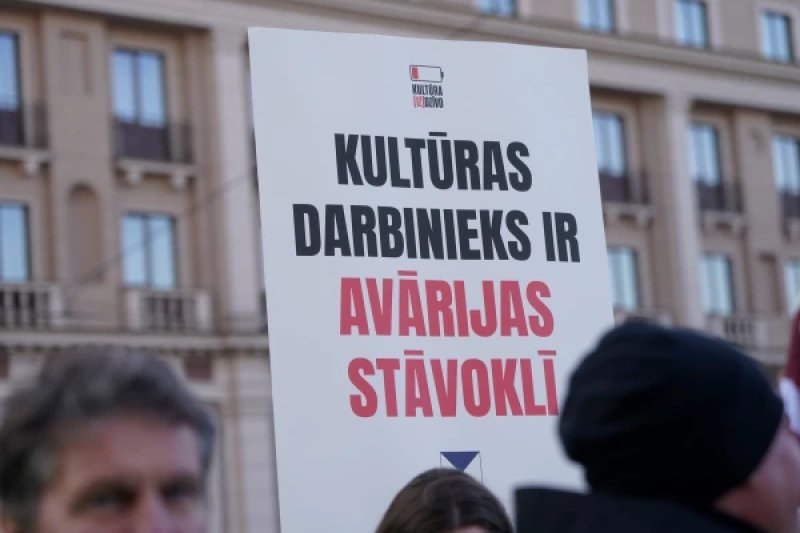
 Foto: BB.LV / Не доплачивают искусству
The march began at the Latvian National Opera and Ballet. With banners and slogans, the participants headed through the center of the capital to the Latvian National Museum of Art. "Culture is not a hobby," "Working for pennies is not art," "Working in a museum = the art of survival," "We want to work in Latvia, do you want us?" — such inscriptions could be seen on the demonstrators' posters. At the Freedom Monument, the participants of the action performed the national anthem, after which they continued their march to the government building. Prime Minister Andris Kulbergs and Minister of Culture Nauris Puntulis came out to the gathered crowd. The head of government stated his readiness to listen to the proposals from industry representatives. According to him, culture is no less important for society than healthcare, education, or security. However, when distributing budget funds, the interests of all these sectors must be taken into account. The Prime Minister also noted that one of the main tasks of the next Minister of Culture will be to ensure predictable funding for the sector in the coming years. **Salaries significantly below the average level** The organizers of the action pointed out the significant gap in wages. According to their data, in the second quarter of 2026, the average salary before taxes in cultural heritage institutions was 1395 euros, while in the performing arts sector it was 1365 euros. For comparison, the average salary in the public sector reached 1926 euros. Thus, cultural heritage workers earned on average 531 euros less, while performing arts employees earned 561 euros less. Industry representatives warn that chronically low salaries force experienced specialists to seek work in other fields or outside Latvia. At the same time, cultural institutions are finding it increasingly difficult to attract young talent. According to the organizers of the march, if the situation does not change, all residents of the country will feel the consequences: there may be fewer cultural events, and their quality and accessibility will be at risk...
