

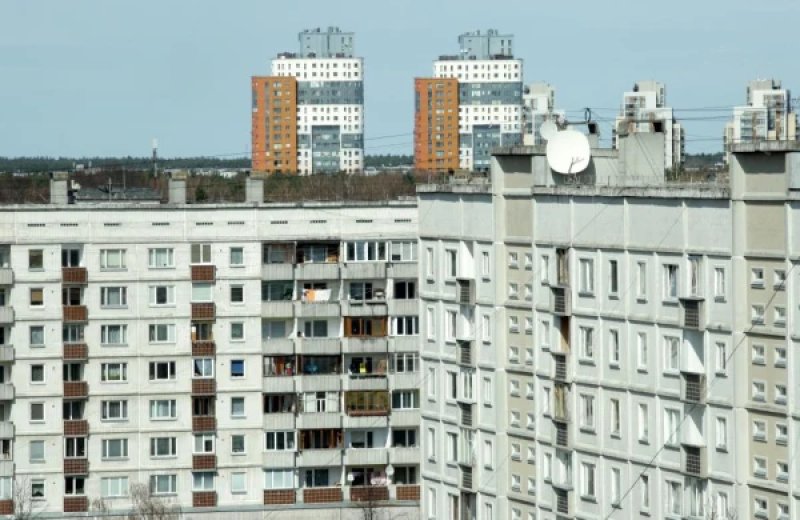
 Foto: BB.LV / многоквартирный дом в Риге
In private homes, the implementation of such solutions is relatively clear; however, a much more complex question arises when a heat pump is wanted to be installed in an apartment of a multi-apartment building and to refuse centralized heating. One reader writes about such a situation to LA.LV. "A friend of mine has a heat pump installed in his apartment in Riga, and he says that the heating season costs him less than with centralized heating. I also started to think whether I should do the same. I live in a multi-apartment building in Riga, so I would like to understand — can I simply refuse central heating and install a heat pump? Do I need the consent of my neighbors, permission from the construction authority, and what should I do first?" — asks the reader. The clarification from the Riga municipality shows that theoretically such a solution is possible; however, in practice, it is not a decision that one apartment owner can make unilaterally. The heating system of a multi-apartment building is usually part of the common property, and disconnecting an apartment from it can affect the heating supply of the entire building, so it is not allowed to unilaterally disconnect radiators, reconstruct risers, or install an external heat pump unit on the facade. The volume of necessary approvals also depends on the legal status of the building. If the building is divided into apartment ownership, a decision from the community of apartment owners is required for the installation of an external heat pump unit on the facade. A majority must vote "in favor," meaning at least 50% plus one vote from all apartment owners in the building, not just those who attended the meeting. The facade is common property, so one apartment owner cannot unilaterally decide on drilling or using it. Conversely, if the building is not divided into apartment ownership and belongs in ideal shares, the Civil Law regulations apply, and in this case, written consent from all co-owners, meaning 100%, is necessary. However, neighbor consent alone is not enough. The installation of a heat pump may be considered as the installation of engineering networks of the building or a change to the facade, so a technical solution prepared by a certified designer may be required, along with the submission of documents to the Construction Information System. Depending on the specific plan, this could be a construction notification, explanatory note, or another construction document. Restrictions are especially possible in the historic center of Riga and in cultural monuments, where the placement of external units on the facade facing the street is often not permitted. In such cases, a solution must be sought from the courtyard, on the roof, in the balcony area, or in another place where it does not affect the cultural and historical appearance of the building. Additionally, special heating supply rules apply in Riga. In certain cases, before installing a local heat source, documents must be submitted to the Housing and Environment Department of the Riga City Municipality, and the plan may be submitted for evaluation to the Heating Supply Commission. A separate application form for the installation of a local heat source in ownership is provided for the commission. Therefore, a person whose apartment is currently connected to the centralized system of AS “Rīgas siltums” is advised by the municipality to first contact the building manager, find out the type of heating system of the specific building, consult with a certified designer, and then contact the Housing and Environment Department regarding the possibilities for the specific property. ## ## The Number of Heat Pumps in Apartments is Increasing Data available to the Riga municipality shows that interest in installing heat pumps in apartments has significantly increased in recent years. In 2024, 24 applications were submitted to the municipality's Heating Supply Commission, and in 2025, there were already 33, which is the historically highest figure. Interest in emission-free heating solutions continues in 2026, although gas heating is still often chosen in apartments, sometimes combining it with a heat pump. The municipality's summary shows that since 2022, the number of applications for the installation of heat pumps in apartments has increased more than five times compared to 2020 and 2021, and in recent years it has remained at around 26 to 33 applications per year. However, in absolute numbers, applications for the installation of gas heating equipment in apartments are still significantly higher. ## ## Not Just the Bill — Consider Noise and Water Too Even if a heat pump for a specific apartment seems economically advantageous, the municipality urges consideration of the technical problems that other residents of the building may experience. When the heat pump operates at full capacity in winter, the compressor creates vibrations, and if the outdoor unit is attached directly to the wall of the building, the vibrations can spread through the structures and create noise in neighboring apartments. It is also necessary to address the issue of condensate and water drainage during thawing, as a significant amount of water may leak from the outdoor unit in winter, which should not damage the facade, drip onto neighbors' windows, or create ice on the sidewalk. The Riga municipality generally supports the transition to more environmentally friendly and energy-efficient heating types and the reduction of fossil fuel use. Heat pumps are regarded as an energy-efficient solution, as they can provide more thermal energy than they consume in electricity; however, each case is considered individually. Factors such as the location of the building, heating supply zoning, availability of centralized heating, and the impact on the building, the environment, and the city's energy supply system as a whole are taken into account. ## ## If Everyone Starts Disconnecting, Heating for Others May Become More Expensive There is also another aspect that an individual apartment owner, calculating their potential savings, may not consider. If more apartments start to refuse centralized heating, this could theoretically affect the costs for other clients. Maintaining a centralized system requires heating networks, heating nodes, production capacities, and other infrastructure, and a significant portion of these costs remains regardless of the number of clients. If the number of consumers decreases, the costs of maintaining the infrastructure may have to be distributed among a smaller group of clients in the future. However, this does not mean that the refusal of one apartment from central heating will automatically increase the bills for neighbors. The actual impact depends on how many clients disconnect, whether this occurs in one specific area or is scattered throughout the city, how heating production costs change, and how successfully heating networks are modernized. This is why the Riga municipality, when assessing the change in heating type, looks not only at the benefits for the specific apartment owner but also at the operation of the centralized heating supply system as a whole. Thus, for a reader who wants to replicate their friend's experience and install a heat pump in their apartment, the first step is not purchasing equipment. They should first talk to the building manager, clarify the technical solution of the heating system and the legal status of the building, obtain an assessment from a designer, and the necessary consent from apartment owners. Only after that can they proceed with the approvals in the municipality and the preparation of construction documentation. Otherwise, what seems to be a cheaper heating solution may end up in disputes with neighbors, demands to dismantle the equipment, or consequences of unauthorized construction.
