

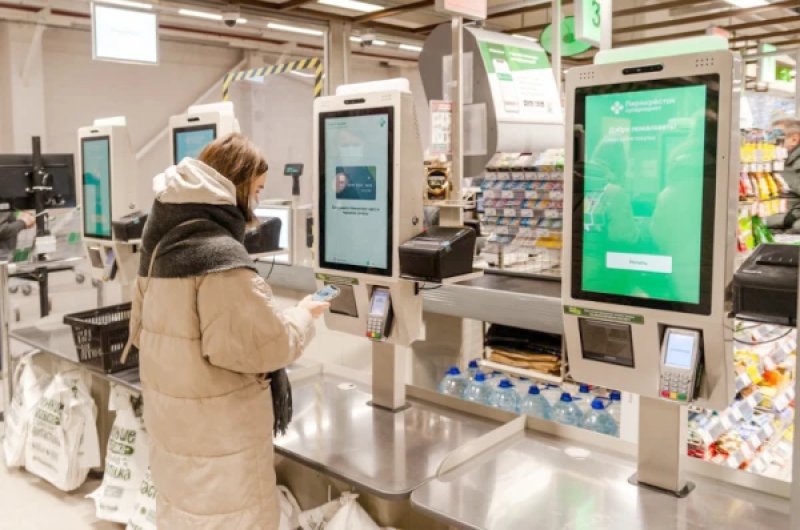
 Foto: BB.LV / касса сомообслуживания
Richards writes on the social media platform "Threads": "There are people who scan their items at self-checkout, then pay, and only after that start putting their items in a bag. To be honest, it annoys me a bit. Why can't they just put their scanned items in the bag right away? Others are standing and waiting!" Looking into the comments section, it is clear that opinions on this issue are divided. Some agree with Richards, while others believe that every shopper has the right to pack their purchases at their own pace. Inga also has something to add: "Because items are placed in the basket or cart this way - sturdier ones at the bottom, more fragile ones on top. If we packed them into a bag right at the checkout, the more fragile items would end up at the bottom. Then one might as well just throw them in the trash..." Agnese is also in no hurry: "At the self-checkout, I’m not going to rush! Go to a regular checkout, where items are tossed around, and then more purchases are piled on top. That’s why I choose the self-checkout - I’ll pack as long as it takes!" Kristine admits to a trick: "I, in turn, get annoyed by those impatient ones who are already breathing down my neck and don’t let me finish my purchases properly. As soon as I swipe my card, they’re already huffing next to me, wondering when I’ll finally be done. To those, I demonstratively pack my bag slowly." Self-checkout counters in Latvia have been operating for over 15 years. Self-checkout counters first appeared in the world in 1992 in the United States, in New York State. The idea was conceived by Howard Schneider, who wanted to create a system that would allow customers to scan and pay for their items without the help of a cashier. In Latvia, the first self-checkout counters were introduced in 2009 by the "Maxima" chain - in Riga, at the store on Augusts Deglavs Street. Meanwhile, "Rimi" began implementing such counters in 2015, and "Lidl" opened the first self-checkout counters in Latvia in August 2024. The extent to which shoppers have become accustomed to this method of shopping is illustrated by a survey conducted by the technology company "StrongPoint" in 2026. It found that 69% of residents in Latvia opted for self-checkout due to long queues in the past 12 months. 36% of respondents in such situations looked for another checkout with a shorter line, while 14% admitted that they left the store without making a purchase due to the long queue. The popularity of self-checkout counters is also evident in the data from retail chains. "Rimi" indicated that in 2026, more than half of its customers used self-checkout. Meanwhile, "Lidl" reported in March 2025 that nearly half of all purchases in its stores were made at self-checkout counters. At that time, there were 326 such counters operating in 36 stores across Latvia.
