

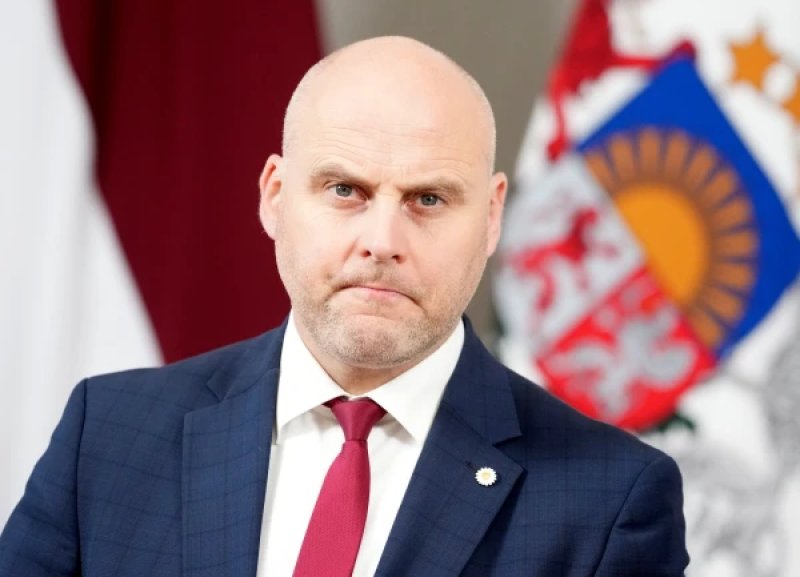
 Foto: BB.LV / Кулбергс
On Tuesday, Kulbergs presented journalists with a plan to improve the situation with the state budget and the economy. Later on social media, he expressed dissatisfaction with the headline of a news article on this topic prepared by Latvian public media. He pointed out that news headlines are misleading and addressed his followers on the social network "X": "If you want to know what is really happening from a direct source, follow my daily reports and do not let yourself be deceived." At the same time, as emphasized by the Latvian Association of Journalists (LAJ), the Prime Minister contrasts his political communication with independent journalism and unjustifiably presents his messages as more credible. LAJ notes that in his post on the social network "X", Kulbergs calls the news headlines "erroneous, distorted, false" and accuses the media of manipulating public opinion. At the same time, in the text of the publication, he does not specify which headlines he is referring to, does not explain which facts are false, and does not provide evidence for his accusations. "Such accusations discredit the work of journalists, not allowing society to verify their validity," the association believes. LAJ also emphasizes that the position of Prime Minister does not grant anyone the authority to possess the ultimate truth. The association points out that politicians are interested parties in the political process: they defend their programs, decisions, and party positions, and seek to maintain voter support. These interests may align with the interests of society but are not automatically identical. Therefore, statements made by politicians should be independently verified regardless of their position, LAJ emphasizes. The association also believes that the Prime Minister's reports can provide useful information; however, he himself chooses the topics, emphasis, and what not to mention. The task of journalists is to verify documents and data, compare promises with actions, ask clarifying questions, and reveal what officials do not want to highlight. Members of the association believe that the seriousness of public finance problems only increases the need for independent verification. LAJ notes that society should know what calculations the government's proposals are based on, what the alternatives are, and how residents will cover the costs of the decisions made. "The media are not obliged to adopt the government's explanations or present the solutions proposed by them as the only possible ones," the statement from the association representing journalists emphasizes. LAJ also points out that discrediting independent media is a troubling signal for democracy. Research from the "V-Dem" institute shows that freedom of speech is one of the first areas targeted during the weakening of democracy, and media censorship is a common tool for consolidating power. Claims that independent media cannot be trusted may help create a justification for limiting their work, the association states. At the same time, the association notes that the media can also make mistakes, and errors need to be corrected. Headlines should correspond to the content of publications, and journalists should maintain substantial context. LAJ believes that if the Prime Minister has discovered false information, he should name the specific publication, point out the error, and provide verifiable facts. Discontent with the emphasis of the news does not in itself prove manipulation, the association emphasizes. LAJ calls on the Prime Minister to substantiate the accusations made or withdraw them, to refrain from generalized discrediting of the media, and to respond to journalists' questions substantively. Society has the right to receive independently verified information about the government's work. In turn, the head of government is obliged to report but does not have the privilege to unilaterally determine what the truth is, the association emphasizes. For his part, Kulbergs, through his public relations representatives, stated to the LETA agency that journalists have the right to analyze his statements, ask critical questions, and express their interpretation, but he, in turn, has the "right and duty" to explain what he meant and what the context of his statements was. "In my social media posts, I expressed an opinion on how what I said was reflected. I pointed out that news headlines do not always fully reflect the content of the publication and can sometimes create an incomplete picture of the message itself," the politician is convinced of his correctness. Kulbergs explained that he urged society to follow his personal communication because he can explain the meaning of his statements most accurately. In this particular case, he was disturbed by the chosen media emphasis when covering his presentation on the financial situation in the country. In particular, the Prime Minister wanted attention to be paid to the "overall picture of the situation" rather than to "individual aspects" that cause "unnecessary concern among part of society."
