

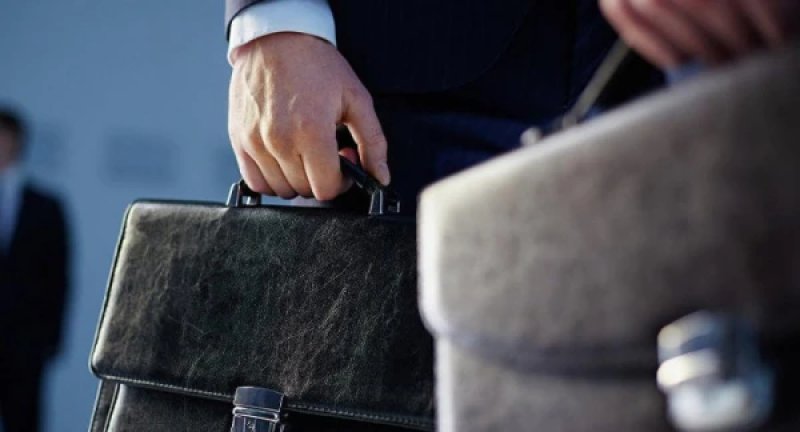
 Foto: BB.LV / люди с портфелями
Amid discussions about revising benefits for children and the disabled, there is an increasingly loud demand on social media: let ministers and parliamentarians review and reduce their salaries. Amendments to the law on the remuneration of employees in state and municipal institutions have been prepared. According to the draft, their basic salaries will remain at the current level next year. This applies to both high-ranking state officials and deputies of the Saeima and local governments, as well as judges and prosecutors. The bill lists four basic rates: the general rate is €1237.06, for the financial and insurance sector it is €2378.59, for telecommunications and energy it is €1781.27, and for the chairman of the port authority it is €1273.38. These are not the salaries that people receive in hand. The basic rate is multiplied by a coefficient established by law for each corresponding position. Hence the different amounts. The chairman of the port authority is mentioned separately because there is a specific calculation method for this position. That is why the word "freeze" sounds more impressive here than the decision itself. By courageously refusing another salary increase, our leadership will not suffer. The Prime Minister will continue to receive around €8659 per month before taxes, the minister €7670, the parliamentary secretary of the ministry €6804, and a regular Saeima deputy €4330. And this is without considering other legally provided payments. For example, the Prime Minister and ministers are reimbursed for representation expenses amounting to 20% of their salary. With this, the same Kulbergs ends up with about €10,390. Saeima deputies can receive compensation for housing rent and transportation expenses, and additional remuneration is provided for performing leadership duties in parliament. In total, these amounts are huge, which parliamentarians and government members are not planning to give up. The entire savings they are willing to show regarding themselves consist of leaving this well-being as it is, without making it even more prosperous. Now that’s what I call saving! One just wants to bow before such self-denial. However, regarding the plebs, the ruling party has other plans. The government is diligently looking for ways to save and is already eyeing social payments — are they too generous? Social benefits were named as a possible source of savings by Prime Minister Andris Kulbergs at a sensational press conference on November 10, suggesting a review of support for people with disabilities and family benefits. Kulbergs cited the state benefit for one child — €25 per month. In his opinion, this money would be better directed only to families with low incomes. Speaking about support for people with disabilities, the Prime Minister also allowed for the possibility of revising the existing system. This caused a storm of public outrage. Kulbergs immediately tried to blame the media for distorting his words (he claimed he was just talking about the State Audit Office's proposal and did not suggest anything himself), but later his press secretary confirmed: the recommendations of the State Audit Office will indeed be evaluated, after which the government will decide which ones to accept. Against the backdrop of this scandal, the modest proposal to freeze the multi-thousand salaries of officials and not touch them further caused a new explosion of indignation in society. The government should simply take a look at Facebook or X and see what people think. There are hundreds of posts about this, and thousands of comments. For example, here is the first publication we came across by a certain Ruta Asberga on Facebook: "About the electricity bills, due to which some of my friends do not turn on the heating and freeze… About the rising prices, which make people sigh heavily when they run out of coffee or have to buy household chemicals again… And let’s not even talk about trips to the pharmacy, where for a common cold, you have to leave almost €100… I don’t care about a LOT. I don’t take it to heart and live in my own microclimate. But it seems I know how to save the state budget! Maybe we should take €1000 from the salaries of deputies and all our esteemed gentlemen every month and direct that money to cover the budget deficit? It seems to me that if this doesn’t save us, at least we will definitely be on the path to recovery!". Commenters supported the idea, eagerly suggesting their recipes: cut salaries in the Saeima and Cabinet by 10%, or even by a third. Eliminate bonuses, payments for work in commissions, and compensations — at least temporarily, while the crisis lasts. At the same time, none of them believe that the ruling party would agree to such measures. As commentator Kristine Zvirgzdha sarcastically noted: "It is much easier to take from pensioners, the disabled, and children. They are already used to living on pennies, they can tighten their belts a bit more...".
