

 Foto: BB.LV / LMT
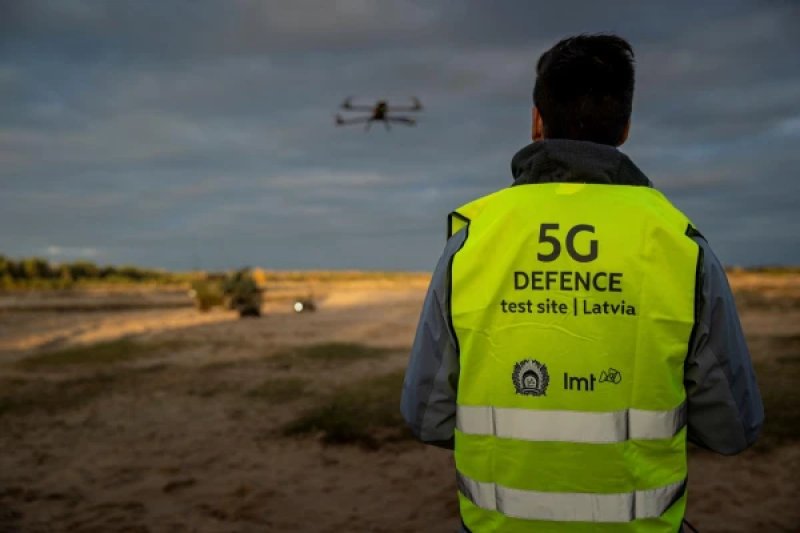
Starting its activities as a mobile operator, today LMT exports high-tech solutions and participates in international projects, including in the field of satellite communications. The president of the company, Juris Binde, talks about the technological future of Latvia, LMT's global ambitions, and new challenges. ## From the First Mobile Phone to Computer Vision **— Mr. Binde, until recently, LMT was primarily perceived as a mobile communication provider. This autumn, we are talking about artificial intelligence, defense technologies, and even space. Is the company changing its business model?** — I would say we are expanding it. LMT started as a national telecommunications operator and will remain one. However, the Latvian market is practically saturated. To grow, develop, and create new sources of income, it is necessary to seek new directions. Huge opportunities are opened up by technological solutions that leverage the advantages of fifth-generation mobile networks, and in the future, sixth-generation networks. Moreover, such developments can be exported. If the technology works successfully in our network, it can work in other countries as well. Today we are actively developing computer vision technologies that combine artificial intelligence and telecommunications, and we are engaged in the integration of various communication systems, including satellite systems. And you know what our advantage is? In our powerful engineering competencies! Many technology companies create good products but do not always fully understand the capabilities of networks. We can develop technology and immediately test it in our own network.  **— How significantly is this transformation reflected in LMT's revenue structure?** — Quite significantly. Today, about half of our revenue comes from sales of intelligent technological solutions, smartphones, and other equipment. The other half comes from telecommunications services. In just nine months of this year, we have nearly doubled our revenues from new technologies and services. ## "Latvia is Historically Strong in Engineering Knowledge!" **— You mention technology exports. What exactly can LMT already offer to the global market?** — Take computer vision, for example. We use video cameras and artificial intelligence to analyze visual information. Based on this, we created a transport monitoring system that allows monitoring the traffic situation, movement at intersections, and public transport lanes. The system, developed by LMT specialists, is successfully operating not only in Riga but also in cities in Austria and Hungary. Another direction is private 5G networks. In large industrial areas, a private mobile network can successfully replace Wi-Fi. We have built several such networks in Latvia, including for the Baltic Container Terminal and several large enterprises. Our experience is also in demand abroad. We have consulted on projects in the ports of Croatia and Lithuania. Thus, LMT exports not only technologies but also engineering competencies. Engineering has always been a strong point for Latvia. **— How did LMT manage to enter the defense sector and gain the trust of international partners?** — We participate in both European Defense Fund projects and civilian developments. Recently, one of the largest European experiments, which has been ongoing for five years, was completed. Without false modesty, I can say that LMT played an important role in this orchestra, acting as an integrator of various communication systems, data transmission, operators, and technologies at different management levels. This digital experiment in the defense sector (known as DiBaX) was not limited to Europe: 100 companies from more than 20 countries participated, and it was organized in collaboration with NATO, the Ministry of Defense, and the National Armed Forces. LMT collaborates with large international companies that see us as equal partners. Such projects provide not only technological experience but also direct contacts with specialists around the world. It’s one thing to write to an unfamiliar company. It’s quite another to call someone you have already worked with and who knows your capabilities. We are known. **— Are Latvian developments also in demand outside of Europe? For example, in the USA?** — Yes, we supply our products to the USA. One example is a compact module that allows connecting sensors from various manufacturers to the mobile network. Its feature is exceptionally low energy consumption. Imagine: a battery can power the device for up to ten years! We are collaborating with Infineon, which is interested in such solutions. This is already a quite concrete international business. ## "Sometimes Unpopular Solutions are Needed..." **— Recent crises have shown how much society depends on communication. Is it possible to create a network that works under any circumstances?** — Absolutely resilient telecommunications networks do not exist. There are different levels of security and resilience. To ensure communication in any situation, a multi-layered system is necessary: fixed and mobile networks, Wi-Fi, satellite communication. All technologies must be integrated so that it is possible to switch from one system to another when necessary. This is the only way! But there are always pitfalls... It is no coincidence that after the recent storm, the topic of national roaming was raised again. The idea is good, moreover, quite correct. But if there is no electricity in the region, for example, due to damage to the power grid, then most likely there will be none for all three operators either. And no roaming will help here.  **— So the main weak link in modern communication is not the telecommunications networks themselves, but the energy infrastructure?** — Absolutely right. The most important thing, just like a hundred years ago, is electricity. I remember a severe storm in 2005. Crisis meetings were held, and a list of measures was prepared, including equipping gas stations with generators. More than twenty years have passed, and much remains undone. Why? We can ensure the operation of base station generators, but sometimes we have to transport fuel for a hundred kilometers because local gas stations do not function without electricity. Another problem is the insufficient width of protective strips along high-voltage lines. If they were twenty meters wider on each side, a significant portion of the problems could be prevented. We also advocate for environmentally friendly thinking, but when it comes to people's safety, sometimes it is worth making unpopular decisions. If a region is left without electricity for a long time, and there is a harsh winter outside, what then? I want to emphasize that during the last storm, the coordination between energy workers, telecommunications specialists, emergency services, and the police in Latvia was quite good. But joint solutions from the state and business are necessary. ## "Satellites are Also Our Interest" **— What can LMT do? How prepared is your infrastructure for crises?** — We approach this task comprehensively. We are developing a dense network, a distributed data processing infrastructure, and installing generators at critical facilities. Today we have 1,717 base stations. This density allows us to partially compensate for the failure of individual stations: neighboring stations take on part of the load. We are working on integrating terrestrial networks with satellite communication, modeling crisis situations, and testing the interaction of various systems. These are complex but interesting engineering tasks. **— You have mentioned satellite communication several times. Is LMT really planning to go into space? Racing against Musk?** — Well, we do not plan to launch our own satellites (smiles)! Our task is to effectively use satellite communication and integrate it with terrestrial mobile networks. We are collaborating with the European Space Agency and Novaspace, working on a concept to combine terrestrial and satellite radio communications of the fifth and sixth generations. We also participate in international working groups for the development of 6G. Moreover, LMT is one of three European operators represented in the relevant working group. I think this speaks to the level of our competencies. **— And what about ordinary users? Will there come a time when a person can connect directly to a satellite with a smartphone - even far from mobile towers?** — This is exactly the kind of technology we are working on. This direction is called Direct-to-Device - satellite communication directly with the user device, such as a smartphone. Technically, this is not simple: large distances, signal transmission peculiarities. But these tasks are solvable. And working on them is very interesting.  Such communication is especially promising where building terrestrial networks is economically unfeasible: in large agricultural areas, remote facilities, and logistics. Together with the European Space Agency, we are developing a version of one of our solutions capable of directly interacting with a satellite. Results are already available. We conducted experiments where we literally pointed antennas upward - and managed to establish communication with an airplane. ## The Impossible is Possible **— How do you see LMT in five years?** — We will continue to develop the directions we have already started. We have research and development projects, prototypes, and promising technologies. Now the main task is their commercialization. Research is an interesting endeavor, but it is necessary to turn their results into real products and revenues. Our strategic goal is to reach a turnover of half a billion euros by 2030–2031. Today it is about 350 million. The main growth areas will be the Internet of Things, computer vision, new telecommunications technologies, including satellite communication, and defense developments. I consider these figures quite realistic. You know, I like the saying by Oscar Wilde: "Be realistic - wish for the impossible!"
