

 Foto: BB.LV / Небо
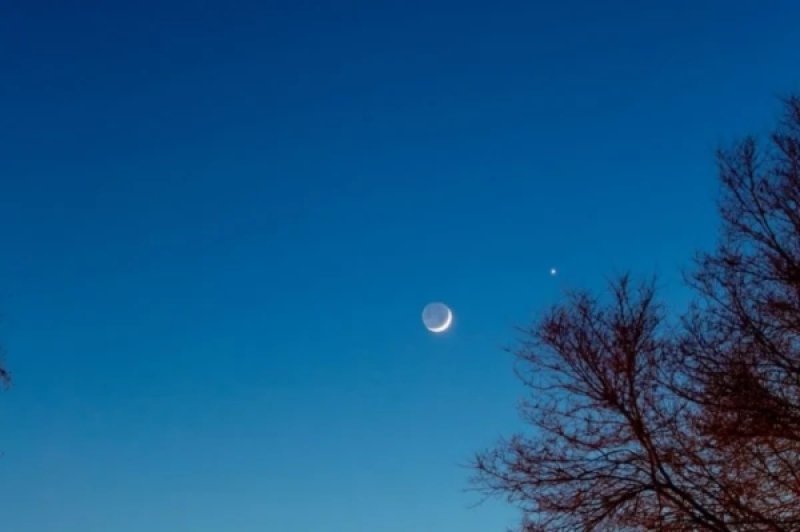
"On November 14, a chain of four planets will align: Mercury, Venus, Mars, and Jupiter. This is a rare sight, and the next similar configuration involving Mercury will not happen soon. Calculations show that the Sun will rise on that day around 08:20 local time. Therefore, the optimal observation window is approximately from 07:15 to 07:55, that is, half an hour to an hour before sunrise. Earlier, the sky will be too dark, but some planets will not have risen high enough above the horizon, and later the brightening dawn will begin to interfere. For observation, you need to choose a spot with a completely open view to the southeast and south: ideally, the riverbank, the edge of a field, a high bank, or the upper floor with a wide window," he said. The astronomer specified that Venus will be the most noticeable in the sky. "The most spectacular link in the chain of planets is Venus, with a brightness of about −4.3 magnitude: only the Moon is brighter in the sky, and it is impossible to confuse the planet with a star. At the moment when there are half an hour left until sunrise, it will be at an altitude of about 16 degrees above the horizon in the direction of south-southeast. Below and to the left of it, near the horizon, shines Mercury — with a brightness of about 0.5m and an altitude of only 9–10 degrees, so it requires a clear horizon and, ideally, binoculars, as it is the most capricious participant in the parade, hiding in the dawn. Higher, closer to the south, at an altitude of nearly 50 degrees, will be Jupiter (−1.9m, the second brightest) and just above it Mars (about 0.7m). It is easy to distinguish them: Jupiter is noticeably brighter, and Mars is noticeably redder. Saturn is not participating in the alignment — at the time of observation, it will be below the horizon, and in the evening, when it rises, it will take part in another, already evening aspect of the sky," the expert noted. According to Kiselev, the planetary parade can be observed with the naked eye. "A regular 8×40 or 10×50 binoculars will give you a nice bonus: Jupiter will show its elongated shape, and Venus will have a distinct crescent disk, as it is currently approaching Earth and visible in the phase of a waxing crescent. A telescope is not necessary for this event, unless you want to take a closer look at Jupiter and its moons," he added.
