

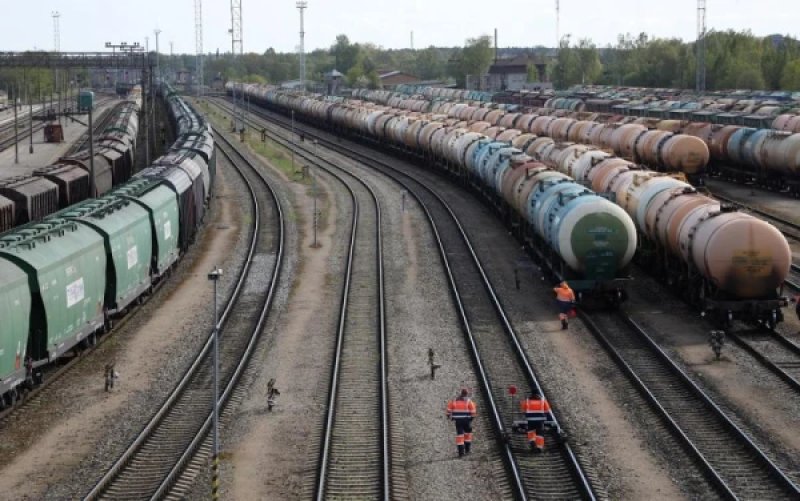
 Foto: BB.LV / железная дорога
The public organization "Entrepreneurs for Peace" has been advocating for a change in this practice for several years, but acknowledges that it has not yet received political support. As journalists from [TV3 News](https://tv3.lv/zinas/ekonomika/latvija-turpina-dot-sava-veida-nodoklu-atlaides-agresorvalstij-krievijai/) discovered, similar difficulties arise in attempts to limit the transit of Russian grain. ### Russia on the offshore list, but exceptions continue to apply After the start of Russia's full-scale invasion of Ukraine, Latvia took a number of steps to reduce its economic dependence on the aggressor country. The country abandoned purchases of Russian natural gas, withdrew from the common energy system with Russia and Belarus (BRELL), and the volumes of bilateral trade significantly decreased. However, it has not been possible to completely sever economic ties. Latvian enterprises still export certain goods to Russia, including alcohol, pharmaceuticals, and knitwear, and Russian cargo continues to be transported through the territory of the country. At the same time, there is another mechanism that allows Russian companies to receive payments from Latvia without additional tax withholding. In 2023, Russia was included in the European Union's list of jurisdictions that do not cooperate in the tax sphere. Latvian legislation stipulates that for certain payments, companies from such jurisdictions must withhold a 20% tax at the source of payment. However, there are exceptions to this rule. ### How a Russian company can receive the full amount without tax withholding The State Revenue Service (SRS) has the right to allow a Latvian enterprise not to withhold the 20% tax if it proves that the specific payment is not related to an attempt to evade taxes. After Russia was included in the European list of non-cooperative tax jurisdictions, the number of requests for such permits sharply increased. An important feature of the mechanism is that the tax is withheld by the Latvian enterprise when transferring funds to a foreign recipient. In other words, the Latvian company acts as a tax agent, and the withholding reduces the amount received by the Russian counterparty. If the SRS issues a permit not to withhold tax, the Russian company can receive the payment in full. This is why critics refer to such permits as a kind of tax benefits for the business of the aggressor country. At the same time, the permits themselves are provided for by current legislation and do not mean that the SRS is violating the law. ### Even the state railway is applying for permits TV3 journalists found out that the practice of issuing permits continues in 2026. Moreover, among the enterprises applying for them is the state concern Latvijas dzelzceļš. In a written response to journalists, the company referred to legislative requirements for the rational use of public funds. > "In accordance with the Law on Preventing the Misappropriation of Financial Resources and Property of a Public Person, Latvijas dzelzceļš and its subsidiaries are obliged to manage financial resources and property rationally, including conducting their activities in such a way as to achieve goals with the least financial and property costs," the concern explained. Thus, the company justifies its actions by the obligation to adhere to the principles of economical and rational management. However, critics raise another question: should such economic considerations remain decisive in dealings with Russian enterprises during wartime? ### "We lack courage and desire" The "Entrepreneurs for Peace" Fund (Uzņēmēji mieram) has been opposing the continuation of such practices for several years. Previously, the organization collected more than 10,000 signatures to stop issuing such permits and to raise the corresponding tax rate. However, no changes have been achieved. The head of the fund, Laura Skrodele, stated that representatives of the organization have repeatedly raised this issue with politicians. > "We have already returned to this issue twice with different governments, to the Budget and Finance Commission of the Saeima in different compositions. Perhaps we will have to return to this conversation for a third time," she noted. According to Skrodele, the problem lies not only in legislative restrictions but also in a lack of political will. > "It seems we lack the courage and desire either to show moral resilience or to approach the issue creatively and understand: perhaps we can repair the rails, perhaps we can apply some innovative solutions like the Lithuanians," said the head of the fund. ### Russian grain — another unresolved issue A similar situation has arisen regarding the transit of Russian grain through Latvia. Public organizations and representatives of the agricultural sector have repeatedly demanded to stop the shipments, but the initiative faces objections from various ministries. Meanwhile, neighboring Lithuania has announced an increase in control over Russian grain shipments. Like Latvian services, Lithuanian regulatory authorities intend to take samples to verify the origin of the grain, particularly to establish whether it has been stolen from occupied territories in Ukraine. However, Lithuania plans not to allow the cargoes to proceed further until the results of the inspections are obtained. This difference in approaches, according to critics of Latvian policy, shows that there are opportunities for more stringent actions. ### "Where was everyone the previous two or three years?" Board member of the "Farmers' Union" (Zemnieku saeima) Martins Trons believes that the responsibility for the lack of a solution cannot be placed solely on the current government. According to him, various political forces have participated in the delay of the issue. > "All political forces are involved in this process, and I would not say that some are white and others are black," emphasized Trons. He also reminded that the problem has been discussed for several years. > "Why has this issue not been resolved with all the good advisors in Brussels who are now tweeting that this could have been done a long time ago and that it should have been done? Where was everyone before?" asked the representative of the agricultural organization. ### Why the government is afraid to ban transit Prime Minister Andris Kulbergs has repeatedly pointed out the legal risks of a complete ban on the transit of Russian grain. According to him, terminating already concluded contracts could lead to legal disputes and the need to pay significant compensation. Therefore, one of the possible options being considered is a restriction that would only apply to new contracts, without affecting existing agreements. However, such an approach does not resolve the issue of an immediate cessation of shipments. As a result, both tax permits in dealings with Russian companies and the transit of grain remain examples of the contradiction between the declared course of reducing economic ties with Russia and the existing legal and economic mechanisms.
