

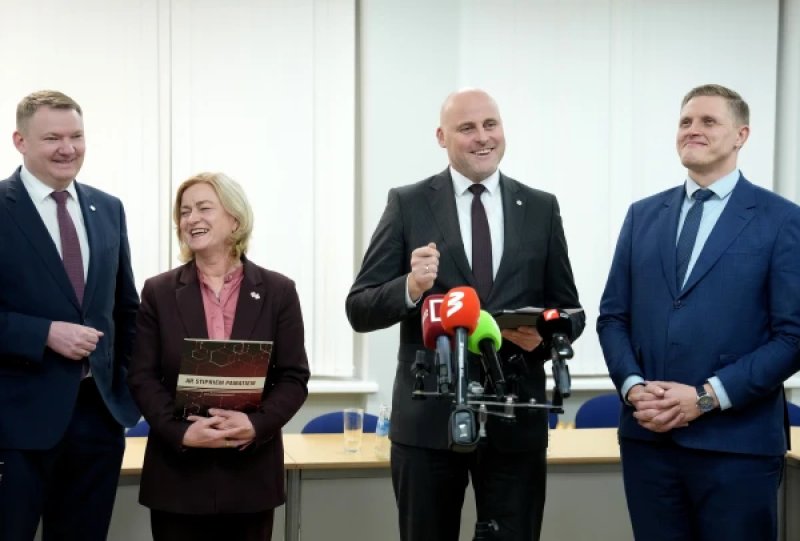
 Foto: BB.LV / Встреча в верхах
This was reported to the LETA agency by Prime Minister Andris Kulbergs ("United List"). According to him, negotiations on the government program and terms of cooperation are still ongoing. The parties need to agree on the final documents, after which they can proceed to form the cabinet of ministers. **The National Alliance Was Offered Three Ministries** The National Alliance was given until Monday, November 16, to propose candidates for three ministerial posts: - Minister of the Interior; - Minister of Welfare; - Minister of Culture. At the same time, Kulbergs proposed that the current Minister of Defense, Raivis Melniks, retain his position in the new government. The Prime Minister emphasized that when selecting ministers, he intends to be guided primarily by their professional qualities rather than party affiliation. The names of the other ministerial candidates are promised to be announced soon. **"The Budget is in Critical Condition"** Kulbergs named four main priorities for the future government: national security, order in public finances, economic growth, and increasing the efficiency of public administration. At the same time, the Prime Minister assessed the current financial situation in the country quite harshly. "We are facing a harsh reality. The legacy of the previous policy is heavy, and the state of the budget is critical," he stated. According to Kulbergs, if decisive measures are not taken, by 2030 Latvia risks facing a shortage of funds for national defense. The Prime Minister also warned of the danger of a repeat situation where the country would have to seek international financial assistance, which would significantly limit independence in decision-making. In his opinion, continuing to live in debt and trying to convince society that the situation is under control cannot replace responsible financial policy. **"New Unity" is Not Trusted** Kulbergs explained the choice of the National Alliance as a partner by long-standing cooperation and proximity of political positions. According to him, for forming a government, it is important not only to have a parliamentary majority but also the partners' readiness to carry out difficult but necessary reforms for the country. At the same time, the Prime Minister expressed doubts about the willingness of the parties that defined the previous state policy to truly change their approach. He was particularly critical of "New Unity." "I currently have no confidence that the parties that were the main creators of the previous system are ready to fundamentally change it. This primarily concerns 'New Unity'," Kulbergs stated. He added that political forces may revise their positions, but the readiness to correct past mistakes must be proven by concrete actions. According to the Prime Minister, such readiness will soon be assessable by votes in the Saeima. Earlier, Latvian television reported that the most active negotiations on forming a government are taking place between the "United List" and the National Alliance. Representatives of "New Unity" and the "Progressives" were not invited to the next round of negotiations. **Only 51 Votes: Can the Coalition Hold?** The main problem for the future government is the extremely small parliamentary majority. Together, the "United List" and the National Alliance have 51 deputy votes. This means that losing support from even one deputy could jeopardize decisions requiring an absolute majority of votes in the Saeima. Kulbergs acknowledges that such a situation will require strict discipline within the coalition and close cooperation with representatives of other parliamentary factions. Earlier, the leader of the "Latvia First" (LPV) party, Ainars Slesers, promised to support the government of AS and NA. However, on Friday he warned that the participation of certain politicians in the future cabinet could complicate support from his party. Thus, despite the agreement reached between the two political forces, the stability of the new government remains in question. **The Opposition Promises More Influence** Kulbergs intends to change the approach to interaction with opposition parties. He proposes to hold regular meetings with their representatives, preferably once a month, to discuss current issues, listen to proposals, and seek support for necessary reforms. In addition, the Prime Minister believes that the opposition should be trusted with positions in the Saeima committees, and its legislative initiatives should be evaluated on their merits, rather than solely from the perspective of party affiliation. In Kulbergs' opinion, issues of national security, financial stability, and economic development require the broadest possible political support. The final terms of cooperation and the full composition of the future government should become known after the negotiations are completed.
