

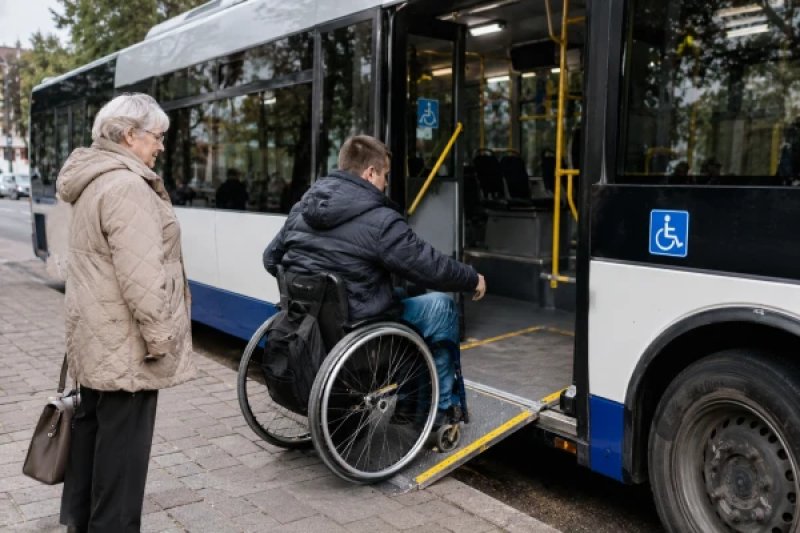
 Foto: BB.LV / Инвалид
The petition on the public initiative portal ManaBalss.lv began on November 6. In just nine days, more than 10,000 people supported the proposal, allowing it to be submitted for consideration by the Saeima. **Will free tickets have to be paid for?** Currently, Latvian legislation guarantees free public transport for people with disabilities of groups I and II, children with disabilities, as well as for those accompanying children with disabilities and people with group I disabilities. However, the Ministry of Transport has proposed to limit the state compensation for the ticket cost to 70%. This means that passengers who currently have the right to travel for free will have to pay the remaining 30% themselves if the proposal is adopted. Changes may particularly impact families with children with disabilities. As explained by initiative representative Raimonds Leiniieks-Puke, if a child is unable to use public transport independently, the family will have to pay for two tickets — one for the child and one for the companion. **Additional payments already exist** The authors of the initiative also point to another issue. On regional commercial routes, there is already a procedure whereby passengers entitled to free travel may face additional expenses. If a ticket for a commercial route costs more than the state-established fare on a subsidized route, the passenger has to cover the difference themselves. The initiators propose to eliminate this situation at the legislative level to ensure that the legally guaranteed right to free travel is genuinely applicable regardless of the chosen suitable route. **What they demand from the Saeima** The authors of the petition propose to maintain free travel in full for all categories of passengers listed in the Disability Law. Additionally, they demand the abandonment of the introduction of a 30% surcharge and to amend the legislation in such a way that the procedure for state compensations does not shift the difference in fares onto people entitled to free travel. Another demand is to provide separate funding in the state budget to fulfill these obligations. If in the future the government proposes to cut benefits again, the initiators want to require it to publish an impact assessment in advance, consider alternative sources of funding, and discuss changes with organizations representing the interests of people with disabilities. According to Leiniieks-Puke, maintaining benefits is especially important outside major cities, where a person often has no option to choose another bus or train. Free travel allows people with disabilities to plan work, education, treatment, and regular rehabilitation without fearing additional transport costs. **Tickets may become more expensive as early as 2027** The proposals from the Ministry of Transport concern not only beneficiaries. The department has prepared three possible options for financing regional public transport starting in 2027. The first option involves strict savings. The cost of travel will increase by an average of 30%, the number of regional bus routes will decrease by approximately 14%, and the volume of rail transport will decrease by 3%. At the same time, the maximum state compensation for beneficiaries will be 70% of the ticket price. The second option provides for maintaining the existing network of bus and rail routes, but with an average increase in ticket prices of 10%. Benefits are also proposed to be limited to 70%. Additionally, tariffs are planned to be reviewed regularly. This option is considered by the Ministry of Transport to be the most realistic under the current budget conditions. According to the department's calculations, limiting benefits will save about 6.9 million euros annually. The third option proposes to maintain the current system of benefits and the existing network of routes. In this case, tickets will increase in price by an average of 10%. To implement such a scenario, the state will need to allocate an additional approximately 15 million euros per year beyond the base funding. If additional funds are available, the ministry considers the third option preferable. **Why the state wants to cut costs** The Ministry of Transport explains the need for changes by the rising cost of transport services. Starting in 2024, the basic state funding for regional transport will be 93.8 million euros per year. At the same time, projected expenses for 2026 reach approximately 109.9 million euros. The main reasons for the increase in costs are cited as rising wages, fuel prices, energy resources, and other services. The ministry acknowledges that a large-scale reduction in routes will worsen access to jobs, educational institutions, medical care, and other necessary services. Therefore, the department advocates for maintaining the transport network while gradually increasing the system's revenues. **The ombudsman opposed the reduction of benefits** The proposal to limit the compensation for travel costs has already faced objections from human rights defenders and public organizations. The Latvian ombudsman Karina Palkova, as well as patient organizations, the association of people with disabilities and their friends Apeirons, and the Latvian Child Welfare Network, have opposed the initiative. The final decision on public transport funding and possible changes to benefits is to be made by the government. For now, the existing right to free travel remains in effect.
