

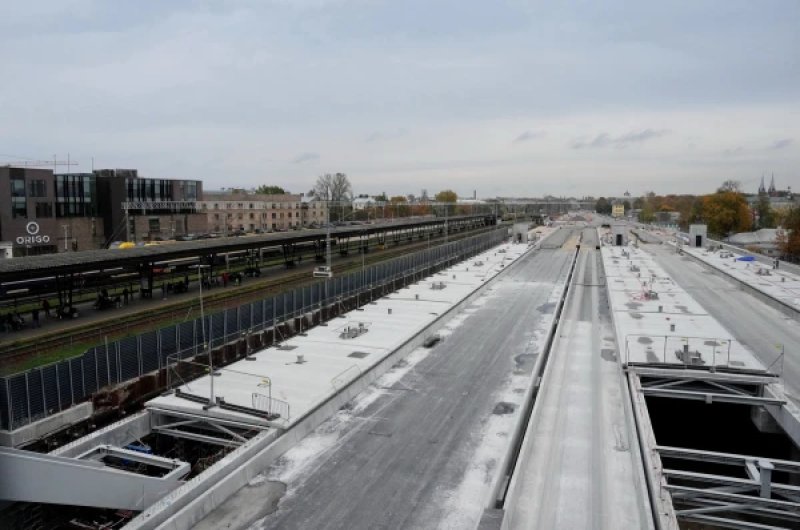
 Foto: BB.LV / Rail Baltica
On November 16, Maris Kucinskis, the leader of the parliamentary faction "United List" (AS), discussed this in the LETA agency's podcast "Kas tas vispār bija?". According to him, during internal negotiations on forming a new government, the need to appoint a separate person who will focus on the most pressing issues in the transport sector for a certain period was discussed. Kucinskis noted that the Ministry of Transport performs extremely complex functions; however, its capabilities and administrative potential are insufficient to effectively address all the accumulated issues. This is why the idea of creating a special ministerial position focused on specific tasks arose. At the same time, the proposal is still in the discussion stage. The candidate for the post of Prime Minister, Andris Kulbergs, still needs to present this initiative to the parliamentary faction "United List". ### Non-Partisan Specialists May Be Invited to the Government Previously, Kulbergs had suggested that the new government could include professionals not affiliated with political parties. He did not specify any particular candidates or their areas of responsibility at that time. Now, Kucinskis clarified that non-partisan specialists are being considered, in particular, for leading the finance, healthcare, and economic sectors. As reported earlier, "United List" and the National Alliance (NA) have already agreed on cooperation in forming the new government and distributing areas of responsibility. The National Alliance has been invited to propose candidates for the positions of Ministers of the Interior, Welfare, and Culture. ### Rail Baltica: Costs Continue to Rise One of the main problems in the transport sector remains the implementation of the large-scale railway project Rail Baltica. In the first phase, Latvia plans to construct the main railway line connecting the Lithuanian and Estonian borders, as well as complete construction work at Riga Airport and the southern part of the Riga Central Station. This should ensure the possibility of connecting the new European railway corridor with the existing network. However, the so-called Riga Loop is not included in the first phase of the project. The cost of the first phase of Rail Baltica in all three Baltic countries may reach 14.3 billion euros. Latvia's share is about 5.5 billion euros, but with indexing, this amount could increase to six billion. The total cost of the project, according to the cost-benefit analysis, is already estimated at 23.8 billion euros. For comparison, in 2017, it was assumed that the construction of the entire corridor would cost 5.8 billion euros. The project involves the creation of a railway line with a European gauge of 1435 millimeters from Tallinn to the Lithuanian-Polish border, with subsequent connection to the railway networks of other European countries. The total length of the new corridor in the Baltic countries is expected to be 870 kilometers, with a maximum train speed of 240 kilometers per hour.
